
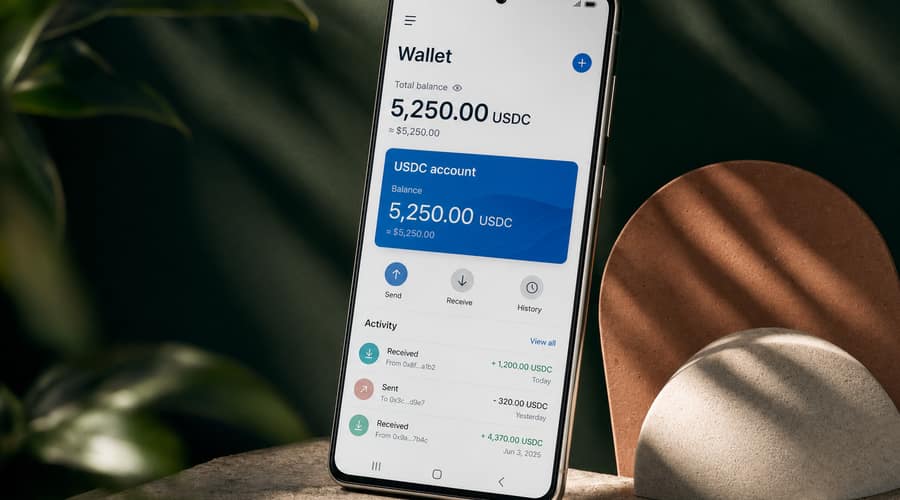
Samsung has put stablecoins on the Samsung Wallet roadmap, and the real story is distribution: USDC was the coin shown on screen, but the feature still has no launch date or confirmed market rollout.
The crypto industry has spent a decade searching for a mainstream on-ramp. The problem was never only the technology. It was convincing ordinary people to open a new app, create a seed phrase, pass exchange checks, and trust a product they didn't ask for. Samsung has pointed to a different route. Put stablecoins inside the wallet app that already holds your payment cards, boarding passes and IDs - and suddenly there's no new app to download, no strange product to trust.
At Galaxy Unpacked on July 22, Samsung outlined plans to expand Samsung Wallet beyond payments and savings into stablecoins. Coin Edition reported that the presentation showed a demo screen for a Stablecoin account
with USDC, including send, receive and top-up options. No launch date. The company didn't name eligible markets or confirm which stablecoins will be supported when the feature actually ships.
That caution matters. A stage demo is not a product launch.
Still, the screen was not subtle. Samsung Wallet is protected by Samsung Knox, the company's mobile security platform, and Samsung's own Wallet materials already frame Knox as the layer securing personal and financial data on Galaxy devices. If stablecoins move into that same app, you don't need to imagine a separate crypto product sitting off to the side. You get digital dollars placed beside the boring things people already use every week.
Circle got the useful signal
The most important name in the demo was not Samsung. It was USDC. Samsung has not announced an exclusive deal with Circle, and there is no public commitment that USDC will be the only dollar token in the wallet. But Circle got the screen. In consumer payments, that kind of placement has value because distribution usually beats purity. Apple Pay didn't win because every consumer studied card tokenization. It won because it was already on the phone.
According to IDC data cited by SamMobile, Samsung shipped 241.2 million smartphones in 2025, up 7.9% from the previous year. That figure is not the same as saying 241.2 million people will get stablecoins on day one. Don't pretend it is. It does show the scale of the hardware channel Samsung controls if this moves from roadmap to rollout.
Circle already has size on its side. In Circle's 2026 proxy statement filed with the SEC, the company said USDC ended 2025 with $75.3 billion in circulation, up 72% year over year, and $33.3 trillion in full-year on-chain transaction volume. Decrypt also reported that Circle's fourth-quarter USDC transaction volume reached $11.9 trillion, up 247%. Big numbers. But they're still mostly numbers from crypto rails and institutional flows - not the market where people split bills, send money to family, and expect the balance to just be there.
That's where Samsung becomes interesting.
Samsung launched the Galaxy Card around the same Unpacked cycle, issued by Barclays on the Visa network. Wired reported that the card carries no annual fee, offers 5% back on Samsung purchases, 3% when used through Samsung Wallet, 2% on streaming subscriptions and 1% elsewhere. Android Central also reported the $200 welcome bonus. Put a credit card and a stablecoin account in the same wallet, and Samsung is no longer just storing passes. It's trying to own more of the payment surface on a Galaxy phone.
The wallet is the lock-in
Samsung's engineers did not wake up passionate about decentralised finance. The Galaxy Card, the stablecoin roadmap and the Wallet integrations are ecosystem plays. The more of your financial life that runs through Samsung Wallet, the less likely you are to treat your next phone upgrade as a clean comparison between hardware specs. Apple understood this with Apple Cash and Apple Card. Samsung is now trying to make the Galaxy version broader, with crypto included earlier in the stack.
The regulatory timing helps. GovInfo records show the GENIUS Act became Public Law 119-27 on July 18, 2025, creating a U.S. framework for payment stablecoins. The rules are still being implemented, with agencies including FinCEN and the FDIC working through proposals in 2026, but the direction is clear enough for a company like Samsung to talk about stablecoins on a global stage without sounding reckless.
Circle also has pressure at its back. CoinDesk reported that Mizuho downgraded Circle this month over the threat from Open USD, a rival stablecoin model that shares reserve income with distribution partners. Tiger Research said Circle's stock fell 17% after Open USD was announced on June 30 with more than 140 companies attached to the project. Frankly, that is the fight investors should watch. Stablecoins are not only competing on trust anymore. They're competing on who gets paid for bringing users in.
For now, Samsung has shown enough to make rivals pay attention, and not enough for anyone to call this a finished consumer product. No launch date. No full stablecoin list. No country rollout. But the direction is plain: Samsung wants Wallet to become a financial layer across Galaxy devices, and Circle's USDC was the token it chose to show first.
Also read: Trump's crypto fortune may be the thing that kills the crypto bill he champions • MoonPay adds Discover Network cards to complete the US card trifecta for crypto buying • Three crypto bridges lost $35 million in a single day and the biggest victim is negotiating with its hacker