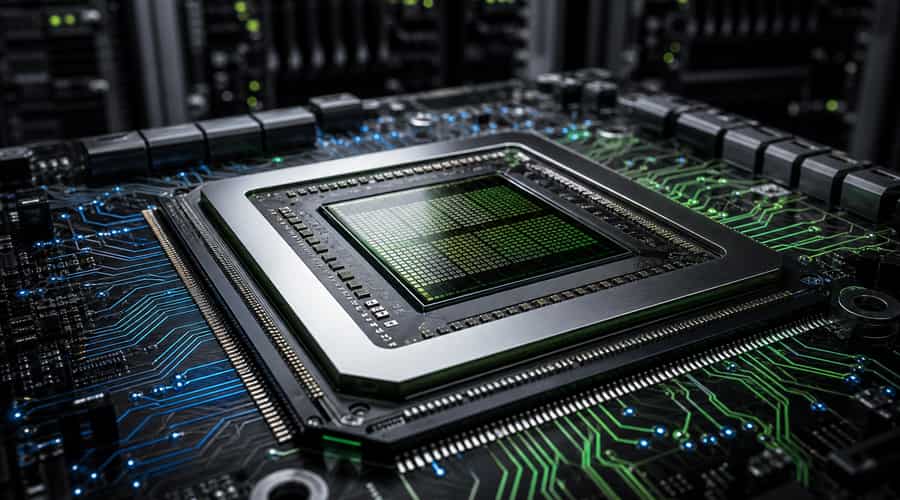
Nvidia is pitching its new Vera CPU to Chinese clients including Alibaba and ByteDance, with availability discussed for as early as August, exploiting a regulatory gap that has so far been written around GPUs, not CPUs.
Jensen Huang has spent the last year trying to keep Nvidia tied to a Chinese AI market that Washington keeps narrowing. The company generated $4.6 billion in H20 revenue from China in the comparable quarter last year, but its latest outlook still excludes China data center compute revenue after U.S. restrictions and licensing uncertainty blocked a clean path for GPU sales. Vera, Nvidia's new data center CPU for agentic AI workloads, now gives the company something it badly needs: a route back into customer conversations.
According to Reuters, Nvidia has begun telling Chinese clients, including Alibaba and ByteDance, that Vera CPUs could be available as early as August and that orders are being solicited now. The pitch matters because the chip sits in a different regulatory category. Current export controls, including the Commerce Department's recent guidance closing the overseas subsidiary loophole for advanced AI chip sales, are written around accelerator performance, memory bandwidth, and related thresholds. A purpose-built CPU running orchestration, inference management, and agent coordination workloads does not map as cleanly onto those parameters.
GPU training clusters sit relatively idle between jobs and move data in large, predictable batches. Agentic AI is different: thousands of concurrent software agents making decisions, spinning up sub-tasks, writing to memory, calling tools, and looping back on themselves. That pressure lands on the control plane, the part of the stack that has always been handled by CPUs. Vera is built explicitly for that demand, with 88 Nvidia-designed Olympus Arm cores, 176 threads, and 1.2 terabytes per second of memory bandwidth. Nvidia says the new core delivers a 1.5 times improvement in instructions per cycle over Grace, while early Linux testing by Phoronix, conducted at Nvidia's Santa Clara headquarters using Nvidia-selected workloads, showed Vera competing strongly with AMD EPYC and Intel Xeon chips in several server tasks.
Huang's framing has been deliberate. Nvidia has described CPUs as a $200 billion market opportunity it has never meaningfully addressed before, and Huang has made clear that China remains part of the company's long-term calculation. For a business that has been forced to write down inventory, redesign products, and wait on shifting export licenses, that is not a small statement. It says Nvidia believes the next phase of AI infrastructure will be less about selling one class of chip and more about owning the whole rack.
AMD's response has been to contest the benchmark framing entirely. The company argues that rack-level throughput inside a fixed power envelope is the right comparison, not single-socket numbers, and it is pointing to higher-core-count EPYC platforms as the more practical answer for hyperscalers trying to squeeze as much work as possible out of every watt. Intel is countering with Xeon 6 and the familiar argument that x86 software continuity still matters when customers are committing to infrastructure they need to run for years.
The benchmarking dispute reflects a genuine architectural difference in philosophy. Nvidia built Vera as an integrated component of a larger system, designed to pair directly with Blackwell GPUs and eventually Vera Rubin, handling orchestration while the GPUs carry inference. AMD and Intel are pitching standalone density and software familiarity, betting that agentic workloads will stay close to x86 because that is where much of the existing cloud stack already lives. Both arguments have merit, and the answer will depend on how quickly hyperscalers decide to standardize on tightly connected Nvidia systems rather than buying CPUs and GPUs on separate tracks.
For China, the near-term picture is sharper than the benchmarking debate. ByteDance and Alibaba are both investing heavily in AI infrastructure while facing limits on what GPU compute they can legally source from U.S. suppliers. A CPU product that sits outside the current control regime gives them a way to build the orchestration and middleware layers of an agentic platform without waiting for every GPU restriction to soften. That does not make Vera a loophole that will remain untouched. The Commerce Department has shown it can revise rules quickly when it sees workarounds being used at scale, and Nvidia is moving fast enough that it clearly understands the window may not stay open indefinitely.
Vera is expected to reach customers in the second half of 2026, with China availability being discussed earlier than many rivals would like. The first real test of Nvidia's CPU ambitions will come when hyperscalers reveal how much of their agentic stack they want running on Olympus cores, and whether AMD's rack-level density argument or Intel's software continuity pitch lands harder with the buyers who actually write the procurement orders.
Also read: The Big Four are selling AI governance while their own reports hallucinate • Alibaba bids $1.5 billion for Pupu as China's grocery delivery wars reach their final round • Dreame Technology pursues a Hong Kong IPO at $9.6 billion as the world's top robotic vacuum maker tests whether consumer hardware can match the market's humanoid fever