Alibaba's reported $1.5 billion pursuit of Pupu shows how quickly China's grocery delivery fight has moved from growth at any cost to control of the last working dark-store networks.
The numbers tell the story plainly, even with one important caveat: the Alibaba bid has not been widely confirmed in accessible public reporting. What can be checked is the broader pattern. On February 5, Meituan announced a proposed $717 million acquisition of Dingdong Fresh, the listed grocery platform that built its business around front warehouses and fast urban delivery. If Alibaba is now offering $1.5 billion for Pupu, as the article says, the company is not just buying another grocery app. It is trying to keep the last major independent fresh-food delivery specialist from becoming someone else's daily-use weapon.
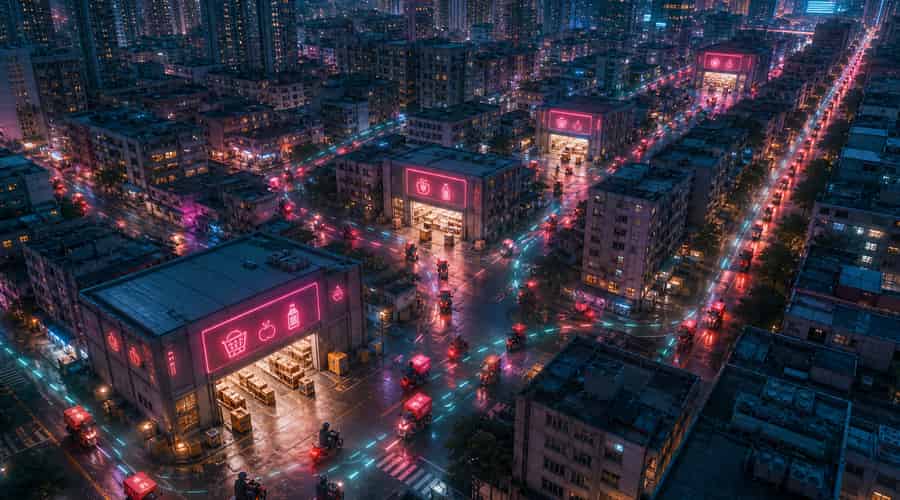
Pupu matters because it represents one of the few versions of the model that still looks commercially useful. The Fujian-based company was founded in 2016 and built itself around 30-minute delivery, forward warehouses, and a broader assortment than the old fresh-only pitch. Its service footprint includes cities such as Fuzhou, Shenzhen, Wuhan, Xiamen, Guangzhou, Chengdu, and Foshan, which gives it a regional density that cannot be copied quickly with marketing spend alone. That is the real asset. In quick commerce, software is only part of the system. The harder piece is having the right goods close enough to the customer, in enough neighborhoods, with enough repeat demand to make every order less expensive to serve.
That is why Pupu sits in a very different category from many Western instant-delivery names that expanded fast and then spent the next cycle shrinking. A dark-store network only works when local demand, inventory discipline, delivery routing, and basket size all move in the same direction. MissFresh showed what happens when the capital bill gets ahead of the operating model. Dingdong survived long enough to become a strategic target. Pupu's value, if Alibaba's reported bid is accurate, is that it gives a larger platform an already tested local infrastructure rather than a distressed network that needs to be rebuilt.
As Securities Times reported when Meituan announced its proposed Dingdong deal, the transaction was framed as an acquisition of all outstanding shares, not simply a small strategic investment. That distinction matters. China's largest consumer internet groups are no longer treating fresh grocery delivery as an experimental side business. They are treating it as a control point for household spending, where the winner gets repeat orders, richer local data, and more chances to pull users back into payments, memberships, advertising, and restaurant delivery.
The strategic pressure on Alibaba is easy to understand. Meituan already owns the food-delivery habit. JD.com has logistics depth and a reputation for dependable fulfillment. Alibaba has Hema, Taobao, Ele.me, and Sun Art Retail links, but fresh grocery remains a place where user behavior is won neighborhood by neighborhood. If Pupu can give Alibaba stronger density in southern and coastal cities, the price looks less like a standalone grocery valuation and more like a defensive payment for relevance in a daily-consumption category.
Why This Matters Beyond China
For investors watching outside China, this consolidation is worth reading carefully. Getir pulled back from multiple markets. Gopuff restructured. Instacart entered public markets with investors far more cautious about delivery economics than they were during the pandemic boom. The lesson is not that instant grocery cannot work. The lesson is that it only works under narrow conditions: high urban density, disciplined inventory, enough assortment to lift basket size, and a parent company willing to carry the customer acquisition cost while the network matures.
China has tested those conditions at far greater scale than the United States or Europe. That is why the price attached to Pupu is interesting even if the deal is not yet closed. It suggests that the survivors are no longer being valued like speculative delivery startups. They are being valued as scarce infrastructure for the next phase of local commerce.
The open question is whether Alibaba can turn a reported acquisition into a cleaner operating advantage. Buying a capable network is one thing. Integrating it with Hema, Ele.me, Taobao traffic, and Sun Art's retail assets without dulling what made Pupu work is harder. Meituan's Dingdong move raised the pressure. Alibaba's next step will show whether China's grocery delivery war is ending, or simply moving inside the balance sheets of its biggest platforms.
Also read: Dreame Technology pursues a Hong Kong IPO at $9.6 billion as the world's top robotic vacuum maker tests whether consumer hardware can match the market's humanoid fever • OpenAI offers equity to Washington to preempt a far costlier forced takeover • Senate's crypto market bill needs 60 votes and a deal on ethics to become law