
Anduril is trying to turn a $61 billion valuation in May into a roughly $100 billion round by July. The number is huge, but the structure of the deal tells you more than the headline does.
Two months is a long time in defense tech right now. Anduril Industries closed a $5 billion Series H in May 2026 at a $61 billion valuation, led by Thrive Capital and Andreessen Horowitz, according to the company and Reuters. Now Reuters reports that Palmer Luckey's nine-year-old defense startup is already in talks for another round at roughly $100 billion.
That is not normal late-stage fundraising. It would put a private company from Costa Mesa within range of Lockheed Martin, whose market value was about $117 billion in July, and ahead of Northrop Grumman, which was around $74 billion. You don't need to love the comparison to see why investors are making it. Money is starting to price Anduril less like a supplier on the edge of the Pentagon and more like a future prime contractor.
The proposed structure is the sharpest part of the Reuters report. One idea under discussion would require investors to commit to the current round and also agree to finance a second round at a higher valuation within a year, with that follow-on tied to Anduril hitting financial benchmarks. You're buying the next ticket before the first show has finished. That gives investors a guaranteed path to more ownership if the numbers keep moving, while forcing Anduril to prove the growth story in hard financial terms.
Here's the thing: the deal sounds aggressive because it is aggressive. But it isn't floating on mood alone. Anduril said its 2025 revenue more than doubled to $2.2 billion, and Reuters reported that the company projects about $4.3 billion in 2026 revenue. For a company founded in 2017, that is the number that makes the valuation conversation possible.
The Pentagon is giving Anduril room to run
The contracts explain why this round has an audience. In March 2026, the U.S. Army awarded Anduril a 10-year enterprise contract with a ceiling of up to $20 billion for its commercial software, hardware, data and compute infrastructure, according to the Army's own announcement. That does not mean Anduril received a $20 billion check. Breaking Defense later quoted an Anduril executive saying there was no money attached at the outset. It is a contract vehicle, which is less dramatic and more important. It gives the government a faster way to buy.
The first task order under that vehicle was an $87 million award for Anduril's Lattice software as a counter-drone command and control backbone, Breaking Defense reported. That is the real signal. The Army is not just buying a drone or a tower. It is trying to consolidate how it sees and tracks threats across systems that have historically struggled to talk to each other - and then respond to them faster than before.
The munitions side is moving too. In May, the Pentagon announced framework agreements with Anduril, CoAspire, Leidos and Zone 5 for a Low-Cost Containerized Munitions program that could procure more than 10,000 cruise missiles over three years starting in 2027. Anduril separately said its part involves at least 3,000 surface-launched Barracuda-500M systems over three years. The hypersonic effort is a different track involving Castelion's Blackbeard missile, so lumping all 10,000 missiles into hypersonics would be wrong.
That distinction matters. Investors are not betting on one magic weapon. They're betting on a company that can sell software, autonomous aircraft and lower-cost munitions into a Pentagon that is suddenly under pressure to buy faster.
Thunder makes the valuation easier to understand
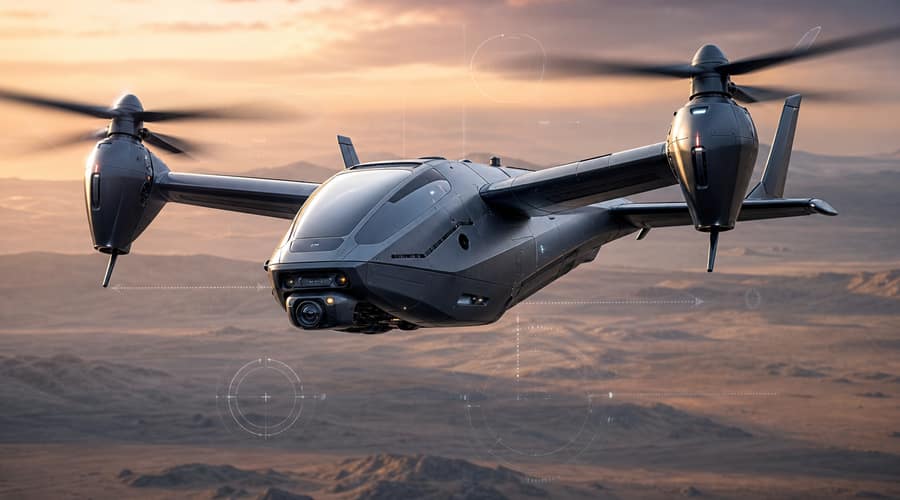
At Farnborough this week, Anduril and Archer Aviation unveiled Thunder, a Group 5 autonomous attack rotorcraft built on a hybrid-electric VTOL platform. Reuters reported the platform was developed under a 2024 deal between the companies. Anduril introduced the defense variant on July 20, during the Farnborough International Airshow.
Thunder is meant to fly alongside crewed attack and assault aircraft, including Apache helicopters. Janes reported that the aircraft uses Anduril's Lattice autonomy software, with modular payload bays for precision munitions, rockets, electronic warfare payloads, counter-UAS equipment and cargo. The Financial Times reported that each drone could carry up to 10 Hellfire missiles or other payloads, with a first flight planned for 2027.
That's a concrete product, not a pitch deck. It also lands at the right moment. CNBC reported that several defense tech startups said demand from Pentagon customers had 'skyrocketed' after the U.S. and Israel first struck Iran at the end of February. The New York Times counted more than 2,100 drones and 500 ballistic missiles launched by Iran across Gulf countries by March, with additional strikes on Israel not fully disclosed by the Israeli government. You can see why counter-drone systems and cheaper mass munitions are not side projects anymore.
The uncomfortable question is whether private capital is now moving faster than the defense budget can responsibly absorb. The Wall Street Journal reported this week that Pentagon contract spending on the top 15 defense tech startups has tripled since 2022, but those companies still receive less than 1 percent of total defense contracts. So yes, the shift is real. It is also early.
Anduril's $100 billion target is the test case. If the company hits its revenue marks and wins production orders rather than only contract vehicles - and gets systems like Thunder into flight testing on schedule - the comparison with legacy contractors will keep getting less strange. If it misses, the two-stage structure will look less like clever financing and more like investors trying to pre-buy momentum before procurement has caught up.
Frankly, the $100 billion number is not the whole story. The real story is that a private defense startup can now make public-market contractors look slow, and investors are willing to price that possibility before the Pentagon has fully proved it will buy at scale.
Also read: Former SentinelOne executives raise $100 million to stop rogue AI agents before they own your enterprise • JPMorgan says the 40-year era of cheap capital is structurally over and every startup valuation was priced assuming it wasn't • SoftBank is weighing a deal for Gravis Robotics as it builds the most ambitious robotics empire outside China