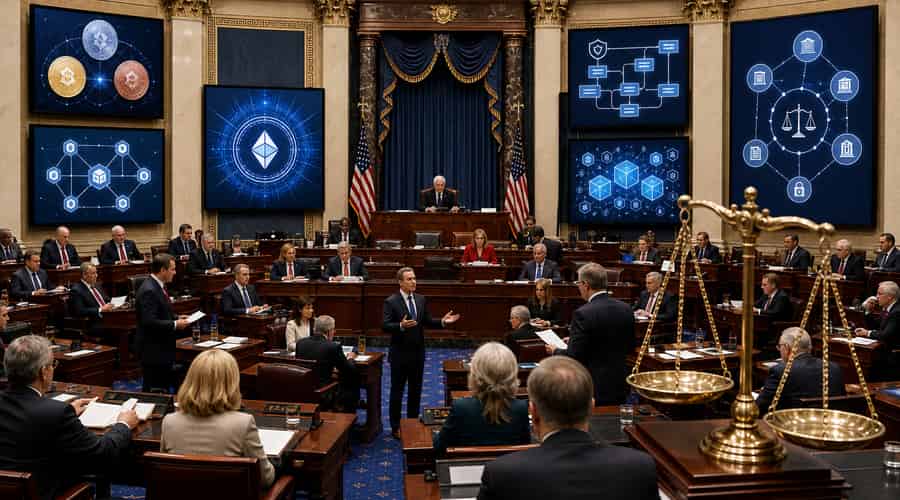
The CLARITY Act is still moving, but its fate now depends on whether Senate Republicans can find enough Democratic support before the election calendar starts to narrow.
The Digital Asset Market Clarity Act has become the crypto industry's best chance at ending years of regulatory uncertainty in Washington. For exchanges, token issuers, and software developers, the question has never been whether digital assets should be regulated. The harder question has been which agency gets to write the rules, and whether companies can comply before they are accused of breaking them.
The House passed the bill in July 2025 by a bipartisan 294-134 vote, alongside separate stablecoin legislation and a measure aimed at blocking a Federal Reserve central bank digital currency. The Senate version moved forward on May 14, 2026, when the Senate Banking Committee advanced the CLARITY Act in a 15-9 vote. Based on MarketWatch's report at the time, every Republican on the committee supported the bill, joined by two Democrats.
That committee vote matters because it showed the bill can attract some cross-party support. It also showed how far it still has to go. Republicans hold 53 Senate seats, but most major legislation needs 60 votes to clear procedural hurdles. That means the bill needs at least seven Democrats on the floor, not merely a clean party-line vote plus one or two defectors.
The pressure is building because crypto policy has already been stuck in this position for years. The Securities and Exchange Commission and the Commodity Futures Trading Commission have both claimed authority over different parts of the market, while companies have tried to decide whether a token is a security, a commodity, a payment asset, or something else entirely. Some projects adjusted their US operations. Others looked to the EU, Singapore, and the Gulf, where digital asset frameworks have been written more directly into law.
The CLARITY Act is meant to replace that guessing game with a statutory framework. Its central promise is to divide digital assets by function and market structure, giving the CFTC a larger role over digital commodities while leaving securities and investment contracts under SEC oversight. For an exchange like Coinbase, that distinction is not theoretical. It can determine which assets can be listed, what disclosures are required, and whether a business can build a compliant spot market in the United States without waiting for the next enforcement action to explain the rules.
For token issuers, the appeal is similar. A clearer registration path would not remove legal risk, but it would make the risk easier to price. That matters for startups deciding where to incorporate, venture investors deciding whether to fund protocol teams, and public companies deciding whether digital asset exposure is worth the regulatory headache. Markets can live with strict rules. What they struggle with is uncertainty that changes after the fact.
The Hard Part Is DeFi
The bill is less definitive when it comes to decentralized finance. Automated market makers, governance tokens, and decentralized exchanges do not fit neatly into the same regulatory boxes as a public company or a traditional brokerage. The Senate text reported in May included further study of DeFi risks and market size, a sign that lawmakers are still not ready to settle every question around software developers, protocol governance, and responsibility for illicit activity.
That is where Democratic concerns are likely to concentrate. Anti-money-laundering rules, sanctions compliance, and consumer protection have become the main fault lines in crypto legislation. Supporters argue that moving activity into a clearer legal perimeter will make markets safer and easier to police. Critics argue that weak language could create a regulated-looking system with too many gaps for bad actors to exploit.
The banking industry has also entered the fight more aggressively. Traditional banks are worried that crypto exchanges and stablecoin issuers could offer yield-like products without the same requirements that apply to deposits. Crypto firms see that as incumbent protection. Banks see it as a financial stability issue. That tension is one reason the Senate process is more complicated than a simple crypto-versus-regulator story.
The Vote Count Is The Story
The practical question now is whether Senate leaders are willing to spend floor time on a bill that still needs more Democratic support. The House vote showed that crypto market structure can pass with bipartisan backing, but the Senate has a higher threshold and a more crowded calendar. Budget fights, election-year politics, and unresolved committee work can all slow a bill that looks close on paper.
That is why the next several weeks matter. If supporters can tighten the illicit finance language without losing industry backing, the CLARITY Act has a real path forward. If they cannot, the United States will remain where it has been for much of the past decade: regulating a fast-moving market through agency interpretation, court fights, and political pressure rather than a durable statute. For crypto companies, that may be the most familiar outcome. It is also the one that keeps pushing the most ambitious builders to ask whether America is still the easiest place to launch.
Also read: Senate's crypto market bill needs 60 votes and a deal on ethics to become law • The World Series of Poker just made Solana's payments push impossible to ignore • CME Group moves gold and oil futures to 24/7 trading as crypto's always-on model wins