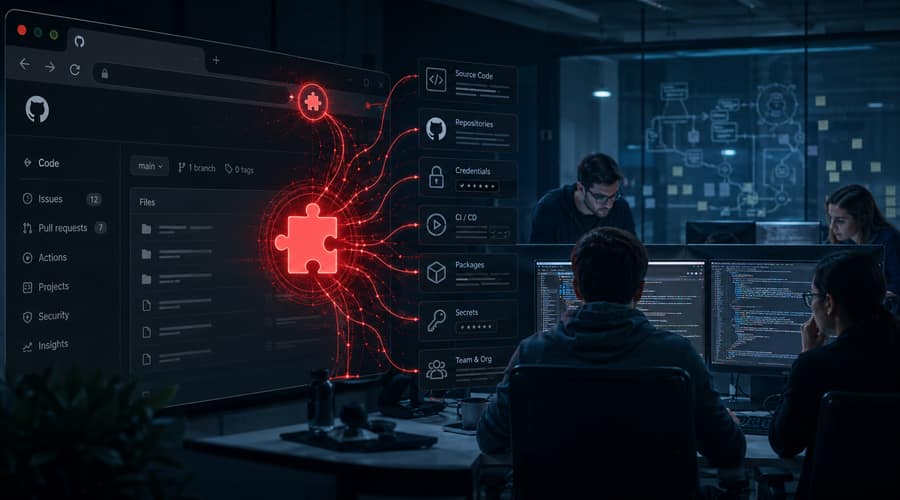
GitHub says a poisoned VS Code extension was enough to compromise an employee device and expose internal repositories. The incident is a sharp reminder that the software tools developers trust most can become the easiest way into an organization.
GitHub's breach matters because it is not just another cybersecurity incident. The Microsoft-owned company sits at the center of modern software development, and when one of its own internal systems is reached through a trusted coding tool, the warning goes far beyond GitHub itself.
According to GitHub's own statement on X, the company detected and contained a compromise of an employee device involving a poisoned VS Code extension, removed the malicious version, isolated the endpoint, and launched incident response immediately. Reporting that followed said the attacker's claims were consistent with GitHub's investigation, which pointed to around 3,800 internal repositories, while the company said it had no evidence of customer repositories or user data being affected.
That scope still matters. Internal repositories often contain source code, deployment logic, security material, and the operational details that show how a platform really works. Even when customer data is not touched, exposure of those systems can tell attackers how to move later, how to target employees more effectively, and how to map the architecture of a company that supports millions of developers.
The attack also lands in the middle of a broader problem that security teams have been warning about for months. VS Code extensions are widely used, often installed with very little scrutiny, and they now sit inside a development workflow that increasingly blends AI assistants, plugins, and automation. That makes them attractive to attackers because the code is trusted, the permissions can be broad, and the user base is huge.
Recent research has shown how serious this ecosystem has become. In January, The Hacker News reported on malicious VS Code AI extensions with a combined 1.5 million installs that were siphoning files and source code to China-based servers. In February, other researchers warned that flaws in popular extensions with more than 120 million downloads could enable remote code execution, file theft, and lateral movement inside organizations. By late April, researchers were already flagging dozens of malicious VS Code extensions as sleeper packages that could later update into backdoors.
That is the important shift. The threat is no longer limited to a single bad package hiding in a niche corner of the marketplace. It is becoming a recurring supply-chain issue inside the tools developers rely on every day. When AI coding tools accelerate extension adoption, they also widen the number of places an attacker can hide.
Why this breach lands differently
GitHub is more than a brand name. It is the backbone of source-code workflows for startups, enterprises, and open-source teams across the industry. So when GitHub itself is compromised through the same kind of extension ecosystem its users depend on, the breach works as a proof point for what CISOs have been saying in less dramatic terms for some time. Trust is now a control surface.
The detail that an employee device was the entry point is also telling. Many organizations still treat the developer workstation as safer than the rest of the corporate fleet because it is built for speed and convenience. But that is exactly why it is so exposed. A single trusted extension can sit inside an IDE, wait for the right permissions, and turn an ordinary coding session into a data-exfiltration path.
That is the lesson here for smaller companies as well as global platforms. Startups often assume the danger is limited to public packages, compromised accounts, or cloud misconfiguration. In practice, the first breach can come from the tool a developer installed to work faster. Enterprises are not immune either, because scale does not remove that risk, it multiplies it.
There is another reason the incident will stay relevant. GitHub said it was still analyzing logs, validating secret rotation, and monitoring for follow-on activity. That means the story is not only about what was taken, but about how many adjacent systems may still need to be checked. In supply-chain incidents, the first disclosure is rarely the last operational task.
For security teams, the conclusion is uncomfortable but clear. Extension vetting can no longer be treated as a minor hygiene issue. It needs to be part of endpoint policy, identity protection, secret management, and developer governance all at once. GitHub's breach did not invent that problem, but it did make it impossible to ignore.
Also read: South Korean funeral firm's Ether bet shows how leverage can travel far • Barnes & Noble's AI book stance could reshape retail shelves • SoftBank's OpenAI bet is drawing fresh internal scrutiny