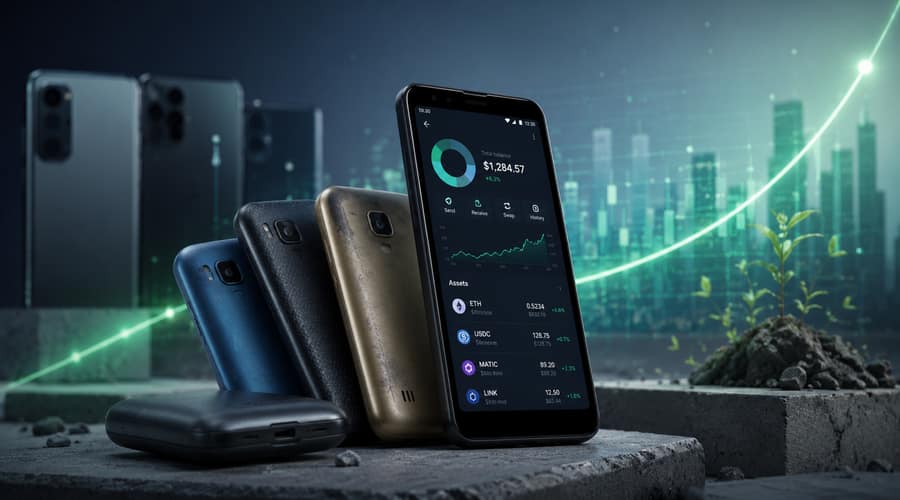
Sorted Wallet's funding story is less about a new crypto app than a stubborn market gap: many of the people who could benefit from stablecoin payments still do not live on reliable smartphones.
Sorted Wallet has not become interesting because it is chasing the same wallet market as everyone else. Its pitch is more practical. The company is building crypto payments for feature phones and low-powered smartphones, aiming at users in emerging markets where expensive devices, patchy data, and limited banking access still shape how money actually moves.
The funding claim needed tightening. Publicly available records and Tether's own announcement show a $1.5 million strategic investment in Sorted Wallet in September 2024, not a clearly verifiable new $4.4 million seed round. That older investment still matters, but the story should be framed honestly: Sorted is relevant now because the stablecoin market has moved closer to mainstream payments, while the last-mile access problem remains unresolved.
Sorted describes its product as a wallet for sending, receiving, storing, and cashing out Bitcoin or USDt without requiring a high-end device or an expensive data plan. Its site says the wallet works on older smartphones and feature phones, and that is the point. In many markets, the phone in someone's pocket is not an iPhone with unlimited data. It is a basic handset, an aging Android device, or something in between.
For years, crypto startups have talked about financial inclusion while building products for people who already have bank accounts, smartphones, and the patience to manage seed phrases. Sorted is taking a more useful route. It is trying to make stablecoin payments work in places where the app economy is not the default distribution model, and where the difference between a smooth cash-out flow and a failed transaction can decide whether a product is used at all.
That approach fits a broader shift in the market. Stablecoins are no longer being discussed only as trading assets for crypto-native users. They are increasingly being examined as payment rails for remittances, local commerce, payroll, and cross-border settlement. According to Reuters, the Bank for International Settlements warned in April 2026 that global cooperation on stablecoins had become critically important, because fragmented rules could create financial risks and regulatory arbitrage. That is a serious signal. The payment rail is becoming the product.
Japan shows how quickly that conversation is moving from theory to infrastructure. Reuters reported in October 2025 that JPYC launched the world's first yen-pegged stablecoin in Japan after receiving regulatory approval, while Japan's largest banks have also been reported to be exploring stablecoin issuance for corporate clients. None of that proves stablecoins are mature. It does show that large institutions and regulators are treating them as part of the payments stack, not just another crypto cycle.
Why the device layer matters
What makes Sorted's positioning useful is that it starts with constraint. If users cannot rely on smartphones or affordable data, a beautiful app does not solve the problem. A lightweight payments layer becomes the business. That is why feature phones are not a side detail here. They are the market thesis.
Tether's September 2024 investment also makes strategic sense in that context. The company behind USDt has every reason to support distribution channels that can extend stablecoin usage beyond exchanges and crypto traders. Sorted gives that idea a practical shape: access for users in Africa, Southern Asia, and other emerging markets who may be underbanked but are not disconnected from mobile money habits.
The hard part is execution. A wallet built for weaker devices still has to handle security, onboarding, education, cash-out partners, liquidity, and local regulation. It also has to earn trust from users who may not care about the ideology behind crypto and simply want money that can be received, held, and spent with less friction. That is a much tougher test than getting attention from investors.
There is also a lesson here for founders. The best venture opportunities are not always the loudest ones. Sometimes they sit between what technology can do on paper and what ordinary users can actually access. Stablecoins may keep attracting policy scrutiny, but the companies that solve distribution, device access, and real cash movement will have a clearer claim on the market than those selling one more polished interface.
Sorted Wallet is a small company in a large and still unsettled space. But its bet is grounded in a real problem: payments infrastructure only becomes useful when it reaches the devices people already own. That is what investors, regulators, and founders should watch next.
Also read: ByteDance's Seedance 2.0 Is Forcing A Re‑think Of Google's Video Story • Meta cuts about 8,000 roles as it pivots people and capital toward AI • Goldman Sachs moves closer to the center of SpaceX's IPO