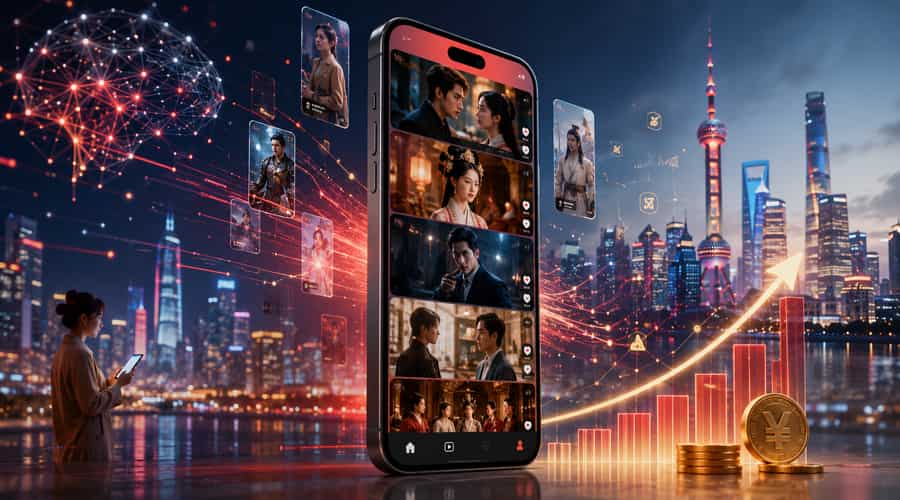
China has turned AI-generated video into a working consumer media business, not just a demo. Its micro-drama boom shows how fast entertainment changes when production costs collapse and distribution is already built for the phone.
The numbers are the point. China’s micro-drama market is projected to exceed 120 billion yuan, about $16.5 billion, in 2026, putting it on track to outgrow the country’s theatrical box office. By March 2026, roughly 50,000 AI-native titles had been added to Douyin in a single month, while AI-generated short dramas were already appearing on Chinese platforms at a pace that would have looked absurd only a year ago.
According to The Next Web, the format has become the world’s first mass commercial application of AI-generated video, and that framing matters. Most AI video discussion in the West still circles around model demos, creator tools and copyright disputes. China has gone further. It has connected AI production to a functioning content economy with platforms, studios, payment systems, regulators and local government support all pulling in the same direction.
How the factory works
Micro-dramas were built for speed before AI arrived. Episodes are short, vertical, serialized and optimized for mobile feeds. Producers move quickly through romance, revenge, fantasy, workplace conflict and historical plots, often adapting web novels or comics into stories designed to hook viewers in the first few seconds. Distribution runs through platforms such as Douyin, Kuaishou, Tencent’s WeChat Video Accounts and ByteDance-linked short drama ecosystems, with revenue coming from ads, subscriptions and in-app purchases.
AI has compressed an already fast model. Production timelines that once stretched across several weeks can now be cut sharply, especially for animated, fantasy and comic-style dramas where generated characters, backgrounds and effects are good enough for mobile viewing. DataEye figures cited by Chinese media show AI-driven digital human dramas accounted for 38 percent of the top 100 manju titles in January 2026, up from 7 percent a year earlier. That is not a marginal efficiency gain. It is a shift in what platforms can afford to test.
The tools behind the boom include Chinese video models and production systems from companies such as ByteDance, Kuaishou and Shengshu Technology. Their real advantage is not only image quality. It is workflow. A studio can test characters, settings, voiceovers and edits in a format where audience feedback comes quickly and where small changes in thumbnail, plot or pacing can alter revenue. This is entertainment treated like performance marketing.
The state is part of the model
What makes China’s version hard to copy is the industrial structure around it. Local governments have supported production hubs, offered incentives and built facilities for vertical video work in cities that want a piece of the cultural technology economy. That support helps lower the cost of experimentation, while platforms provide the traffic and payment rails that make a high-volume model viable.
Regulation sits beside that support. The National Radio and Television Administration has tightened oversight of micro-dramas and moved toward a more formal review structure, including rules that vary by production scale and platform responsibility. China has also removed large numbers of episodes for content violations, a reminder that this market is being encouraged and constrained at the same time. The message to producers is clear: grow fast, but stay inside the approved lane.
That dual role is familiar in Chinese technology sectors. The state wants AI entertainment to become a commercial engine and a cultural export channel, but it also wants control over the stories that scale. For startups and investors outside China, this is the part that deserves careful attention. The boom is not just about cheaper video. It is about aligning incentives across production, distribution, financing and oversight.
The quality problem has not disappeared
Lower costs create their own problem. When the price of making content falls sharply, the market gets flooded with similar stories, similar visual styles and similar emotional beats. AI makes it easier to produce, but it also makes sameness easier to reproduce. That is already visible in the lower end of the micro-drama market, where thousands of titles compete for the same moments of attention.
The stronger companies are responding by splitting the market. AI works well for fantasy, animation and effects-heavy concepts that would be expensive in live action. Human actors and more polished production still matter for stories built around performance, intimacy and emotional credibility. The winning model may not be AI replacing live production entirely. It may be AI absorbing the volume layer while premium titles use human talent to stand out.
The international opportunity is already visible. Apps such as ReelShort, DramaBox, GoodShort and My Drama have built audiences in the United States and Southeast Asia, proving that mobile-first serialized storytelling is not just a Chinese habit. The global micro-drama market was estimated at around $11 billion in 2025 and is projected to keep expanding in 2026, with China’s production machine supplying both content and operating lessons.
For founders, the takeaway is not to clone China’s model directly. The regulatory environment, labor market and platform structure are too different. The real lesson is that AI video has crossed from novelty into paid, high-volume consumer media. The next fight is over infrastructure: who owns production workflows, testing tools, localization, distribution and monetization. China has shown the model can work at scale. Now the question is who can adapt it without drowning viewers in cheap sameness.