Old EV batteries are no longer just a recycling problem. Redwood Materials is using them to power Crusoe's AI compute in Nevada, and the real story is that automakers now want a piece of the same stationary storage market.
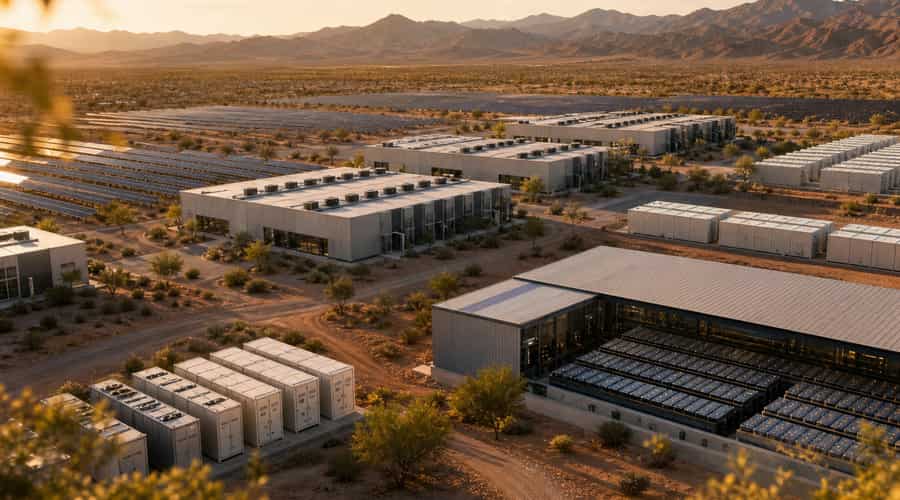
The most interesting AI infrastructure story in Nevada isn't another giant training cluster with a new chip count attached. It's a battery yard. At Redwood Materials' Sparks facility, used electric vehicle packs are being wired into a 12 MW, 63 MWh microgrid that powers a 2,000-GPU modular data center for Crusoe, the AI infrastructure company.
That should get your attention. Data centers are running into the same problem in market after market: they can raise money, buy servers, and find land faster than they can get dependable power. A second-life battery system sitting beside the compute doesn't fix the U.S. grid. It does something narrower and more useful. It gives a power-hungry site a way to move now.
As The Verge reported when Redwood launched its Redwood Energy division in June 2025, the company said the Nevada project was the largest second-life battery deployment in the world. Redwood also said it receives more than 20 GWh of batteries a year, roughly the equivalent of 250,000 EVs, and that this represents about 90 percent of lithium-ion batteries and battery materials recycled in North America. Those are the numbers that make the story more than a clever pilot.
Here's the thing: a retired EV battery is not dead. It may no longer be good enough for a car, where weight, range, warranty risk, and fast charging all matter at once. But Business Insider noted that many of the packs Redwood handles still retain 50 percent to 80 percent of their original capacity. For stationary storage, bolted to the ground behind a fence, that remaining life is worth real money.
Redwood's argument is plain. Test the packs, grade them, group the ones that still work, and use them before sending them into full materials recycling. You don't need to dress that up as a circular economy slogan. The expensive cell has already been manufactured, paid for, driven, depreciated, and recovered. If it can sit beside a data center and store power for years before it gets broken down for lithium, nickel, cobalt, and copper, throwing it straight into the furnace is wasteful.
The AI boom makes that waste harder to defend. Goldman Sachs has forecast that data center power demand could rise 165 percent by 2030 from 2023 levels, while Axios recently pointed out that Big Tech is already under pressure to pay for its own power as communities blame data centers for rising grid strain. You can see why batteries that once looked like an end-of-life headache now look like infrastructure inventory.
Automakers have noticed the same opening
GM is not watching this from the sidelines. In June 2026, GM announced a partnership with Peak Energy to develop and manufacture sodium-ion battery cells for stationary storage systems used by utilities, data centers, and other large power customers. TechRadar reported that Peak's passively cooled sodium-ion systems claim to reduce storage costs by 20 percent compared with lithium-ion options, while GM brings cell design and manufacturing experience from its EV work.
Sodium-ion is not a magic substitute for lithium in cars. It has lower energy density, which is a serious problem when you're trying to squeeze range into a vehicle. For a storage box on the ground, weight matters much less. GM's Kurt Kelty put the point directly in the company announcement coverage: utilities and hyperscalers care about reliable, affordable power over long periods in real conditions, not maximum driving range.
Ford has moved too. MarketWatch reported in May 2026 that Ford signed a five-year agreement with EDF Power Solutions North America that lets EDF buy up to 4 GWh of Ford battery energy storage systems each year, or 20 GWh over the full term, with deliveries expected to begin in 2028. Ford has said it wants to deploy at least 20 GWh of storage products annually. That is not a side project if the company follows through.
You can read these moves as climate strategy, and there is some truth in that. But frankly, the business case is sharper than the branding. Automakers spent years building battery supply chains for EVs. Now they see a second market for the same expertise at the exact moment AI companies are desperate for faster power solutions.
The weak point is supply. Redwood can process a huge stream of used batteries, but the first major wave of EV retirements is still building. New lithium-ion storage prices also keep falling, which means second-life systems have to prove that testing, integration, safety work, and maintenance don't eat away the cost advantage. That is the real test, not whether the idea sounds neat on a conference stage.
Still, the Nevada project changes the conversation. A used EV battery pack that once looked like scrap can now sit behind an AI data center and help keep GPUs running. If you are building compute, making cars, or investing anywhere near the power stack, you should pay attention to that shift. The old battery is becoming part of the new data center.
Also read: Amazon moves Prime Day to June for the first time as AI takes over how shoppers discover deals; Google DeepMind's AI Control Roadmap treats its own agents as insider threats and sets the compliance bar for everyone else; Singapore puts S$48 million behind local media firms to build AI content skills and reach new audiences