
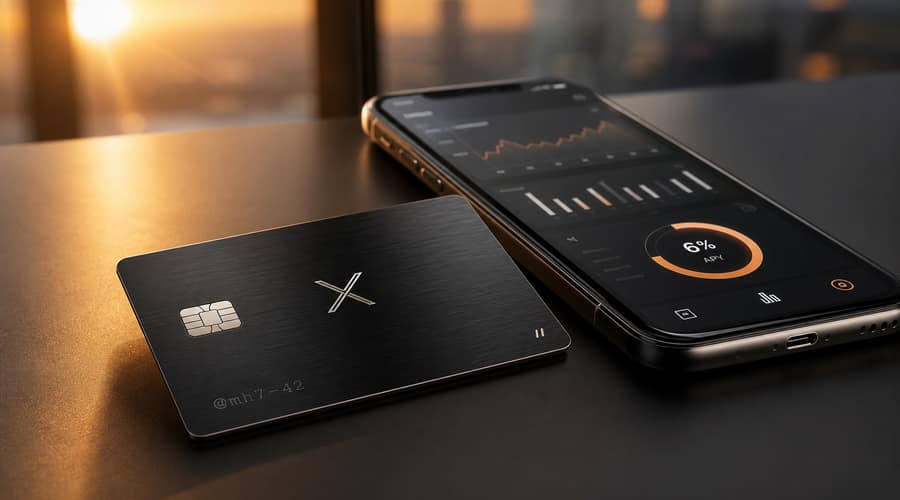
X Money's wider verified-user rollout gives Elon Musk a serious payments product at last, but the 6% savings rate is only the bait. The real test is whether X can make people trust a financial tool inside the same app where they argue, post, and get scammed.
The offer is meant to make you stop scrolling. X Money is dangling a 6% APY on deposits, 3% cashback on purchases, a Visa-linked debit card, and peer-to-peer payments inside X. Business Insider reported in March that early users had already started posting sightings of the X Money card in the wild, including photos from gas stations and restaurants. MarketWatch later noted that beta users were seeing the same headline terms: 6% yield, 3% cashback, and deposits held by Cross River Bank.
That is the story. Not another vague super-app promise. A real banking product is being pushed into a social platform with hundreds of millions of monthly users, and it is being introduced with a savings rate that sits far above what most ordinary bank customers receive.
The bank behind the product matters more than the metal card. X is not holding the deposits itself. Cross River Bank, based in Fort Lee, New Jersey, is. The Verge reported in April that screenshots from early X Money access showed deposits held by Cross River, which is an FDIC member and has long worked behind the scenes with fintech companies. Cross River is the kind of institution most consumers never name, even when its rails sit underneath products they use every week.
That arrangement gives X the relationship without forcing it to become a bank. You see the X brand, the X handle on the card, the payment button inside the app. Cross River carries the regulated banking role. That split is familiar now, from Apple Card's partnership with Goldman Sachs to the banking-as-a-service deals behind many consumer fintech apps. Frankly, it is also where the risk hides. When something breaks, users usually blame the brand on the screen before they blame the chartered bank in the fine print.
The 6% APY is the sharpest part of the pitch. MarketWatch cited Mizuho analyst Dan Dolev, who said X has between 500 million and 600 million global monthly active users, compared with Venmo's roughly 100 million active accounts. If even a small share of X users move idle cash into an X Money account, the product stops being a side feature and starts becoming a deposit-gathering machine.
Don't treat the rate as a permanent fact. Treat it as an acquisition cost. The Federal Reserve's target range, ordinary high-yield savings accounts, and money-market yields all put pressure on a 6% offer. Sen. Elizabeth Warren made that exact point in her April letter to Musk, questioning how X Money or Cross River would fund such a yield and asking whether user data, investment risk, or other revenue would sit behind it. You do not have to share Warren's politics to understand the question. Six percent has to be paid for somewhere.
The fraud problem is just as important. Peer-to-peer payments in the US have spent years teaching consumers a brutal lesson: instant money is wonderful until it goes to the wrong person. MarketWatch reported that Bank of America, JPMorgan Chase, and Wells Fargo reimbursed 38% of Zelle fraud claims in 2023, down from 62% in 2019, according to a Senate subcommittee report. Cash App had its own reckoning in January 2025, when the CFPB ordered Block to pay $175 million over alleged failures in fraud handling and customer support. Block denied wrongdoing, but it still settled.
That is why verified-user access is not just a growth throttle. It is part of the trust pitch. A verified X account will not stop every scammer, and nobody serious should pretend otherwise. But a payments product tied to identity, account history, and platform standing starts from a better place than a wide-open money-transfer tool where a fake support agent can vanish after one transaction.
The WeChat comparison will follow X Money everywhere, and Musk wants it to. WeChat turned messaging, payments, shopping, and financial products into one daily habit in China. Yu'e Bao, the money-market product linked to Ant Group's Alipay, showed how quickly deposits can move when money management sits inside an app people already open all day. The US is different. Bank regulation is different, consumer trust is different, and X's own brand carries more political and cultural baggage than a neutral wallet app.
Still, distribution is distribution. Cash App and Venmo had to build payment networks user by user. X begins with a live social graph, creators who already monetize on the platform, advertisers, subscribers, and users who are already trained to transact attention in real time. If payments become native to that behavior, the product does not need every X user. It needs enough of them to make sending money inside a post or DM feel normal.
The current rollout is still controlled. US residents 18 and older with accounts in good standing can request access, according to the product terms reported by outlets covering the beta. The card, the cashback, and the savings rate make the launch loud. The quieter question is better: can X run customer support, fraud review, compliance, and banking disclosures with the discipline finance requires?
That is where this story will be won or lost. A 6% rate can buy attention. It cannot buy trust for long.
Also read: OpenAI is leaning toward a 2027 IPO as its CFO warns the company isn't ready for public markets • Iran strikes a Singapore-flagged vessel in the Strait of Hormuz as transit fee dispute deepens the global oil crisis • AI revenue has finally outpaced the cost of building the infrastructure behind it