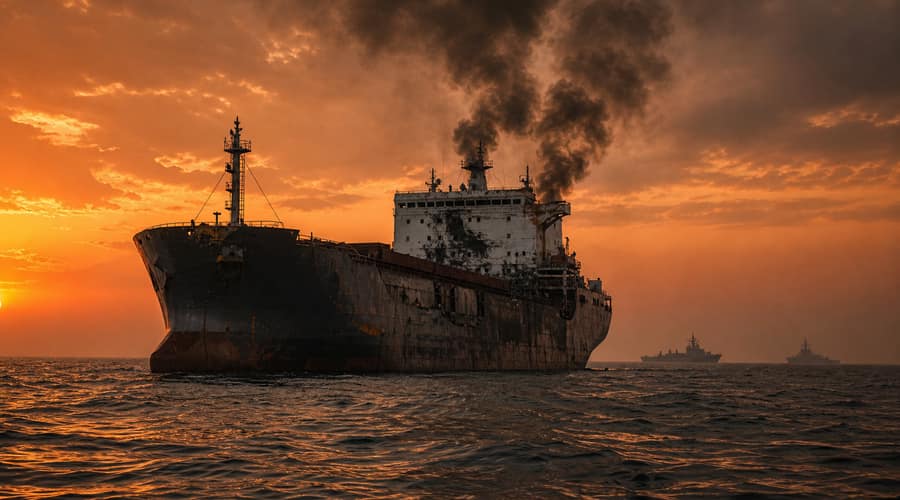
A Singapore-flagged vessel was hit off Oman just as the UN tried to move stranded ships out of Hormuz. If you needed proof that the strait is still running on fragile promises, this is it.
The attack came at exactly the wrong moment. UK Maritime Trade Operations said a vessel was struck by an unknown projectile off Oman on Thursday, with damage reported but no immediate casualties. Axios reported that the UN's International Maritime Organization then paused its plan to evacuate more than 11,000 sailors stranded around the Strait of Hormuz. That pause tells you plenty. Even the body coordinating the exit routes doesn't yet know whether the safety guarantees it thought it had still mean anything.
This is not a clean reopening. It is a standoff with traffic lights attached. Shipping through the Strait of Hormuz has been heavily disrupted since February 28, when the US and Israel launched strikes on Iran and Iran moved to restrict passage through the waterway. The strait normally carries about 20 million barrels of oil a day, roughly a fifth of global seaborne oil trade, from producers including Saudi Arabia, the UAE, Iraq and Qatar. When Iran controls the practical terms of passage, every refinery, insurer and shipping desk that depends on Gulf flows has to price that political fact into the next cargo.
The latest dispute is over routes, authority and money. The Guardian reported Thursday that Iran rejected UN-backed evacuation lanes proposed with Oman, including a southern route through Omani waters that was considered more passable than the mined pre-existing transit route. The IRGC said coordination with its navy was mandatory for any transit. That is the hard line in the whole story. Iran does not want a humanitarian evacuation plan to become a precedent for ships moving through Hormuz without its approval.
Oman is trying to keep this lawful and usable. According to the Guardian, Muscat has been discussing a longer-term management system for the strait based on voluntary contributions tied to safety and environmental services, modelled partly on arrangements around the Malacca and Singapore straits. Gulf states and western governments are wary for the obvious reason: a voluntary safety contribution can start to look like a toll very quickly if one side has mines, missiles and the power to stop ships. Frankly, no importer wants its energy supply chain resting on that distinction.
The oil market has already shown how quickly fear can move the price. Brent crude jumped sharply after the February closure, then fell back as ceasefire talks and partial transit made traders less nervous. MarketWatch reported Thursday that Brent rose 2.1% to $75.26 after the reported attack, while US crude climbed 2.2% to $71.92. The price is nowhere near the March panic, but the direction matters. A single projectile off Oman was enough to remind the market that normalization is still more hope than operating condition.
You should not read the lower oil price as proof that the crisis is over. The Guardian reported that prices had fallen toward prewar levels as more tankers exited the strait, but that was before the new attack complicated the evacuation plan. Wood Mackenzie, cited in Wall Street Journal market coverage, has estimated that the crisis removed more than 11 million barrels a day from global markets at its worst, and that full normalization could take months even if the strait reopens properly. That is the problem with chokepoints. The damage happens fast, and the repair takes paperwork, security guarantees and trust no one currently has.
The human side is just as blunt. Axios reported that the IMO estimates about 600 ships remain stranded in the region and that 14 sailors have died since the Iran war began in February. Those figures cut through the market language. A vessel delayed outside Hormuz is not only a line in a freight model. It is a crew waiting for orders, an insurer recalculating risk, a buyer wondering whether the cargo will arrive, and a government deciding how much confrontation it can tolerate before energy security becomes a domestic political problem.
For Iran, the leverage is obvious. Mohammad Ghalibaf, Iran's parliamentary speaker and chief negotiator, said the administration of the strait would not return to the way it was before the war, according to the Guardian. You do not need to dress that up. Tehran is saying the old freedom-of-navigation assumptions are gone, at least for now. Washington and Beijing may both oppose tolls and further militarization, but opposition is not the same as control of the route.
For shipping companies, the calculation is ugly and practical. Use an Iranian-approved route and accept the political cost, try an Omani-backed evacuation lane and risk being treated as outside the rules, or wait while ships, cargo and crews sit idle. None of those choices looks like normal commerce. Until the mines are cleared, the routes are agreed and the enforcement rules are public, Hormuz is open only in the narrowest sense: some ships may pass, when Iran allows it, under conditions everyone else is still trying to understand.
Also read: AI revenue has finally outpaced the cost of building the infrastructure behind it • North Korea stole $1.5 billion from Bybit and Iran's central bank quietly spent it • The CLARITY Act has four weeks to pass the Senate or crypto regulation waits until 2030