Xi Jinping used his first keynote at China's flagship AI summit to pitch a rival to Washington's approach: a Shanghai-based governance body already backed by 29 countries.
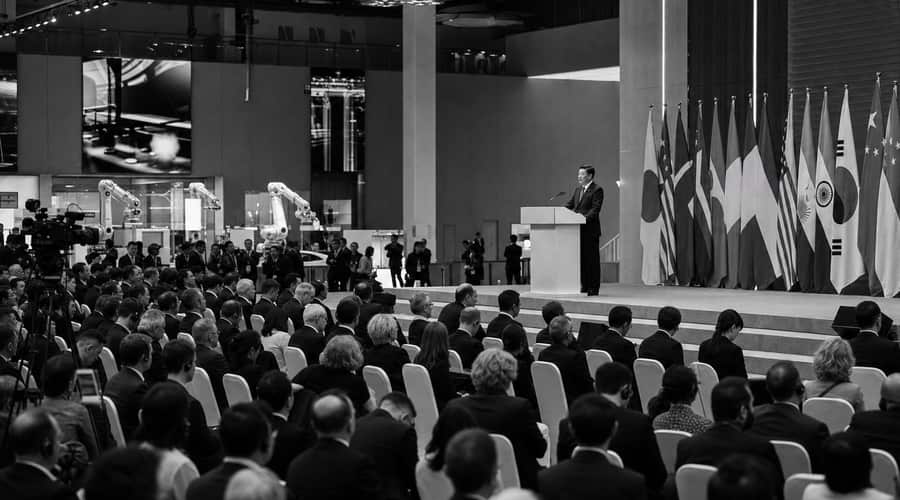
Xi Jinping stood before China's flagship AI summit for the first time on Friday and told the room that no single country gets to run this technology alone.
Speaking at the opening of the World Artificial Intelligence Conference in Shanghai, the Chinese leader said AI development "should not be a solo performance by a single country, but a symphony of international cooperation," a line carried by Al Jazeera and other outlets covering the speech. It was his debut keynote at WAIC, an event Beijing has run since 2018. The timing was not subtle. The summit runs July 17 to 20 in Shanghai, landing squarely in the middle of an AI rivalry with Washington that has only sharpened this year.
Xi did not name the United States. He did not have to. He said countries should "jointly oppose overstretching the national security concept in the field of AI, or placing one country's security over that of others," a line NPR and Houston Public Media tied directly to the string of US export controls that have throttled China's access to advanced chips. Nvidia said in its own annual report that it has been effectively foreclosed from competing in China's data center computing market since the end of its last fiscal year, unable to build a product that satisfies regulators in both Washington and Beijing at once.
That's the backdrop. Xi's answer to it wasn't a threat. It was an offer.
He called for a "people-centric" approach to AI, one where governments build out laws, technological monitoring, early warning systems and emergency response mechanisms to keep the technology "always under human control." Then he made it concrete with a number. That's the part of a speech like this that actually means something. China, he said, will offer developing countries 5,000 training and seminar opportunities in AI over the next five years. Xinhua also reported that China will help 30 countries use the MAZU AI-powered meteorological early warning system and build AI application cooperation centers with ASEAN, the League of Arab States, the African Union, CELAC, the Shanghai Cooperation Organization and BRICS. Numbers, not adjectives.
Building a rival table
Words alone don't build a coalition, so China built an organization to go with the speech. Foreign Minister Wang Yi and representatives from 29 countries, including Kazakhstan, Laos, Pakistan, Russia and Indonesia, signed an agreement establishing the World AI Cooperation Organization in Shanghai on Thursday. It is headquartered in Shanghai. Its stated job is to promote what Chinese officials call "healthy and orderly" AI development among its members. In practice, it's a standing table where Beijing sets the agenda for governance conversations the US isn't chairing.
That's the real story sitting underneath the "symphony" line. The US has spent the past few years tightening chip export rules and pulling allies toward its own AI standards. China's answer, at least on this stage, isn't to out-compete Washington chip for chip. It's building the diplomatic infrastructure first. The hardware race can play out underneath it. Twenty-nine countries signed the founding document. That says more about where this is headed than any line in Xi's speech.
Why it matters beyond the speech
If you build or sell AI products outside the US, this is worth watching. A rival governance body headquartered in Shanghai, backed by training programs aimed squarely at the Global South, is a direct pitch for the customers and regulators Washington hasn't locked down yet. Indonesia and Pakistan didn't sign onto the new organization because they picked a side in a superpower conflict. That wasn't the calculation. They signed on because Beijing offered something concrete: training seats, a seat at the table and a stated commitment not to let AI security policy get "overstretched" against smaller nations.
Whether China's own AI companies, still working around chip restrictions of their own, can back the rhetoric with tools those countries actually want to use is a separate question. Huawei's chip output and the performance gap with Nvidia's latest hardware remain a real constraint, one the South China Morning Post flagged heading into this year's summit. That's the gap Beijing still has to close.
For now, Xi has drawn a clear line: multilateral AI governance against a US-led model built around export controls. That's the divide. The next test isn't what got said on stage in Shanghai this week. It's whether the 29 countries that signed show up for the next meeting.
Also read: Apple Hands China's AI Brain to Alibaba to Get Apple Intelligence Approved, Hackers hijacked Brian Chesky's X account to push an AI-written crypto tokenization thread and Zhipu Stock Soared 1,500 Percent While Revenue Stayed Under $105 Million