
Bura Marie makes some of the best Thai food I have eaten in Bangkok. It also makes one of the strongest arguments for why even the most accomplished brands should resist the temptation to borrow someone else's identity.
I walked into the restaurant and tearoom not quite knowing what to expect. What I found was genuinely impressive food, a spacious and beautifully designed room, and service that reminded me why Thai hospitality has earned its global reputation. The crab omelet was outstanding. The tea program, built around Thai flowers and fruits, was thoughtful and clearly the product of real care. By every culinary measure, this place delivers.
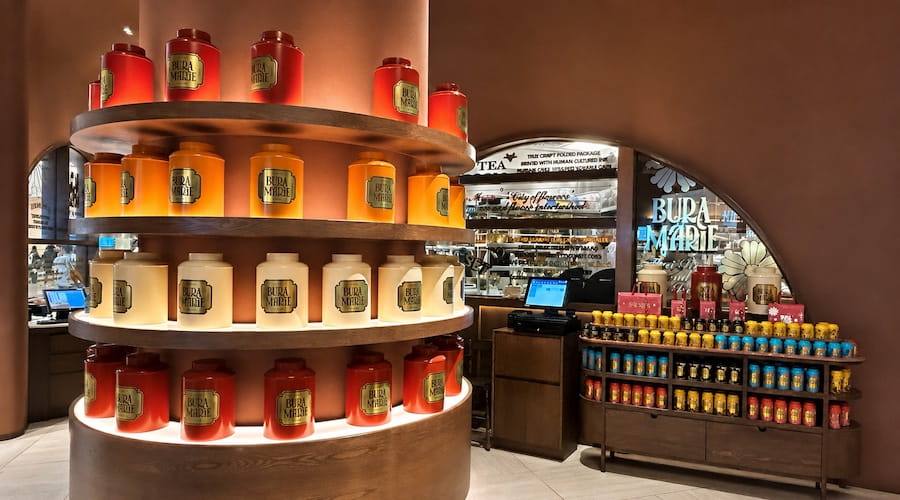
But something was pulling at me the entire time I sat there. A feeling I could not quite place until I stepped back and looked at the room as a whole. The warm vintage palette, the old-world tearoom aesthetic, the carefully arranged jars of tea, the deliberate sense of arriving somewhere refined and European. I had seen this before. Not in Bangkok. In Singapore, in Dubai, in airports across Asia and beyond. I had seen Bacha Coffee. I had seen TWG Tea. And Bura Marie looked, in unmistakable ways, like both of them.
Before this reads like an attack on a restaurant that genuinely deserves praise, let me be clear. The food is exceptional. The experience is warm. The concept of pairing elevated Thai cuisine with artisanal tea is smart and original. None of that is in question. What is in question is the visual identity, the aesthetic language that greets you at the door, and whether it truly belongs to Bura Marie or to someone else entirely.
This matters because of who is behind it.
Bura Marie is a concept from Atchara Burarak, founder of the iberry Group, one of Thailand's most respected restaurant operators. She started iberry as a homemade ice cream brand in 1999, with no marketing budget and no guarantee anyone would take her seriously. Since then she has built a portfolio that recent Thai coverage now puts at more than 16 brands and over 100 branches across Thailand, including ThongSmith, Kub Kao Kub Pla, and Ros'niyom. As the Bangkok Post reported in January, the company also spent more than one billion baht on a central kitchen facility outside Bangkok to support further growth. This is not someone finding her footing. This is someone who has proved, repeatedly, that she knows exactly how to build a brand from nothing.
Which is exactly why the aesthetic choice of the place is so puzzling.
When a startup borrows visual cues from an established player, you understand it. Resources are limited, the market is unfamiliar, and sometimes a reference point helps communicate your positioning before your own identity has had time to take hold. But when an operator of this scale and track record produces something that closely echoes the look and feel of other brands in the niche, it stops reading like inspiration and starts reading like imitation. And imitation, at this level, carries a real cost.
Bacha Coffee and TWG Tea have become familiar reference points for luxury beverage retail across Asia, the Middle East, Europe, and North America, with prominent locations in malls and international airports. The world has seen those stores. Educated travellers, which increasingly means most travellers, will notice the resemblance immediately. And when they do, the conversation shifts from what Bura Marie is to what it reminds them of. That is not a brand conversation any restaurant wants to be having, least of all one with food this good.
What genuinely frustrates me is that the raw material for something entirely original is already sitting right there inside this restaurant. The name Bura Marie carries a floral meaning and a sense of place. The teas are built around lychee oolong, bael fruit, jasmine, and Siam Earl Grey. These are not borrowed ideas. They are rooted in Thai culture, in memory, in ingredients that grow in Thai soil. That is a genuine identity. A compelling one. And it is not being fully expressed in the space that surrounds it.
The lesson here is not unique to restaurants. Any entrepreneur building a brand with serious resources at their disposal faces this choice at some point: build from what you actually have, or reach for the comfort of what has already worked for someone else. The second option feels safer. It shortens the hard work of building consumer recognition around something new. But it trades long-term brand equity for short-term familiarity, and that trade rarely pays off the way founders hope.
The higher your track record and resources, the more visible the imitation becomes, and the more it quietly undermines the very credibility you spent years earning. People will eat the food and love it. But they will also talk about who the restaurant looks like. And that framing, once it settles, is difficult to shake.
Bura Marie has everything it needs to stand entirely on its own. Remarkable food, a story worth telling, a name with genuine emotional depth, and a founder who has built lasting brands from far less. The one thing missing is the decision to trust all of that enough to let go of the borrowed aesthetic and build something as original as what is already on the plate. Bangkok deserves that restaurant. And frankly, so does the team that built it.