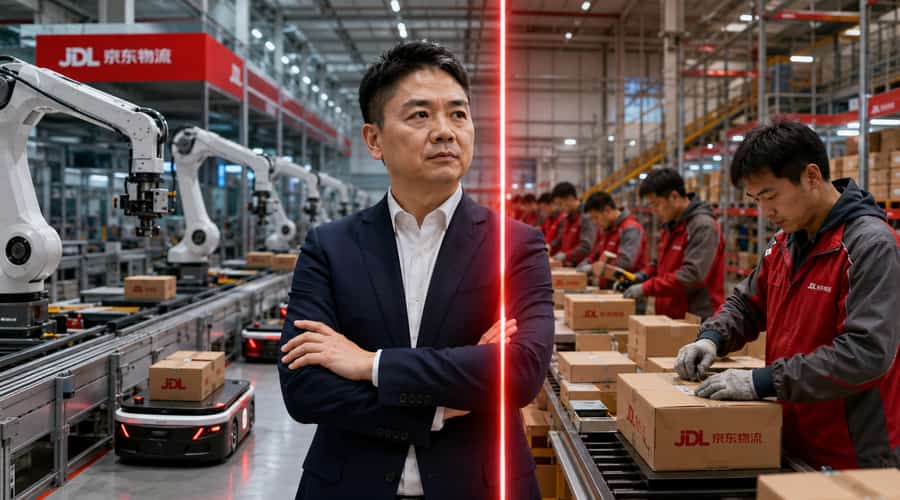
JD.com founder Richard Liu is trying to make automation sound less like a threat to workers and more like a test of management.
That is a notable stance from one of China's most automation-heavy e-commerce and logistics groups, especially because JD.com has spent years building one of the country's most advanced warehouse and delivery networks. Reuters reported in 2018 that Liu predicted robots would eventually replace human workers in retail. His latest message does not reverse that view. It reframes it for a moment when companies are under more pressure to explain what automation will do to jobs.
According to a 36Kr report published this week, Liu said JD.com must do everything possible to protect the jobs of hundreds of thousands of employees, including blue-collar workers, as new technologies reshape the business. The timing matters. JD is not speaking from the sidelines. It runs large-scale logistics operations, has invested heavily in automation, and reported that personnel across the JD ecosystem exceeded 900,000 as of March 31, 2026.
The obvious reading is that Liu is trying to draw a line between efficiency and social pressure. China's policymakers have been pushing a broad AI rollout, but Reuters noted in March that officials are also stressing job stability and trying to manage the labor risks that come with faster automation. In that context, a big private-sector promise to shield workers from displacement is not just a brand statement. It fits Beijing's current balancing act.
There is also a more practical angle. JD.com has long built its reputation on logistics performance, and automation has been part of that story for years. Reuters reported in 2018 that the company raised $2.5 billion for its logistics arm, with Liu saying the funding would support further investment in automation, drones, and robotics. The company has also been one of China's most visible e-commerce operators when it comes to robotics inside warehouses and delivery systems.
That history is what makes the promise interesting. Liu is not rejecting automation. He is trying to separate automation as a business tool from the social cost of automation as a political problem. In China, that distinction matters. A company that can keep regulators comfortable while still modernizing its supply chain has a better chance of moving quickly than one that looks indifferent to jobs.
What it means for startups
For AI automation startups selling into Chinese enterprise accounts, the implication is straightforward. The conversation may shift from pure efficiency to compliance, labor sensitivity, and narrative control. If the biggest operators in the market start making public pledges about job protection, smaller vendors will have to show not only that their products save money, but that they can do so without creating a political headache for the buyer.
That could sharpen procurement criteria in a way founders do not always anticipate. A warehouse robot is no longer just a robot. It becomes part of a story about employment, social stability, and the company's relationship with regulators. In that environment, firms that can offer gradual deployment, worker retraining, or systems that augment labor rather than visibly replace it may find a warmer reception than those selling outright labor substitution.
The legal backdrop is also moving in the same direction. In late April, Chinese courts in Hangzhou ruled that employers could not justify dismissing workers simply because AI could perform their jobs more cheaply. That does not mean automation will stop. It does mean companies may need stronger legal and operational arguments before turning a technology rollout into a headcount reduction.
JD.com is a useful case study because its own public history cuts both ways. Reuters reported in 2018 that Liu predicted robots would replace humans in retail, and a separate Reuters report from that year covered the company's financing push for logistics automation. The current pledge does not erase that record. It suggests the company now sees value in presenting automation as a way to raise productivity and expand capacity, rather than as a direct path to cutting frontline staff.
That is where the political calculation comes in. Chinese tech firms are operating under tighter scrutiny, and leaders know that being seen as aligned with employment goals can buy them room to maneuver. Liu's statement may therefore be less about sentiment than strategy. It is a reminder that in China, the most important automation decision is not always technical. Sometimes it is about how a company decides to explain itself.