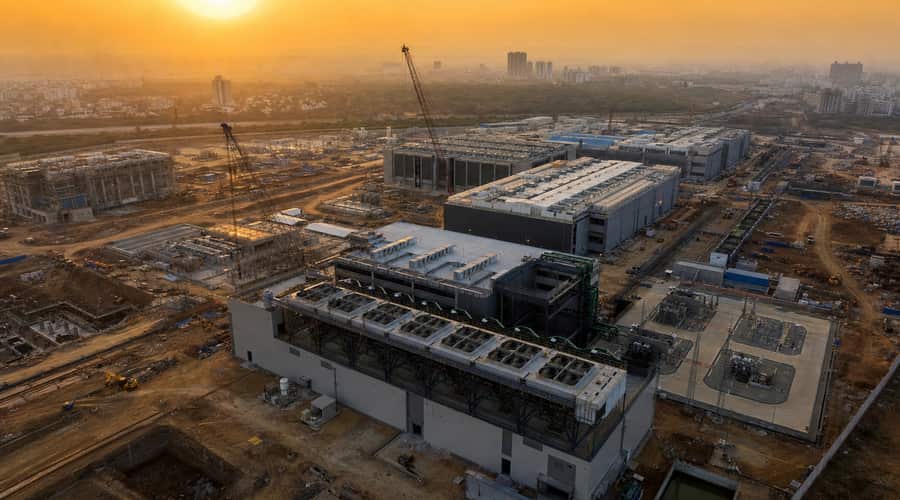
RMZ Group wants to turn a real estate balance sheet into AI infrastructure, but the hard test is not announcing 3 gigawatts of data center capacity. It is finding the land, permits and power to make that capacity real.
Real estate companies don't usually get cast as builders of the AI age. RMZ Group is trying to force its way into that role. The Bengaluru-based developer has laid out a plan to deploy $35 billion over five years, with about $17 billion directed toward digital and AI infrastructure, as it tries to move from 250 megawatts of data center capacity today to 3 gigawatts.
That's a serious number. You don't get there by treating data centers as a side business attached to office parks. You get there by behaving more like an infrastructure owner than a landlord, which is exactly the position RMZ is trying to claim.
The plan is already more specific than a press-release ambition. RMZ is working through a late-2024 joint venture with Colt Data Centre Services that was set up to invest $1.7 billion in India, and the company is in advanced discussions on three new projects that would push its total capacity past 1 gigawatt. Co-location facilities are planned across Navi Mumbai, Chennai, Hyderabad, Bengaluru and Visakhapatnam, with 750 megawatts pencilled in for Navi Mumbai and close to 500 megawatts for Visakhapatnam. Manoj Menda, one of RMZ's co-founders, has also signalled that an IPO is on the table as the company looks for the kind of permanent capital that suits a buildout measured in years, not quarters.
The timing is not accidental. India's data center market is being pulled at once by cloud adoption, data localisation rules, AI training demand and the simple fact that Indian companies don't want every serious compute workload sitting somewhere else. If you're building software in India, you want latency, compliance and price to work in your favour. That means more facilities on Indian soil.
RMZ is not walking into an empty field. Earlier this month, the Economic Times reported that Blackstone-backed AirTrunk, owned by Blackstone and Canada Pension Plan Investment Board, plans to invest more than $30 billion in India and develop more than 5 gigawatts of digital infrastructure capacity by 2030. On June 17, the Economic Times also reported that CPP Investments had entered a strategic partnership with CtrlS Datacenters to invest up to C$1 billion, or about 7,000 crore rupees, into Indian digital infrastructure.
That tells you where the serious money is going. Pension funds and private equity giants are not buying slogans about AI. They are buying power-hungry buildings, long contracts and strategic locations near cloud demand.
RMZ's argument is that it brings something foreign capital can't import overnight: land relationships, local approvals, construction discipline and an operating base that already includes 250 megawatts of capacity. The company is also building an AI factory business that would offer GPU-as-a-Service to Indian startups. That piece matters because smaller companies can't sensibly buy and run their own high-performance compute stack. If RMZ can sell access to GPUs as well as racks and power, it has a stronger story than a pure co-location landlord.
Here's the thing every big data center announcement in India has to answer: where does the electricity come from?
India's data center capacity was around 950 megawatts in 2024 and is expected to reach about 1,800 megawatts by 2026, according to industry estimates cited in public market summaries. The proposals now being announced would take the sector far beyond that. The gap between what is promised and what can be energised is where these plans will either become infrastructure or stay as investor decks.
Power is not a footnote in this business. AI servers draw far more energy than ordinary enterprise racks, and the best land parcel in Navi Mumbai or Chennai is not enough if grid connection, backup supply and cooling economics don't work. Some Indian data center developers are already looking at behind-the-meter power projects because waiting for grid upgrades can turn a construction plan into a stalled asset.
RMZ has not publicly given enough detail on its power sourcing for a 3 gigawatt buildout. That is the right place to be sceptical. The company can talk about land banks and investor appetite, but every one of those three projects now in advanced discussions needs to prove that RMZ can get dependable power at scale, not just announce megawatts on paper.
The demand side is easier to believe. Hyperscalers, SaaS companies, banks, telecom networks and AI startups all need domestic compute capacity, and Union Budget 2026-27's proposed 21-year tax holiday for foreign cloud providers using India-based data centers would make the pull stronger if implemented. The supply side is more stubborn. It asks for transmission, substations, permits, cooling, water and trained operating teams.
RMZ is not the first property company to decide that the next cycle runs through server rooms rather than office towers. But the scale of this proposal puts it in a different category. A developer dabbling in co-location can survive a slow project. A company promising $35 billion of deployment and 3 gigawatts of capacity has to show execution city by city.
Watch Navi Mumbai and Visakhapatnam first. If RMZ can turn those sites into powered, contracted capacity, the company's AI infrastructure pitch starts to look real. If it can't, the headline number will join the long list of ambitious infrastructure promises that looked convincing until someone asked about the grid.
Also read: Yann LeCun calls xAI a failure as Elon Musk's lab pivots from frontier AI to renting out servers • Hyundai takes full control of Boston Dynamics as SoftBank exits for $325 million • Texas just rewrote the rules for connecting AI data centers to its power grid