As a durian glut crashes prices across Singapore, one seller is betting that proof of origin, not a lower price tag, is what will get customers to open their wallets.
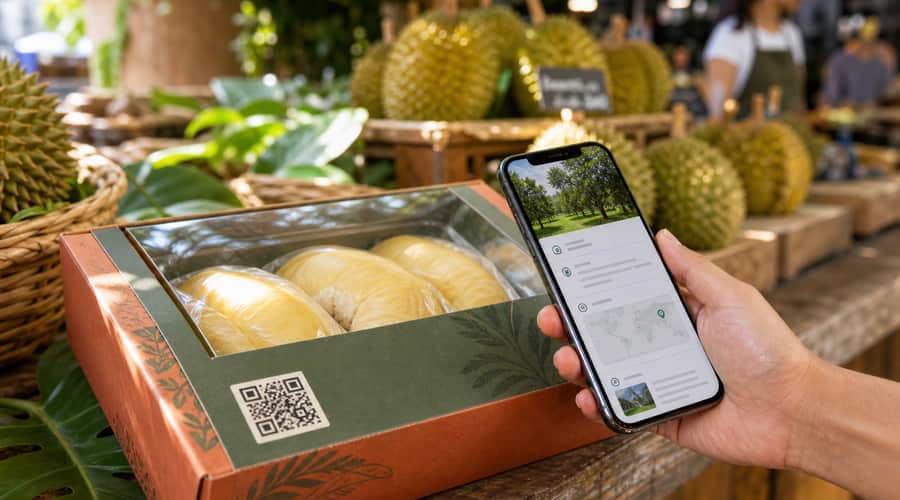
Mao Shan Wang durians are selling for as little as $8 a kilogram at some Singapore stalls this year, the fallout from a bumper Malaysian harvest that has flooded the market. AGONG Durian is charging $45 for a 400g box of dehusked fruit and asking customers to scan a QR code before they even open the lid.
The QR code, printed on the packaging, pulls up a webpage showing which orchard the durians came from, whether the fruit is Mao Shan Wang or Black Thorn, and the orchard's exact location and contact details. Quek Wei Ling, chief operating officer of e-commerce firm Synagie, the parent company of AGONG Durian, says the tamper-resistant record gives customers a way to independently verify what they are paying for.
That's the pitch. Pay a premium, but know exactly what you're getting. It's a direct answer to a market where telling a real Mao Shan Wang from a cheaper stand-in is nearly impossible for anyone who doesn't buy durian for a living.
The oversupply driving this experiment is well documented. Malaysia produces roughly 550,000 tonnes of durian a year, and newly matured farms, many planted on land where rubber and oil palm once grew, are now bearing fruit at the same time, according to reporting from The Star. That glut pushed Mao Shan Wang as low as $8 to $18 a kilogram at value stalls in Singapore earlier this year, before prices firmed somewhat as supply tightened ahead of Lunar New Year. Singapore sellers say local prices won't fall as far as Malaysia's because of transport costs, overheads and GST, according to the Malay Mail.
Synagie isn't inventing durian traceability from nothing. Singapore based DiMuto has been turning harvested durians into traceable digital assets since 2019, photographing and tagging each fruit and recording transaction data on the Ethereum blockchain through Singapore's TradeTrust trade portal. DiMuto went on to track roughly four million durians for Thailand's largest durian exporter. Over in Penang, the Fruit Farmers Association rolled out its own QR code system after counterfeit durians sold under the Penang name became enough of a problem that growers built an authentication scheme themselves, tagging the stem of each fruit so a buyer can trace it back to a specific orchard within seconds.
DiMuto and the Penang scheme are supply chain tools, aimed at exporters and wholesalers moving fruit in bulk. AGONG Durian's QR code is consumer facing, built for the person standing in a Singapore mall deciding whether a $45 box beats the $20 pile one stall over.
There's a real risk in leaning on technology to justify a premium in a market that's currently drowning in cheap fruit. A glut tends to punish anyone charging more, not reward them for showing their work. But durian buyers in Singapore have long paid up for certainty, whether that's a stall owner who's run the same corner for decades or a grade stamped on the box. AGONG Durian is simply swapping a handshake for a webpage.
Whether that swap pays off depends less on the blockchain record itself, which is straightforward to build, and more on whether shoppers actually bother to scan it. Most durian buyers have never demanded a paper trail before. They've relied on trust in the seller, a look at the fruit, sometimes a whiff through the husk. Asking them to check a QR code before paying for a box that's dehusked and can't be smelled or shaken is a different kind of trust exercise entirely.
Frankly, the harder test isn't whether the tamper-resistant record holds up. It's whether enough buyers will pull out their phones and look before they decide the fruit is worth the premium, at a moment when the fruit next door costs half as much.
Also read: Cloudflare Starts Charging AI Companies for the Web Data They Once Took Free • Netflix Proves That Even Streaming's Biggest Winner Cannot Coast on Its Own Success • Kevin Warsh Just Put Marc Andreessen In The Room Where Fed Policy Gets Made