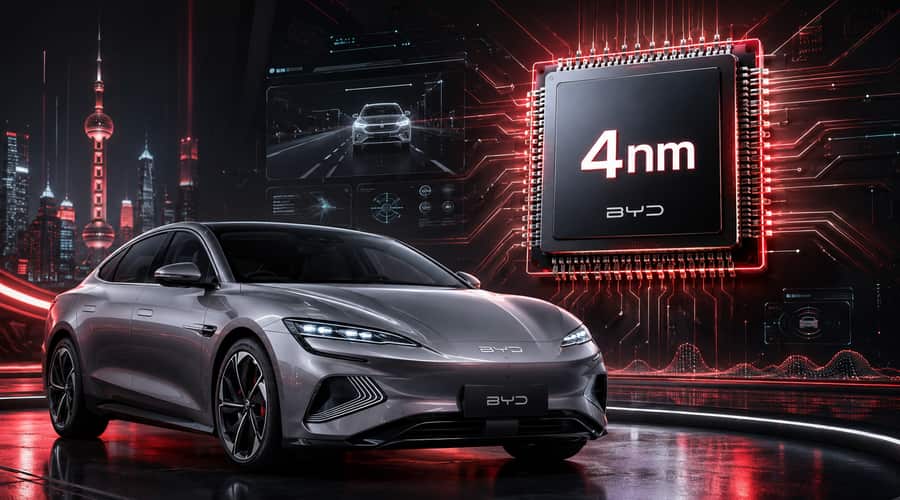
BYD has moved its smart-driving ambitions deeper into its own supply chain with the Xuanji A3, a 4nm chip it says is already in mass production and built for higher-level autonomous driving workloads.
BYD is no longer treating autonomous driving as something it can buy from the usual chip suppliers and bolt onto a car. At an intelligence strategy event in Shenzhen on May 28, chairman Wang Chuanfu unveiled the Xuanji A3, a self-developed 4nm smart-driving processor that the company says can support L3 and L4 autonomous driving functions.
That matters because BYD is already the world's largest new-energy vehicle maker by volume, and scale changes the economics of every component it touches. Batteries made BYD a cost leader. Now the company is trying to bring the same logic to the computing hardware behind assisted driving.
Why The Chip Matters
According to CnEVPost, BYD said the Xuanji A3 is China's first 4nm-based smart-driving chip and has entered large-scale mass production. The company says three of the chips can be clustered to deliver more than 2,100 TOPS of computing power, enough for the sensor processing and decision-making loads behind more advanced driver-assistance systems.
The headline number will draw comparisons with Nvidia and other auto-chip suppliers, but raw computing power is only part of the story. Wang emphasized energy efficiency and software-hardware optimization, saying BYD's own algorithms can be tuned more closely to its own silicon. In an electric vehicle, that is not a technical footnote. Power draw, heat management and component cost all affect how widely advanced driving features can be offered beyond premium models.
This is where BYD has an advantage that smaller rivals struggle to match. A custom chip program is expensive, but BYD can spread that investment across millions of vehicles rather than a narrow flagship lineup. If the company can put more capable assisted-driving hardware into lower-priced cars without destroying margins, it changes the competitive baseline for the Chinese EV market.
The Safety Guarantee Is The Bigger Signal
BYD also paired the chip announcement with a one-year safety guarantee for its urban navigation assist feature. The company said that if drivers use the system as intended and are involved in an at-fault accident, BYD will cover the resulting economic losses.
That is a bold way to sell confidence. Consumers do not judge assisted driving only by spec sheets. They judge it by whether they trust the car when traffic is messy, pedestrians are unpredictable and lane markings disappear. By putting money behind the claim, BYD is trying to move the conversation from capability to accountability.
It also creates a practical adoption loop. If more owners use the system because they feel protected, BYD gets more real-world driving data. More data can improve the system. Better performance can reduce claims and make the guarantee less costly to maintain. That is the kind of loop Tesla, Xpeng, Huawei-backed systems and other autonomy players have all chased in different ways.
From Battery To Brain
BYD's long-term strength has been vertical integration. It makes batteries, power electronics and key vehicle components in-house, which helped it absorb cost shocks during earlier lithium price spikes and push EV pricing lower across China. Xuanji A3 extends that playbook from the battery pack to the vehicle's computing brain.
The company said it has built a broad semiconductor operation, including chip design, packaging, testing and wafer production capacity. That does not mean BYD is suddenly a replacement for the entire global chip supply chain, and the exact manufacturing details behind a 4nm automotive processor will still matter. But the strategic direction is clear: BYD wants less dependence on Nvidia, Qualcomm and other outside suppliers for the systems that will define the next generation of vehicle differentiation.
There is one important caveat. A strong chip does not automatically make a strong autonomous-driving system. BYD has scale and cost discipline, but its assisted-driving reputation has often trailed more software-focused Chinese rivals such as Xpeng and Huawei's automotive partners. The Xuanji A3 gives BYD more control over the hardware layer. It still has to prove that its software can match the ambition.
For the market, the message is straightforward. The EV price war is no longer only about batteries, range and discounts. It is moving into custom silicon, data and liability-backed driver assistance. If BYD can bring those pieces together at mass-market prices, competitors will have to answer with more than a better spec sheet.
Also read: Europe's €120 Billion Chip Pivot: No More Blank Checks for Empty Fabs • Has the hunt for AI compute uncovered the next Cerebras? • Space surveillance startup raises 184 million