
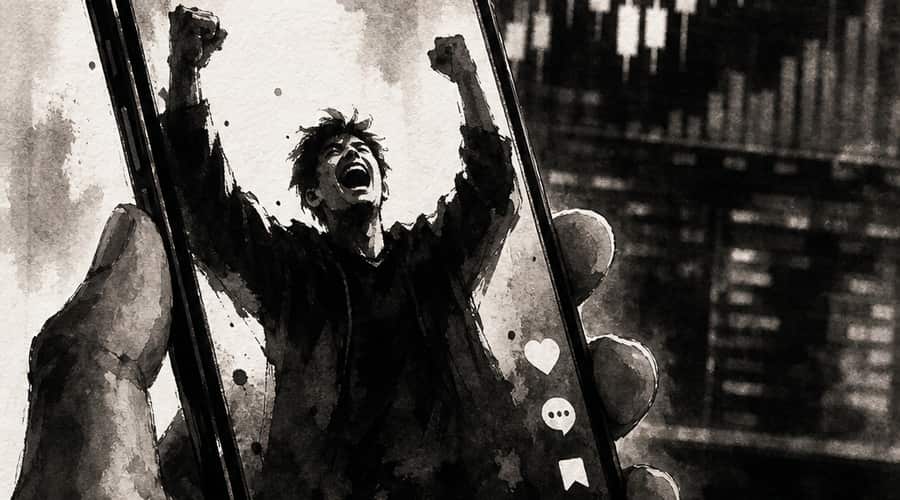
The Wall Street Journal has now put hard detail behind the uncomfortable Polymarket story: fake winning-bet videos, dummy trading sites, and paid creators who were told not to tell you they were being paid.
The details are worse than the headline. The Wall Street Journal reported this week that Polymarket used near-identical replicas of its live exchange so creators could film trades they never actually placed. One January video showed a college student apparently winning $100,000 on a single bet. The Journal said the trades were simulations, not real wagers, and identified more than 1,100 videos in the campaign. If you watched those clips as proof that ordinary users were getting rich on Polymarket, you were not seeing the market. You were seeing an ad dressed up as a win.
That is the part Polymarket cannot talk its way around. Politico, in reporting republished by Business Insider earlier this month, said chief marketing officer Matthew Modabber used a personal PayPal account to send more than $2.5 million to over 800 people between January 2025 and February 2026. Politico verified about two dozen creators who received money and found at least 490 Polymarket posts on X without clear paid-promotion disclosures. The paid names it identified included Alex LoRusso, Brian Krassenstein, and Riley Gaines. The spread across politics was not an accident. It made the campaign look organic from several directions at once.
The Federal Trade Commission has been clear about paid endorsements for years. If there is a material connection between a creator and a company, the reader or viewer has to be told. The FTC updated its endorsement guides in 2023, and this is exactly the kind of conduct those rules are meant to catch: paid praise presented as ordinary enthusiasm. Polymarket was not wandering through some obscure compliance thicket. It was trying to become a mainstream financial information brand while letting sponsored content pass as social proof.
Here is the uncomfortable part for investors. Polymarket has spent the past year asking serious institutions to treat it as more than a crypto betting site. Reuters reported in October 2025 that Intercontinental Exchange, the parent company of the New York Stock Exchange, agreed to invest up to $2 billion in Polymarket at an $8 billion valuation. The Guardian reported in April 2026 that Polymarket was in talks to raise money at a valuation of up to $15 billion. Those numbers do not belong to a hobby project. They belong to a company trying to sell Wall Street on the idea that prediction markets are usable financial infrastructure.
None of that sits comfortably beside personal PayPal payments, undisclosed creator posts, and videos of fake wins staged on clone websites. If your pitch is that markets reveal truth, you do not get to manufacture the crowd that supposedly proves your product works.
Polymarket also has a regulatory history that makes this worse, not better. In January 2022, the Commodity Futures Trading Commission said Polymarket had operated an illegal unregistered event-contracts market and ordered it to pay a $1.4 million penalty. Reuters reported in July 2025 that the CFTC and the Justice Department ended later investigations into the company without bringing new charges. Polymarket then bought QCEX, a CFTC-licensed derivatives exchange and clearinghouse, in a move widely understood as part of its route back into the United States.
That comeback depends on trust. It depends on regulators, users, and institutional partners believing the company has learned the difference between growth hacking and regulated-market behavior. The influencer campaign tells you something else: Polymarket understood the optics of credibility before it internalized the discipline behind it.
The marketing mess is not the only pressure point. Bloomberg reported this month on suspicious trading around Polymarket markets tied to a possible U.S.-Iran agreement, including a newly created wallet that took large positions before public developments moved the odds. Spanish outlet Cinco Días, citing Bloomberg's analysis, reported that one account created shortly before trading could make as much as $1.1 million if several Iran-linked markets resolved in its favor. Separately, academic researchers have been digging into Polymarket's market structure, with one recent paper documenting failed on-chain settlements and attack patterns that put real money at risk.
Frankly, this is the problem prediction markets keep inviting. Their best argument is simple and powerful: prices can collect information faster than pundits, polls, and press conferences. But that argument only works if the market and the conversation around it are real. Fake winning videos do not merely embarrass the marketing department. They weaken the central claim.
The sector does not have many more of these scandals to absorb. Kalshi and Polymarket are already under scrutiny from lawmakers and state regulators over whether event contracts look too much like gambling, especially when politics, war, sports, and public decisions become tradable outcomes. The Senate has moved to restrict prediction-market trading by members and staff. Paid influencer posts, election-denial flare-ups, suspicious wallets, and staged wins all land in the same pile for a skeptical regulator.
Polymarket can still argue that prediction markets have value. They often do. But you cannot build that argument on a fake user story and then ask everyone to admire the signal. The next phase of Polymarket's life will not be decided by whether creators can make the odds go viral. It will be decided by whether the company can prove the thing underneath is cleaner than the campaign that sold it.
Also read: A Japanese pension fund's 1% crypto allocation signals that institutional adoption has crossed the Pacific • Brazil's $318 billion crypto market is both a growth story and a money laundering warning sign • The study that blows up the biggest argument against AI data centers