A Hangzhou startup just raised $280 million to prove you don't need brain surgery to read a mind.
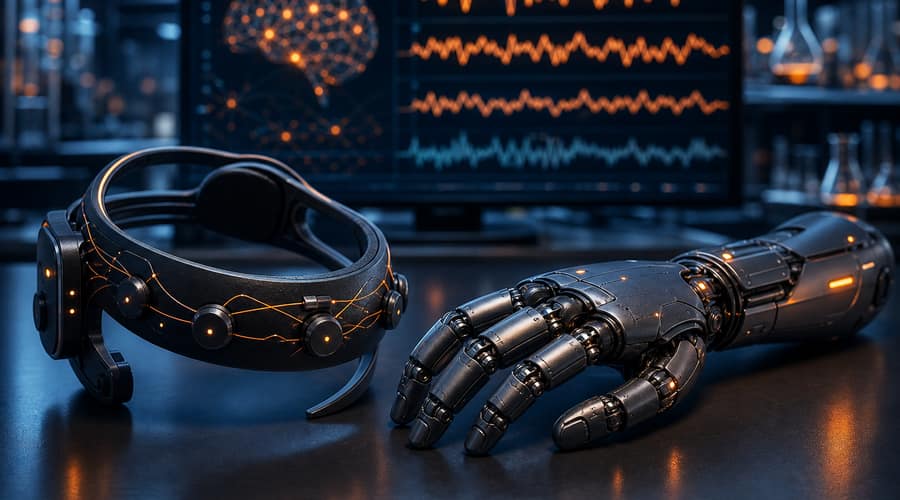
BrainCo doesn't cut into skulls. That's the whole pitch. While Elon Musk's Neuralink implants a coin sized chip beneath the skin, BrainCo builds gloves, wristbands and headsets that read electrical signals from outside the body. According to CNBC, the company just closed a 2 billion yuan funding round, about $280 million, co-led by IDG Capital and Walden International, the venture firm founded by current Intel CEO Lip-Bu Tan.
You don't raise that kind of money on a novelty. BrainCo's bionic hands read residual nerve and muscle signals in a wearer's forearm and translate them into finger movements, and the US FDA has granted listing permission for both its bionic hands and bionic legs. The company also sells a sleep aid that uses low intensity electrical pulses to help users fall asleep faster, and in January it rolled out FocusJoy, a medical grade attention and ADHD intervention device. None of this requires a surgeon.
That's the bet. Founded in 2015 out of Harvard Innovation Labs, BrainCo is now one of what local media calls Hangzhou's "six little dragons," the city's crop of hard tech startups that includes DeepSeek. Its engineers built a dry electrode sensor: no gel, no scalp prep. An AI algorithm does the rest, decoding the noisy signals a skull inevitably muddies. Reading a brain from outside is harder than reading one from an implant sitting directly on neural tissue. Harder, but cheaper. BrainCo's answer is to accept the noisier signal and let software do more of the work.
Neuralink Bets the Other Way
Neuralink took the opposite bet. Musk's company has implanted its N1 device in 12 patients across the US, Canada, the UK and the UAE, letting people with ALS or quadriplegia move a cursor or control a robotic arm with thought alone. It's genuinely remarkable technology. It's also expensive, invasive and slow to scale: each implant needs a craniotomy and a robotic surgical system - and a patient willing to accept the risk that comes with real surgery. Neuralink closed a $650 million round last June at a $9 billion valuation, and secondary market trades this year have implied figures as high as $40 billion, though that number is unconfirmed. Total funding since 2016 runs around $1.3 billion, almost entirely from venture capital and Musk himself.
Here's the real divide, and it's not about electrodes. It's about who's paying. Neuralink is a Silicon Valley story: a billionaire founder with marquee VCs behind him. The valuation moves on hype as much as trial data. BrainCo's money comes from a mix of private capital and an industrial policy machine. Seven Chinese ministries jointly issued an implementation plan for the BCI sector, targeting breakthroughs in electrodes, chips and integrated BCI products that meet advanced international standards by 2027. By 2030, Beijing wants two to three globally competitive BCI companies built inside its borders. That's not a moonshot pitch deck. That's a five year plan with a scoreboard.
Frankly, the non-invasive path was always going to reach patients faster. A wearable doesn't need an operating room, a neurosurgeon or years of safety trials before it touches a human skull. BrainCo can sell a sleep aid at a consumer price point today while Neuralink is still measuring its rollout in single digit patient counts. That's not a knock on Neuralink's science. It's a difference in what each company can actually ship this year.
What Comes Next
BrainCo isn't stopping at fundraising. Sources told Yicai Global and TechNode the company has confidentially filed for a Hong Kong IPO, working with China International Capital Corp and UBS Group on a listing that could raise several hundred million dollars, which would make it the largest brain chip developer funding event outside the US. If that listing closes, BrainCo becomes a test case for whether public markets will price non-invasive BCI as seriously as investors have priced Neuralink's implants.
The chip war has a rhyme now playing out in neurotech. Washington leans on export controls and venture capital. Beijing leans on five year plans and state-guided funding rounds. Both are racing toward the same finish line, a device that reads your mind reliably enough to sell to millions of people, not just trial patients. Whoever gets there first won't just win a product category. They'll set the standard everyone else has to build around.
Also read: FuriosaAI Brings Its Nvidia Challenger Chip to a Lisbon Data Center • US IPO proceeds hit $115.6 billion in the first half of 2026 and the market is about to broaden • Elon Musk Orders Tesla Staff Off Claude Despite Admitting Grok Is Worse