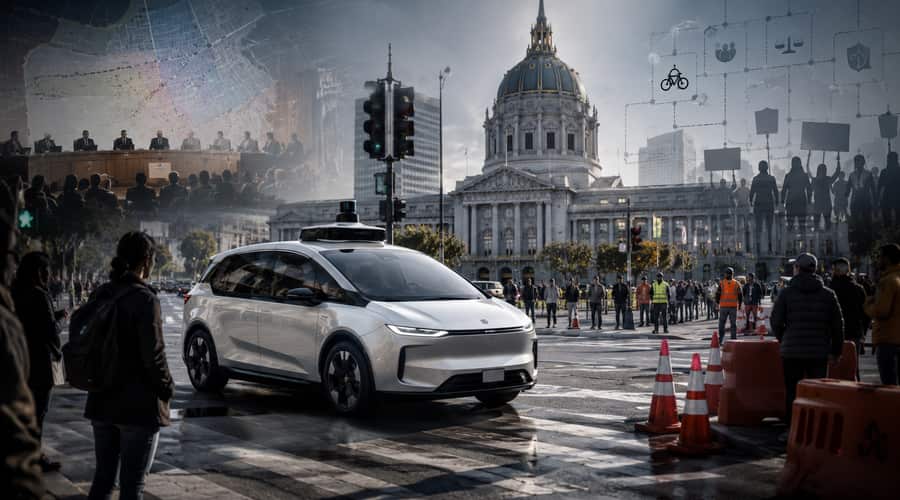
Robotaxis are moving from novelty to infrastructure, and that is where the fight begins. The harder part may not be the driving software, but winning permission to operate at scale.
The robotaxi industry wanted 2026 to look like the year autonomous rides finally became normal. Instead, the cars are arriving in more cities at the same time as city councils, labor groups, emergency responders and residents are asking a sharper question: who is actually in charge when a driverless vehicle gets it wrong?
That question is no longer theoretical. Waymo has expanded its service footprint, Tesla is still pushing the robotaxi story as a core part of its valuation, and Amazon-owned Zoox is trying to move from testing into paid rides. But the rollout is now being shaped by events that do not fit neatly into a pitch deck. Cars have stopped in awkward places. They have entered flooded streets. They have drawn complaints around schools, ambulances and local traffic rules. Each incident may be small in isolation, but together they are turning autonomous vehicles into a political issue.
As the Wall Street Journal recently reported, the backlash is spreading just as companies including Waymo, Tesla and Zoox are trying to launch AI-powered rides in more U.S. cities. That timing matters. A technology can look inevitable when it is discussed by investors. It looks very different when a neighborhood sees empty vehicles queue up, block a street or require public workers to figure out how to respond.
Waymo remains the company most exposed to this tension because it has the largest visible robotaxi operation. In May, the Alphabet-owned company paused freeway rides in several cities while it worked on how its vehicles handled construction zones and flooded roads. The Los Angeles Times reported that the pause followed a recall covering about 3,800 autonomous taxis tied to software that could allow vehicles to enter flooded lanes.
For a normal ride-hail company, a service pause is an operations issue. For a robotaxi company, it becomes a trust issue. Freeways are important because they make airport trips and cross-city rides more useful. Flood response is important because cities do not operate under laboratory conditions. Construction, weather, unclear markings and impatient human drivers are not edge cases. They are the daily texture of urban transportation.
That is why the political response is expanding beyond one city. Philadelphia officials held a public hearing this month on Waymo, with labor leaders and local advocates raising concerns about safety, jobs and accountability. In Austin, officials pressed for answers after a Waymo vehicle briefly blocked an ambulance responding to an emergency. New York let a small Waymo pilot expire at the end of March, sending a clear signal that large markets can choose caution even when the technology is advancing elsewhere.
The industry response is that autonomous vehicles can be safer than human drivers, and that argument should not be dismissed. Human driving is dangerous, distracted and often reckless. Waymo says peer-reviewed research shows its vehicles are involved in far fewer injury-causing crashes than comparable human drivers on the same streets. Tesla argues that its Full Self-Driving system improves safety as miles accumulate. The promise is real. But public acceptance is not built on aggregate statistics alone.
Labor sees automation arriving at street level
The backlash is not only about traffic safety. It is also about work. Ride-hail drivers, taxi operators, delivery workers and unions see robotaxis as one of the clearest examples of AI moving from software into livelihoods. When a city allows driverless taxis to operate commercially, it is not just approving a transportation service. It is opening the door to replacing paid local drivers with vehicles owned by some of the most valuable companies in the world.
That is why labor groups have been quick to organize. The Teamsters in California called for stronger action after a Waymo vehicle struck a child near a Santa Monica school earlier this year, an incident now under federal review. In Philadelphia, opponents argued that transportation revenue could shift away from local workers and toward large technology companies headquartered somewhere else. These arguments will not disappear because the cars improve. If anything, better robotaxis make the labor question more urgent.
This is where entrepreneurs should pay attention. The robotaxi fight shows that technical progress and market permission are not the same thing. A company can raise enormous sums, hire world-class engineers and still be slowed by a city council hearing, a state transportation rule or a viral video that changes the mood overnight. For founders building in AI, robotics or infrastructure, that is a useful lesson. Deployment is part of the product.
Autonomous vehicle companies appear to understand this. Waymo has been building government-relations capacity and pressing for clearer rules. The industry wants consistent standards, while cities want local authority over streets, emergency response and enforcement. That tension is likely to intensify if federal preemption becomes a bigger part of the debate. Companies prefer a single national framework. Local officials do not want to discover after the fact that they have little power over vehicles operating on their own roads.
The next stage of the robotaxi market will be won in two places at once. One is the engineering stack, where vehicles must handle strange, messy and rare situations without drama. The other is the public process, where companies must prove they can answer basic civic questions before they ask for scale. The winners will not simply be the operators with the best sensors or the deepest balance sheets. They will be the ones that make cities feel like partners rather than test sites.
Also read: AI agents are starting to do real research math • Pump.fun brings coin communities onto its own platform • Wall Street is already building funds for the SpaceX IPO