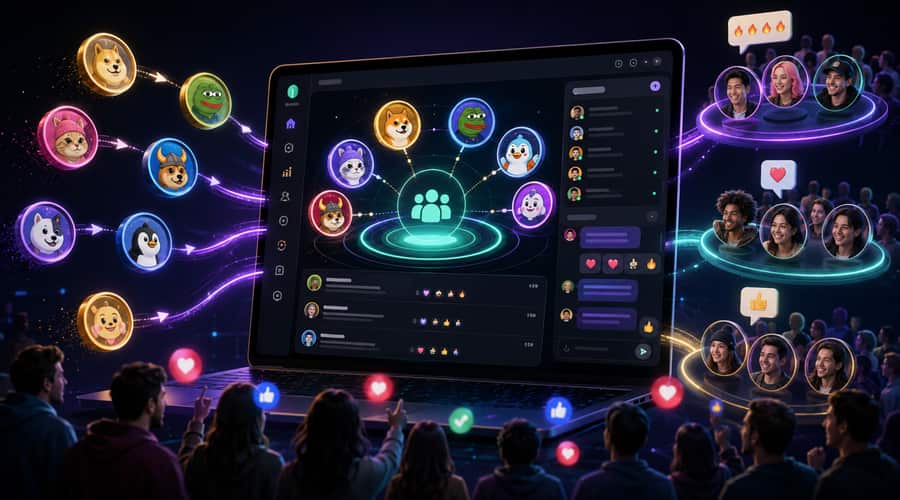
Pump.fun is no longer treating community as something that happens somewhere else. Its new Coin Communities feature is a clear move to own the social layer around Solana meme coin launches.
Pump.fun built its name by making token creation almost absurdly simple. Now it is trying to make the conversation around those tokens just as native to the platform, after X shut down the Communities feature many crypto traders and creators had been using as an informal coordination layer.
The new Coin Communities product gives each token its own in-platform social space where holders and followers can post, reply, like messages and follow other users. That may sound like a small product update, but for a platform built on attention, timing and community pressure, it is more than a chat box. It is infrastructure.
For meme coins, the launch is only the first moment. The real test comes after the mint, when creators need to keep traders engaged, explain the narrative, defend the price action and pull new buyers into the story. Until now, much of that work happened on X, Telegram and Discord. Pump.fun is now asking users to do more of it where the trading actually happens.
According to TechCrunch, X moved to close Communities after the feature struggled with low usage and heavy spam, with the shutdown taking effect at the end of May. For most consumer internet companies, that would be an ordinary product cleanup. For Pump.fun, it removed a useful social rail at exactly the point where token communities need somewhere visible to gather.
The important part is not only that Pump.fun added a community feature. It is that every token can now have a social surface attached to it. Coin Communities documentation says the product is organized around communities, messages, users and wallets, with each community tied to an on-chain token address. In plain English, the token page is being turned into a place to talk, not just a place to trade.
That matters because Pump.fun has always monetized speed. A creator can launch a coin quickly, traders can pile in quickly and the market can decide quickly whether the idea has legs. But speed creates its own problem. If attention leaves the page and moves to X or Telegram, Pump.fun loses part of the user journey after the first trade.
Owning that layer gives the company more control over retention. It can surface the most active communities, track which tokens have real discussion behind them and potentially turn social behavior into another discovery signal. In a market where many tokens look identical after five minutes, the quality and velocity of conversation may become a ranking system of its own.
It also reduces dependence on platforms that can change rules overnight. Crypto has learned this lesson repeatedly. Projects build audiences on Web2 networks, then discover that account suspensions, API changes or product shutdowns can break their funnel. Pump.fun has already seen how fragile that dependency can be, with meme coin accounts facing X suspensions in the past. Bringing communities inside the product is a practical response to that risk.
The hard part is habit
The challenge is that crypto users are already deeply embedded in X and Telegram. X is where public signaling happens. Telegram is where smaller groups coordinate quickly. Discord still matters for longer-running projects. Pump.fun can add community features, but it cannot assume users will abandon their existing attention loops just because a cleaner native option exists.
This is where the product has to be useful in a very specific way. If Coin Communities only copies the basic mechanics of a social feed, it will struggle. If it connects directly to trading context, wallet identity, token history and live market activity, it has a better reason to exist. The advantage Pump.fun has is proximity. It knows what coin a user is looking at, what activity is happening around it and which communities are gaining traction at the moment traders are making decisions.
There is also a moderation question. Meme coin culture rewards edge, speed and provocation, which can drive engagement but also create reputational and regulatory problems. Pump.fun has already faced scrutiny for the behavior that can form around speculative tokens and livestreams. A native community product gives it more visibility, but also more responsibility. Once the conversation happens on its own rails, the company cannot as easily treat it as someone else’s problem.
The monetization path is obvious even if Pump.fun does not spell it out. Active communities can support promoted placement, creator tools, analytics, premium discovery products or incentives tied to token performance. A richer social graph also helps the platform understand which users launch, trade, promote and sustain attention. That is valuable data in a market where attention is the commodity.
There is a larger signal here for crypto founders. The next phase of consumer crypto will not be built only by making transactions faster or fees cheaper. It will be built by owning the full experience around the asset, from creation to distribution to conversation. Pump.fun is trying to make the token page feel less like a terminal and more like a living market square.
Whether Coin Communities becomes a durable social layer or just another short-lived feature will depend on behavior. If traders check it before buying, creators post there first and active communities gain visibility because of it, Pump.fun becomes harder to replace. If users keep treating X and Telegram as the real home of the trade, the feature becomes an accessory. That is the test to watch now.
Also read: BNB rally shows how Binance still moves crypto markets • The FBI seized $8 billion in crypto from a global scam network • Hyperliquid's HYPE sets a record above $67 as ICE's CEO calls it bigger than Nasdaq and CFTC opens the door to regulated perps