SK Hynix just pulled off the biggest foreign listing in Wall Street history, and its chairman says the chip shortage behind that pop won't ease before 2030.
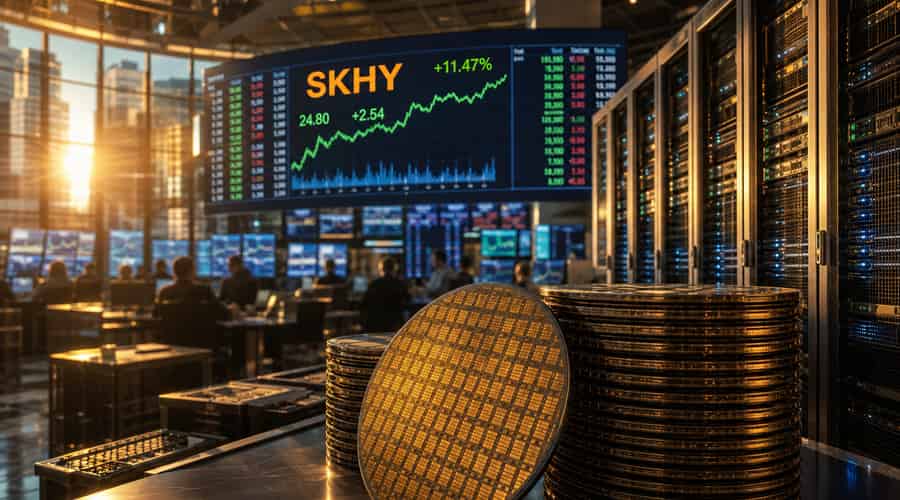
SK Hynix's American depositary receipts jumped 13% in their first day of Nasdaq trading, closing at $168.01 after pricing at $149 a share. The offering raised $26.5 billion, the largest debut by a foreign company on a US exchange on record. Investors weren't shy about it. Order books came in seven times oversubscribed, according to Bloomberg. The shares trade under the ticker SKHYV for now, and switch to SKHY next week.
Chey Tae-won, chairman of parent SK Group, told CNBC the demand behind the memory crunch is enormous. He pointed to AI agents and robots as the source of an appetite that shows no sign of slowing, arguing that both need far more memory than a phone or a laptop ever did. He's not hedging on the timeline either. Chey and SK Hynix chief executive Kwak Noh-Jung have both said the supply demand gap in memory chips will likely persist beyond 2030, Bloomberg reported Friday. That estimate keeps stretching further out the more the company revisits it.
That's a long runway for a shortage that's already rewritten the DRAM market once this year.
SK Hynix isn't the only one benefiting. Micron has already sold out every high bandwidth memory chip it can produce in 2026, with the entire output locked into contracts. Morgan Stanley analyst Joseph Moore more than doubled his price target on Micron to $1,050 from $520, and his own DRAM pricing model shows prices surging 40% in the May quarter and another 15% in August. Samsung, meanwhile, is already shipping samples of its next generation HBM4E chips, adding real competitive pressure just as SK Hynix tries to lock in its lead.
Not everyone is convinced the party lasts. Morgan Stanley has separately warned that momentum across chip stocks is fading and has started steering clients toward hyperscalers instead, a sign that even the bulls are getting choosier about where the AI trade still has room to run. Goldman Sachs is the sharpest outlier, holding a target near $400 on Micron and arguing that today's fat margins are a peak, not a floor. JPMorgan lands somewhere in between, telling clients the recent pullback is a buying opportunity because supply won't meaningfully expand before 2028.
Where the next fabs actually get built
Chey used the Nasdaq bell to make a bigger point than the stock price. Asked whether SK Hynix would expand its chip making footprint in the US, he told CNBC yes, with conditions. His team is studying whether the US can actually support a memory fab. Enough power, clean water, land, workforce, and a functioning supply chain around it. That's not a small ask. Building a fab isn't like opening a warehouse.
For now, the US buildout stays modest next to what's happening at home. SK Hynix already runs a $4 billion advanced packaging plant in Indiana, handling some of the HBM that ships to Nvidia and other customers. But the real money, roughly $390 billion, is going into a fabrication cluster in Yongin, South Korea. The company disclosed plans in June to double its wafer capacity over the next several years, and even that only buys time. Wafers take four to five years to come online once ground breaks.
Wall Street's math on this listing was simple enough. A company selling out its most valuable product for years to come, priced into a US listing at a discount steep enough to draw seven times the demand, was always going to pop. The harder question, the one Goldman is asking and Morgan Stanley is starting to hedge on, is whether 2030 is a real supply wall or just the latest estimate that keeps sliding further away.
Also read: Apple Sues OpenAI Over Claims It Stole Trade Secrets For Hardware • Mike Novogratz Turned a Distressed Bitcoin Mine Into an AI Power Giant • US grants the UAE license free access to advanced AI chips after reclassifying its export status