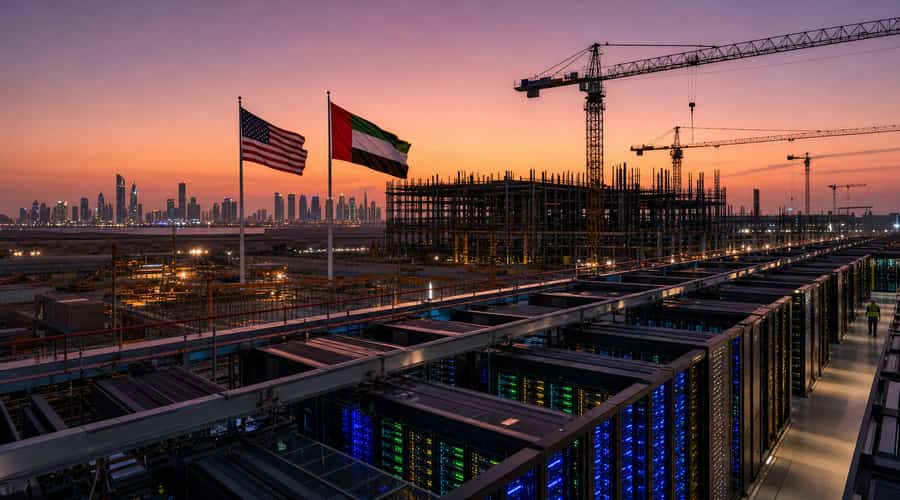
The Commerce Department just gave the UAE a cleaner path to advanced AI chips, and that changes the pace of Abu Dhabi's compute buildout.
On July 10, the Bureau of Industry and Security announced that it is removing the United Arab Emirates from Export Administration Regulations Country Groups D:3 and D:4 and reclassifying the country as Group A:5. If you've never had to parse an export control chart, here is the useful part: the UAE now sits closer to Washington's trusted security partners for advanced computing hardware. That is the point.
The old status mattered. D:3 and D:4 are not cosmetic labels, they cover missile technology and chemical and biological weapons concerns. Under that treatment, advanced AI chips and servers could still reach approved UAE buyers, but they moved through case by case licensing. Commerce's July 10 announcement says the new A:5 status clears license exception treatment for eligible shipments, while keeping diversion controls in place.
This is a real change. Until this week, the UAE and Saudi Arabia were the only two countries approved to receive Nvidia's top tier GB300 Blackwell chips that were not classified as Tier 1 destinations, according to reporting on the Bureau of Industry and Security's rules. Every shipment required its own review. When the UAE's ambassador to Washington said in May that the country had received its first batch of advanced Nvidia chips, AGBI reported that the shipment needed high level government intervention, took months to win approval, and then another half year to arrive. That was not how a strategic partner was supposed to operate.
The bottleneck was the policy
Commerce tied the reclassification to two things. First, the UAE's status as a Major Defense Partner, a designation President Biden granted in September 2024, only the second time Washington had used that label after India. Second, the UAE's support for Operation Epic Fury, the joint US-Israeli strike campaign against Iranian military targets that began on February 28, 2026. The department also pointed to the US-UAE Artificial Intelligence Cooperation framework signed in May 2025. That is the hinge. Chip access is now being treated as part of a wider security bargain, not as a one off favor for Abu Dhabi.
The practical beneficiary is G42, the Abu Dhabi AI firm led by Peng Xiao. Commerce had already authorized G42 last November to import chips equivalent to 35,000 Nvidia Blackwell GB300 processors, alongside Saudi Arabia's Humain. Xiao called that approval a shift from planning to execution. Execution has been harder. The new A:5 status removes the licensing bottleneck that slowed everything after the approval, from Microsoft's internal chip transfers to the direct G42 sale.
G42 is building Stargate UAE, a planned 1 gigawatt AI compute cluster backed by OpenAI, Oracle, Cisco, Nvidia and SoftBank. The Wall Street Journal has reported that the first 200 megawatts are expected by the end of 2026, with G42 funding construction and OpenAI and Oracle operating the data center. The Guardian reported last year that the wider UAE-US AI campus is planned at 5 gigawatts across a 10-square-mile site in Abu Dhabi. You don't need to admire the scale to see the practical issue: a 200 megawatt first phase cannot be built on paperwork that moves one shipment at a time. The queue mattered.
China is the shadow over this deal
The China contrast is blunt. While Beijing has spent the past year watching export rules tighten and loosen unpredictably on Nvidia's China-specific chips, Abu Dhabi just moved into a friendlier regulatory tier. That is not an accident of bureaucracy. Washington is saying where it wants the AI supply chain to run, and it is not through Shenzhen.
There is still a reason Commerce keeps talking about diversion controls. G42's China links have worried US officials before, and Microsoft's $1.5 billion investment in the company in 2024 came with public assurances that G42 would move away from Chinese technology. Frankly, that is the trade. The UAE gets faster access to the chips it wants, and Washington gets a Gulf partner more tightly tied to US hardware, US cloud operators and US security rules.
None of this guarantees Stargate UAE hits its gigawatt target on schedule. The chips still have to be made, shipped, installed, powered and cooled. The UAE's promises on diversion controls and matching investment in US AI infrastructure still have to survive scrutiny. But the largest friction point, the license by license approval process that AGBI reported was frustrating officials on both sides, is now largely gone. The chips no longer have to wait in a queue built for a country Washington says it no longer treats as that kind of risk.
Also read: Morgan Stanley Warns Chip Stocks Look Overbought Just as SK Hynix Debuts | Raytheon and Rheinmetall Just Won Britain's Biggest AI Army Training Deal | OpenAI and Google Sold AI Access to Blacklisted Chinese Firms via Singapore