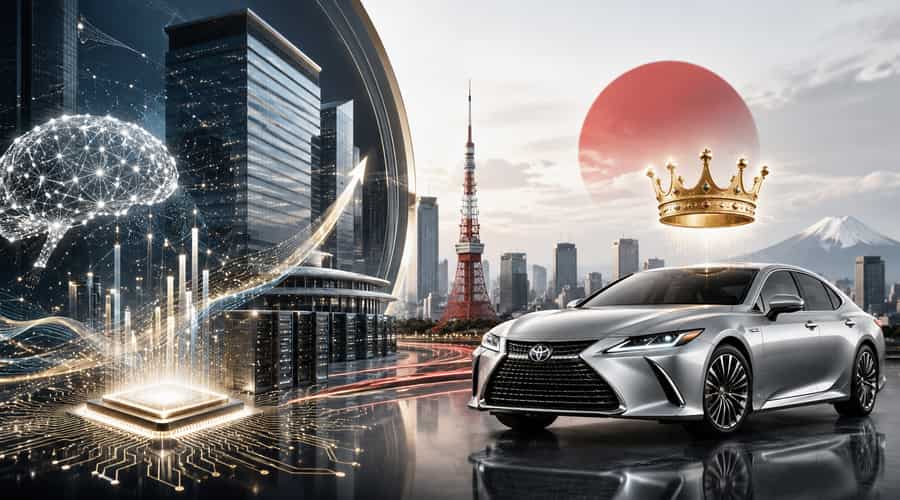
SoftBank's run at Toyota's market value shows how quickly AI infrastructure has become a national-scale investment story. The important question is whether markets are pricing durable power or another Masayoshi Son cycle at full speed.
SoftBank is no longer being valued like a telecom-linked investment house with a volatile history. It is being valued as one of the clearest ways to buy into the physical buildout of artificial intelligence, from OpenAI to chips, data centers, power and the financing machinery needed to hold it all together.
That is why the comparison with Toyota matters. Toyota is still the operating giant, with a global manufacturing base, enormous revenue and a brand built over decades. But the market has started to treat SoftBank as something more elastic: a leveraged claim on the next layer of AI infrastructure. In late May, market data compiled by Simply Wall St showed SoftBank Group briefly ahead of Toyota on Japanese large-cap rankings, with a market value of about 41.4 trillion yen against Toyota's 39.2 trillion yen. Other live market-cap trackers have since shown Toyota back in front, which is exactly the point. The gap has become small enough to turn Japan's corporate hierarchy into a daily market argument.
This is not happening because SoftBank suddenly looks more like Toyota. It is happening because investors are changing what they reward. Toyota sells cars, manages factories, works through suppliers and lives with the familiar pressures of tariffs, currencies, batteries and consumer demand. SoftBank sells a story about ownership of the future, and for now the future has a very specific shape: compute.
The center of SoftBank's case is OpenAI. SoftBank has put about $34.6 billion into the ChatGPT maker, and recent earnings showed major valuation gains tied to that position. Associated Press reported in May that SoftBank's annual profit rose nearly fivefold, helped by AI investments, with OpenAI recording gains of about $45 billion for the group. Those are accounting gains, not the same thing as cash from selling products, but public markets have been willing to treat them as evidence that Son has found his next Alibaba-scale asset.
Then there is Stargate, the AI infrastructure venture announced with OpenAI, Oracle and MGX. The plan calls for up to $500 billion of investment over four years in the United States, beginning with an initial $100 billion commitment. The scale is almost difficult to process, but it helps explain the re-rating. If generative AI keeps growing, the scarce assets are not only models. They are land, chips, power, cooling, networking, financing and customers with enough demand to fill huge data centers.
SoftBank is trying to sit across that chain. It owns a large stake in Arm, has backed OpenAI, has been tied to Stargate and has pushed deeper into the hardware and power needs around AI. The company has also moved aggressively to fund those bets, including bond issuance and asset sales. That is classic Son. He does not make small adjustments when he believes a platform shift has arrived.
The risk is just as obvious. The more SoftBank's value depends on private AI marks, the harder it becomes for investors to separate operating strength from market enthusiasm. OpenAI is a remarkable company, but it is also expensive to run, faces competition from Google, Anthropic, Meta and others, and needs enormous infrastructure spending before the final economics of the market are settled. A higher valuation today does not remove those questions. It simply raises the cost of being wrong.
Toyota Still Shows The Other Side Of Japan
Toyota remains the cleaner expression of Japan's industrial power. Its fiscal 2026 financial summary showed sales revenue of 51 trillion yen and a forecast for operating income of 3 trillion yen for fiscal 2027. That is not a speculative business. It is a machine that turns procurement, engineering, logistics and consumer trust into cash at global scale.
But markets do not only pay for what exists. They pay for what can expand. That is where Toyota has faced a more complicated story. Investors still respect the company, but they are also weighing the slower transition to battery electric vehicles, China competition, U.S. tariff uncertainty and the heavy capital demands of the next automotive cycle. Toyota may be more stable than SoftBank, but stability is not always what wins a momentum market.
SoftBank's challenge is the opposite. It has the market's imagination, but imagination comes with debt, timing risk and dependence on private-company valuations that can move sharply when sentiment changes. The WeWork collapse is still part of the institutional memory around Son because it showed how quickly vision can turn into impairment when governance, valuation and execution drift apart.
That history is why this moment feels so important. SoftBank's rise toward Toyota is not only a stock-market curiosity. It is a signal that capital is being reallocated away from the old symbols of industrial Japan and toward companies seen as gatekeepers of AI capacity. The factory floor is not disappearing, but the data center is becoming just as central to how investors imagine national competitiveness.
For readers, the practical takeaway is simple. The AI trade is moving beyond software winners and chipmakers. It is now lifting companies that can finance, assemble or control the infrastructure beneath the models. SoftBank may yet prove that Son's biggest bets were early rather than reckless. But the next test will be harder than passing Toyota on a market screen. It will be turning AI infrastructure ambition into cash flows strong enough to justify the price investors are already willing to pay.
Also read: SK hynix shows why AI investors are moving into memory • Jiducloud becomes a unicorn as China’s AI money moves into 3D tools • MiniMax M3 gives Chinese AI labs a new frontier coding test