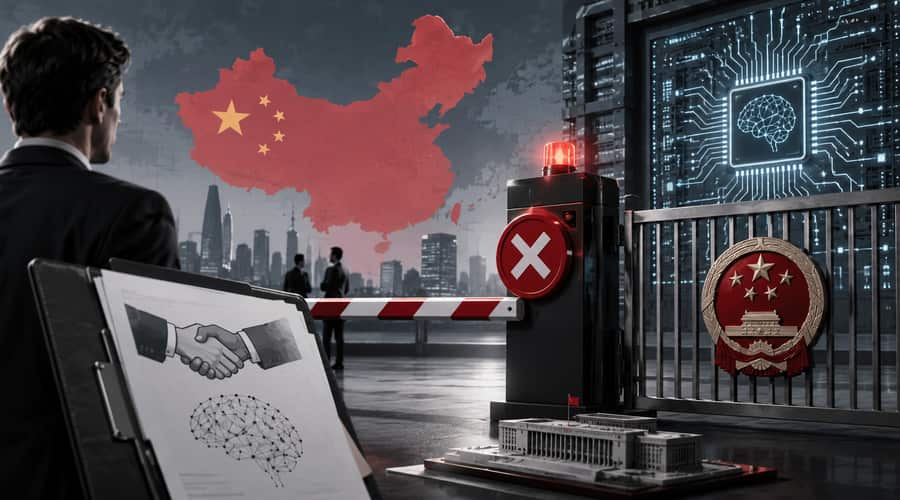
China is making it harder for foreign buyers to reach Chinese technology, even when the company involved has moved offshore. The message for AI founders and investors is simple: location alone will not remove Beijing from the deal table.
China has turned the Meta and Manus fight into something bigger than one blocked acquisition. On June 1, Beijing issued new rules that widen the government's ability to scrutinise overseas deals involving Chinese investors, technology, data and national security, a month after regulators ordered Meta to unwind its purchase of the AI startup Manus.
That matters because Manus was not a routine software target. It became one of the most closely watched AI agent companies with Chinese roots, after pitching a product that could handle tasks such as research, coding and presentation work with less step-by-step prompting than a standard chatbot. Meta wanted that capability inside its own AI push. Beijing saw something else: Chinese-origin technology leaving its orbit at the exact moment AI has become a strategic contest.
According to a report from Reuters, the new rules tighten control over overseas investments and cross-border transfers tied to goods, technologies, services and data that China restricts from export. The regulations also give Beijing broader authority to act when national security is involved, and they include language aimed at preventing sensitive technology from being moved through personnel, overseas work arrangements, technical guidance or training.
The Manus case showed how complicated AI ownership has become. The company was Chinese-founded and associated with Beijing Butterfly Effect Technology, but it had shifted its corporate center toward Singapore. That kind of relocation has become a familiar strategy for startups caught between US restrictions on Chinese technology and Chinese controls on outbound technology transfer.
For investors, the old question was often where the company was incorporated. The new question is more difficult. Where was the core technology built? Where are the engineers from? Who trained the model, controlled the data, wrote the agent framework and moved the intellectual property? If the answers point back to China, Beijing is now making clear that it may still claim a say.
Meta's acquisition was reported at around $2 billion, though some accounts placed the value higher. The number is less important than the precedent. A major US technology company tried to buy an AI asset with Chinese origins, the target had moved offshore, and Chinese regulators still moved to stop the transaction. That will not be lost on venture firms, private equity buyers or startup founders looking for exits.
This is not only about Meta. It affects any cross-border deal where the buyer wants talent, model architecture, agent systems, training methods or data pipelines connected to Chinese AI work. A company can look international on paper and still carry enough Chinese technological DNA to trigger a review.
Capital now has a compliance problem
The practical effect is that Chinese AI deals will take longer, cost more and carry greater completion risk. Investors will need to treat regulatory clearance as a core part of the deal, not an item left for lawyers near the end. That changes valuation, timing and negotiating power.
For founders, the tradeoff is sharper. Moving a startup to Singapore, Dubai or Silicon Valley may help access foreign capital and customers, but it may not be enough if the technology was developed in China or by a China-based team. The new rules make personnel movement part of the control system too, which means the movement of engineers can be treated almost like the movement of code.
That is a big shift. AI capability does not sit neatly inside a patent filing or a server. It lives in models, data, workflow design and the experience of the people who built the system. By targeting technical guidance, overseas work and training, China is trying to close the gaps through which know-how can travel without a formal asset sale.
The rules also add a retaliatory edge. Beijing can restrict foreign entities from trading with China if their home countries place limits on Chinese investment. That makes the framework not just a domestic technology control, but a tool in a wider contest over market access. US policy has already made Chinese capital and technology a national security issue. China is now applying the same logic in reverse.
This is where structural decoupling becomes less theoretical. Western capital still wants exposure to Chinese AI talent, and Chinese founders still want global markets. But every new restriction makes the middle ground narrower. The result may be fewer clean acquisitions, more minority investments, more licensing structures and more deals that never reach announcement because the risk is visible too early.
For the AI market, the immediate lesson is not that China is closing itself off completely. It is that Beijing wants control over which technologies leave, who benefits and under what conditions. That is a very different environment from the open exit market many founders and investors built their plans around.
The next thing to watch is whether pending AI deals with Chinese-origin teams are quietly restructured or delayed. If they are, the Manus case will look less like an exception and more like the first public signal of a new rulebook for global AI capital.
Also read: ChatGPT is testing a small fix for long conversation threads • Cognitive debt is becoming AI's hidden business cost • LG Electronics has become the market’s physical AI test case