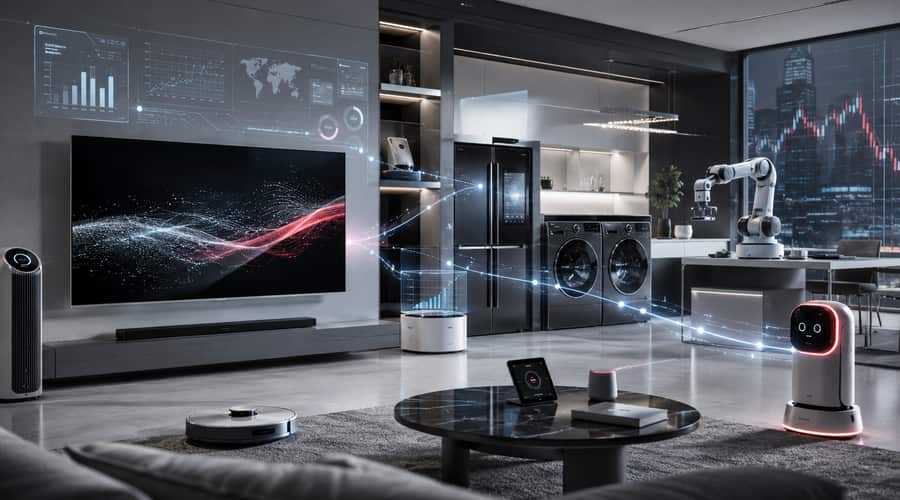
LG Electronics is no longer being valued like a slow appliance maker. Investors are treating it as a serious candidate for the next layer of AI hardware.
LG Electronics shares have moved with the kind of force usually reserved for chipmakers at the center of an AI supply squeeze. The South Korean company has more than tripled this year, with the latest jump tied to investor excitement around robotics, physical AI and speculation about deeper work with Nvidia.
That is a remarkable change in market attitude. For years, LG was easy to understand as a maker of televisions, refrigerators, washing machines and premium home appliances. Useful businesses, yes, but not the sort of company investors normally chase when they want exposure to the future of artificial intelligence. Now the market is asking a different question: if AI moves from screens and servers into factories, homes, cars and service robots, who already knows how to build the physical layer?
According to Reuters, LG Electronics shares rose sharply on Monday, June 1, after South Korean media reports fueled expectations of expanded cooperation with Nvidia in physical AI and robotics. That matters because Nvidia has spent the past several years proving that the most profitable part of an AI boom is often the infrastructure beneath the application. If physical AI becomes the next serious cycle, investors are looking for companies that can turn models into machines.
The idea behind physical AI is simple, but the execution is not. A chatbot can make mistakes inside a browser. A robot operating in a kitchen, warehouse or hospital has to understand space, movement, safety and timing. It needs sensors, actuators, onboard computing, software, supply chains, industrial design and support systems that survive real use.
That is where LG has a more credible story than many speculative AI names. The company already operates at industrial scale. It builds consumer hardware, vehicle components, HVAC systems and factory equipment. It has manufacturing discipline, procurement relationships and a brand that can put connected devices into homes without needing to introduce itself.
The robotics story is also not only theoretical. LG secured a majority stake in Bear Robotics in January 2025, adding a Silicon Valley company focused on autonomous service robots to its portfolio. Bear Robotics is best known for robots used in restaurants and hospitality settings, which may sound narrow until you think about the operational problem. A robot that can navigate crowded indoor spaces, avoid people, move goods and work for long periods is a practical foundation for broader commercial automation.
LG has also been pushing its CLOi robot line, including home and service robot concepts shown at major technology events. The market is not valuing those products only for current revenue. It is trying to decide whether LG owns enough of the pieces required to make robotics a real business when AI models become better at controlling movement in the physical world.
The rally still needs proof
This is where investors need to be careful. A 300% move can make a reasonable strategic shift look like a guaranteed transformation. It is not. Hardware cycles are slower than software cycles. Margins can be thinner. Production mistakes are expensive. A robot that works well in a controlled demo may struggle when deployed across thousands of messy real-world locations.
LG’s financial base gives the story some support. Chosunbiz reported that LG Electronics posted first-quarter revenue of about 23.7 trillion won and operating profit of roughly 1.67 trillion won, its best first-quarter performance on record. Seoul Economic Daily also reported earlier this year that LG planned more than 4 trillion won in capital expenditure for 2026, with AI and robotics investment rising sharply.
Still, the valuation question is not whether LG can talk about robotics. Many companies can. The harder question is whether robotics can become large enough, profitable enough and differentiated enough to change the company’s earnings power. Investors have already seen what happens when AI enthusiasm moves faster than commercial adoption. The next stage will require orders, deployments and repeatable margins, not just partnership rumors.
The Nvidia angle explains why the market is paying attention. Nvidia’s AI ecosystem has already lifted memory companies such as SK Hynix and Samsung because high-bandwidth memory became essential to training and running large models. Physical AI could widen that map. Instead of only rewarding GPU and memory suppliers, it could pull in companies that provide cooling, motors, sensors, robotics platforms, factory systems and edge devices.
That is the real signal in LG’s rally. Investors are hunting for the next infrastructure layer beneath large language models. They are moving from the question of who builds the model to who builds the machine that lets the model do something useful outside a data center.
For entrepreneurs, the takeaway is not simply to buy into the physical AI theme. It is to study what the market is rewarding. Legacy hardware manufacturers are suddenly interesting when they have three things: real manufacturing capacity, a credible AI partner network and a product path into commercial automation. Without those, physical AI becomes just another label attached to an old business.
LG now has to prove it belongs in the first group. The next few quarters should show whether the company can turn investor enthusiasm into customer adoption across robotics, smart factories, vehicle systems and AI infrastructure. If it can, the market may keep treating LG as more than an appliance company. If it cannot, this rally will become a useful reminder that even the strongest AI themes eventually have to pass through revenue, margins and execution.
Also read: SpaceX is about to test the limits of passive investing • China’s index reshuffle is about to move $48 billion • TSMC investors in Taiwan are catching up with Wall Street on AI