
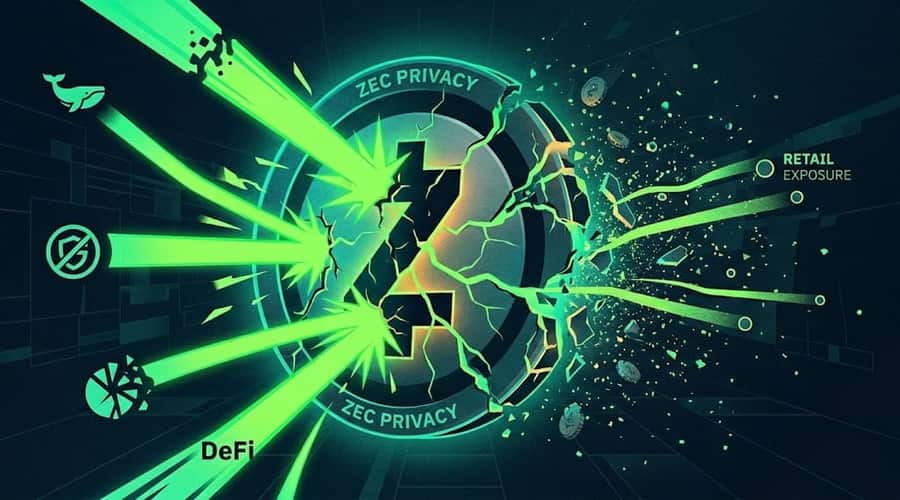
Zcash is back in the market conversation, but the rally is carrying more risk than the price chart admits. The recent Orchard emergency upgrade shows why investors should separate privacy demand from protocol and liquidity risk.
Zcash has had the kind of run that pulls old crypto arguments back into the room. After trading near cycle lows last year, ZEC surged toward the $600 mark in 2026, reviving the case that privacy coins still have a place in a market increasingly shaped by surveillance, sanctions screening, and exchange compliance. That is the bullish version. The more practical version is less comfortable: a sharp rally can make a thin market look healthier than it really is.
The renewed attention has been helped by several overlapping narratives. Privacy is once again a live issue for crypto users. Zcash developers and aligned groups have been discussing longer-term consensus changes, including hybrid Proof-of-Work and Proof-of-Stake research. Institutional interest has also become part of the story, with privacy assets attracting fresh speculation after years of being treated as regulatory liabilities. None of that is irrelevant. But it does not make ZEC a simple revival trade.
The Rally Is Running Ahead of Utility
The central weakness is that Zcash still sits outside most of the practical activity that defines decentralized finance. Ethereum, Solana, and other programmable networks have deep ecosystems of lending markets, decentralized exchanges, stablecoin rails, derivatives, and automated liquidity. Zcash has a different purpose. It was built for private value transfer, not as a broad DeFi settlement layer.
That distinction matters when markets turn. Assets with deep composability can find buyers across multiple use cases. Traders borrow against them, market makers route through them, and developers build applications that keep some baseline demand alive even when sentiment cools. ZEC does not have the same kind of support. Its shielded pools provide privacy, but they are not naturally plugged into the automated market makers and lending protocols that create sticky liquidity across the rest of crypto.
That leaves a narrower buyer base carrying a much larger narrative. In a rising market, this can work beautifully. A limited float, renewed privacy demand, and speculative positioning can send prices upward fast. In a falling market, the same structure can work in reverse. When liquidity is thin, large holders do not need to sell much to move the price, and retail buyers often discover too late that the order book they trusted was not as deep as it looked.
The Orchard Bug Changed the Risk Conversation
The strongest reason to revisit the story now is not the rally itself. It is the emergency response around Zcash's Orchard shielded pool. According to the Zcash Foundation, independent security researcher Taylor Hornby discovered a critical soundness bug in the Orchard Action circuit on May 29, 2026, prompting a temporary soft fork that disabled Orchard actions before the NU6.2 upgrade re-enabled them with a fix.
That correction is important because it narrows the claim. The vulnerability could have allowed invalid state transitions and possible double-spending inside Orchard. The Foundation said it did not allow inflation of the total ZEC supply, which is protected by Zcash's turnstile mechanism. There was also no public indication in the Foundation's disclosure that the bug had been exploited before the fix.
Still, the incident lands at an awkward moment. Investors are being asked to value Zcash as a serious privacy asset while its most important privacy pool required urgent coordination to freeze and repair part of the system. That does not mean Zcash is broken. It does mean the risk profile is more complex than a simple price chart suggests. Advanced cryptography is powerful, but it is also unforgiving. When the market capitalization grows quickly, the tolerance for emergency fixes shrinks just as quickly.
Regulators Are Still Part of the Trade
Zcash also remains exposed to a regulatory problem that no rally can fully solve. Privacy coins have long made exchanges nervous because they make transaction monitoring harder. Some jurisdictions have already pressured platforms to restrict or delist privacy-focused assets, and European compliance rules are keeping that pressure alive. For a token that depends on centralized exchanges for much of its retail access, that is not a small concern.
The irony is that regulation is also part of what makes the privacy narrative attractive again. The more users worry about financial surveillance, frozen stablecoins, and traceable wallets, the more privacy becomes a real demand rather than a fringe talking point. But market demand and exchange access are not the same thing. A coin can have a compelling purpose and still face poor liquidity if the venues most investors use decide the compliance cost is too high.
That is the tension investors need to watch. Zcash may continue to benefit from a stronger privacy narrative, especially if developers keep improving the protocol and credible backers support the ecosystem. But a 10x move does not erase concentration risk, limited DeFi integration, or the fact that its privacy technology just needed an emergency fix. The next phase will depend less on whether traders still like the story and more on whether Zcash can turn renewed attention into durable liquidity, safer infrastructure, and access that survives regulatory scrutiny.