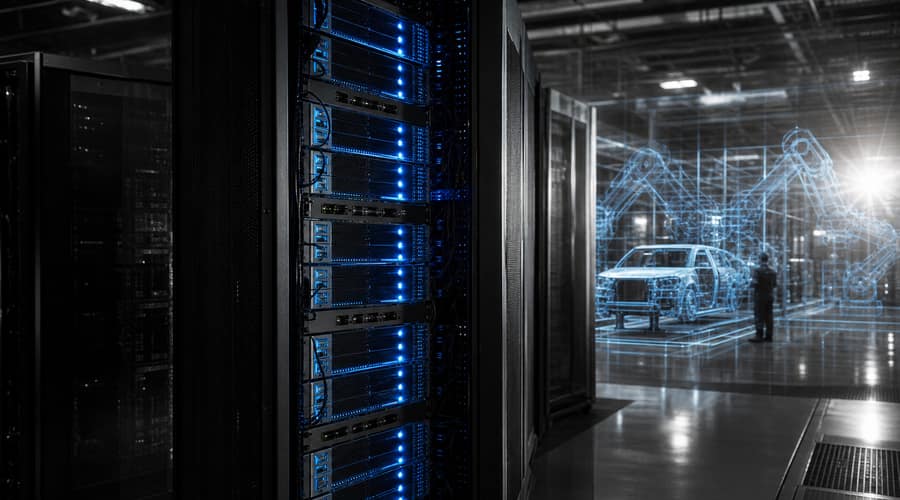
AI's next bottleneck is no longer just chips or models. It is the electricity, water and land required to keep the infrastructure running.
The AI boom is starting to look less like a software cycle and more like an industrial buildout. Data centers are being planned, financed and fought over with the urgency usually reserved for energy projects, because that is what they are becoming: some of the largest new power customers on the grid.
A new United Nations University report has put a sharper number on that pressure. As Business Standard reported this week, the UNU-INWEH study warned that global data centers could consume about 945 terawatt-hours of electricity by 2030, a level described as comparable to the annual residential electricity needs of roughly 1.3 billion people in Sub-Saharan Africa. That comparison is blunt, but it is useful. It turns an abstract infrastructure forecast into something boards, regulators and investors can understand.
The point is not that AI should stop. The point is that AI is becoming physical. Every chatbot response, coding assistant, model training run and enterprise automation product depends on facilities filled with servers, cooling systems, backup power and high-voltage connections. The sector can still feel weightless to users, but the bill is being delivered to utilities, local communities and energy markets.
The UN warning fits with what energy analysts have been saying for more than a year. The International Energy Agency has estimated that data centers accounted for about 1.5% of global electricity consumption in 2024 and that demand could more than double by 2030, with AI-optimized facilities growing much faster than ordinary cloud workloads. In the United States, the Electric Power Research Institute has said data centers could consume up to 17% of national electricity by 2030 under high-growth scenarios.
Those ranges matter because AI infrastructure is not spread evenly across the map. Northern Virginia already carries one of the heaviest data center loads in the world. EPRI has warned that data centers across Virginia could rise from roughly a quarter of the state's electricity use today to well over a third by 2030. Other states including Arizona, Indiana, Iowa, Nebraska, Nevada, Oregon and Wyoming are also becoming part of the same debate as developers chase land, fiber and power availability.
This changes the economics of AI. For the last two years, investors have focused on GPUs, model quality and customer adoption. Those still matter. But the next question is whether companies can actually secure enough power at a price that supports the business model. A model may be impressive, but if inference costs are tied to constrained electricity markets, cheap AI at massive scale becomes harder to promise.
Efficiency will not remove the constraint
Tech companies will argue, fairly, that hardware gets better. Nvidia, AMD, Google and Amazon are all pushing more efficient chips and systems. Cooling technology is improving. Software teams are finding ways to make models smaller, route queries more intelligently and reduce wasted compute. These gains are real and necessary.
But efficiency does not automatically reduce total consumption when demand is expanding this quickly. It can make AI cheaper to use, which often encourages more use. That is good for adoption, but it does not make the infrastructure question disappear. If every finance team, law firm, hospital, call center, developer shop and government agency starts embedding AI into daily work, the aggregate load can keep rising even as each task becomes more efficient.
Water adds another layer. Data centers need cooling, and the tradeoffs are local. A facility that lowers carbon by using certain cooling or energy choices may increase water demand in a region already under stress. A project that brings jobs and tax revenue can still strain the grid connection queue or push utilities into expensive upgrades. That is why the UN report's broader framing matters: carbon is only one part of the environmental cost.
For business leaders, this is not an abstract climate discussion. It is a planning issue. AI vendors that can prove lower energy intensity, predictable compute costs and responsible siting will have a stronger case with enterprise customers. Cloud providers that can pair capacity with credible power procurement will have leverage. Startups building on top of expensive models may need to watch infrastructure pricing as closely as they watch API performance.
There is also a policy question that will get harder to avoid. Communities want the investment, but they do not want household electricity bills carrying the cost of grid upgrades for a small number of very large customers. Regulators will need clearer rules on who pays, how fast interconnections are approved, and whether new facilities bring their own clean generation or simply absorb capacity that others were counting on.
The next phase of AI will be judged by more than benchmark scores. Watch power purchase agreements, utility queues, data center permits and local rate cases. They may tell us more about the speed of AI adoption than another model demo ever could.
Also read: Netflix is making AI search its next streaming advantage • Anthropic turns its safety reputation into enterprise leverage • Broadcom shows that AI chip investors now expect perfection