AI is no longer just a software story. The next phase of the boom will be decided by power, water, land and the patience of the communities asked to host the infrastructure.
The biggest constraint on artificial intelligence may not be chips, models or talent. It may be the grid. A new United Nations University report has put a hard number on the physical footprint behind the AI boom: by 2030, global data centers could use 945 terawatt-hours of electricity a year, close to 3% of projected global power demand.
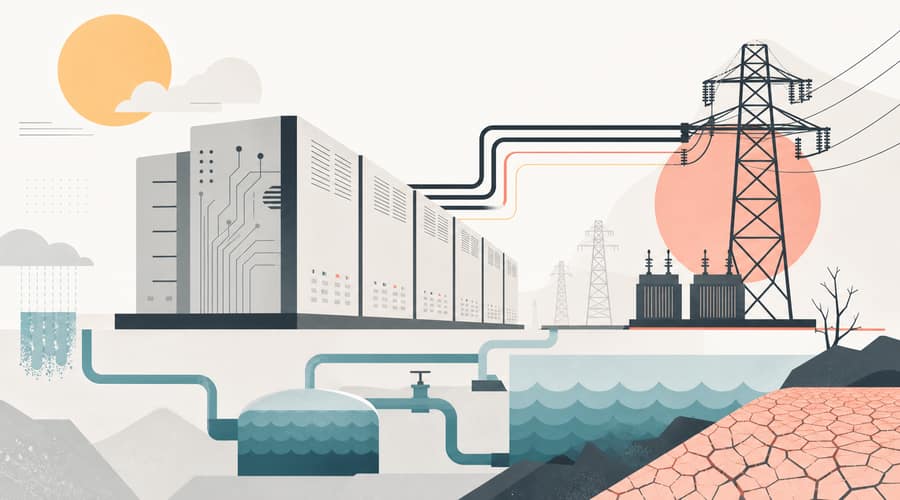
That is a difficult figure to picture, which is why the report’s comparison is landing so widely. The water tied to operating and powering those data centers could equal the basic domestic needs of 1.3 billion people in Sub-Saharan Africa for a year. The point is not that AI servers are drinking household water directly in every case. The point is that cooling systems, electricity generation and supply chains are turning the technology into a resource-intensive industrial sector.
In its report, the United Nations University Institute for Water, Environment and Health warned that data center power and water use could roughly double by 2030 as companies expand infrastructure to meet AI demand. That makes this less of a distant climate debate and more of a near-term business issue. If power becomes scarce, expensive or politically contentious, the AI economy starts to look very different.
For the last two years, the market has treated AI infrastructure as a race for capacity. Microsoft, Google, Amazon, Meta and a long list of specialist operators have been judged partly by how quickly they can secure GPUs, build data halls and bring new clusters online. The assumption has been simple: more compute means more product capability, more enterprise adoption and more revenue.
The UNU-INWEH numbers challenge that clean story. Data centers already consume electricity on the scale of major economies. The report estimates current electricity use at about 448 terawatt-hours, with associated carbon emissions of roughly 208 million tons of carbon dioxide and water consumption around 1.2 trillion gallons. By 2030, emissions could approach 400 million tons of carbon dioxide equivalent if growth continues and the energy mix does not improve fast enough.
That matters because AI infrastructure is not spread evenly around the world. It clusters near cheap power, fiber connections, tax incentives and available land. In the United States, Ireland, the Netherlands, Singapore and parts of the Gulf, data center demand is already forcing difficult questions about transmission, permitting and who pays for grid upgrades. A global percentage can look manageable while local pressure becomes severe.
This is where investors need to be careful. A model company can scale users quickly. A data center cannot be wished into existence. It needs transformers, substations, cooling, water rights, environmental permits, backup power and community consent. Every one of those can slow a deployment schedule or change the economics of a project.
Efficiency will help, but it will not settle the issue
The industry has a fair response to some of the alarm. AI hardware is becoming more efficient. Cooling is improving. Companies are experimenting with liquid cooling, closed-loop systems, lower-water designs and siting strategies that use cleaner energy. Google announced new water stewardship commitments this week, a sign that the biggest operators understand how quickly public scrutiny is rising.
But efficiency gains do not automatically reduce total consumption when demand is growing this quickly. Cheaper and faster inference tends to create more usage, not less. Text generation becomes image generation, then video, then autonomous agents that run for longer periods. The unit cost falls, but the number of units expands. Anyone who has watched cloud computing for the past decade should understand that pattern.
The bigger lesson is that AI companies will increasingly be judged like infrastructure companies. Their competitive advantage will depend on power procurement, data center siting, energy partnerships and local credibility, not only model quality. A startup selling enterprise AI may never build a data center, but its margins and reliability still depend on someone else’s energy strategy.
This also changes the policy conversation. Governments that want domestic AI capacity will need more than grants and semiconductor plans. They will need grid planning, water governance, permitting reform and rules that make operators disclose enough data for communities to understand the tradeoffs. Without that, the backlash will grow in the places where the costs are most visible.
AI is still a productivity story, but it is no longer only a digital one. The companies that win the next stage will be those that treat electricity and water as strategic inputs from the start. Watch the power contracts, the cooling choices and the local permits. That is where a lot of the AI race will now be decided.
Also read: AI data centers are turning electricity into the new chip constraint • China has turned brain implants into a commercial medical race • Seattle is moving to pause new data centers for one year