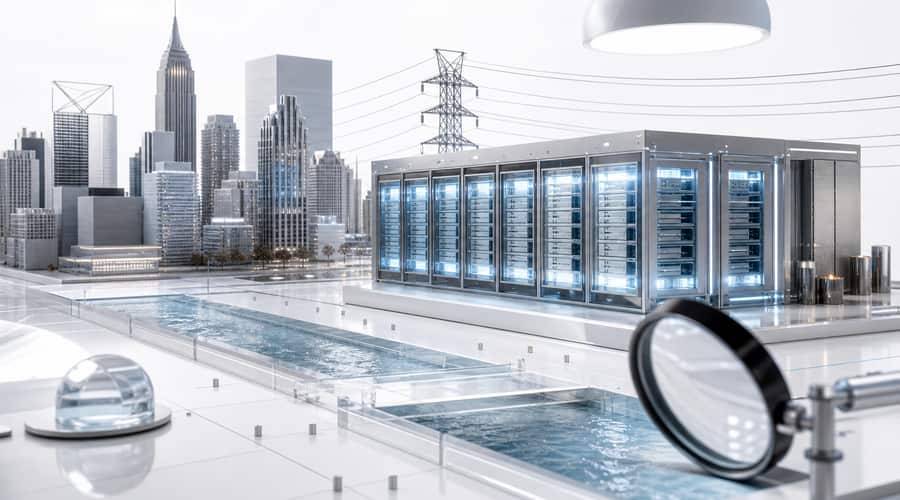
Seattle's data center moratorium has moved from a permitting dispute to a test of how cities manage the physical costs of AI growth.
Seattle is not trying to stop the internet from working. It is trying to decide whether the next wave of AI infrastructure should be allowed to land inside the city before residents know who pays for the power, water, noise and land use impacts that come with it.
The City Council's Land Use and Sustainability Committee has advanced a one-year moratorium on new large data centers, a pause aimed at giving Seattle time to write rules for facilities that can consume electricity at a scale more familiar to utilities than zoning boards. As The Guardian reported this week, Seattle would be the largest U.S. city yet to consider such a moratorium, which matters because this is not a town with a casual relationship to the tech industry. Amazon is headquartered there. Microsoft sits nearby in Redmond. The cloud economy has shaped the region for decades.
The immediate trigger was a group of proposed projects served by Seattle City Light. City officials have said four companies approached the utility about five large-scale data centers that together could demand up to 369 megawatts of power, roughly one-third of Seattle's current average electricity use and enough to power about 300,000 homes. Two of those proposals have since been withdrawn, according to local reporting, but the political problem did not disappear with them.
That is the important part. The moratorium is not only about five buildings. It is about whether cities are willing to treat AI infrastructure as ordinary industrial development when its utility footprint can feel anything but ordinary.
Data centers used to be the sort of infrastructure most people did not think about unless they worked in cloud computing, real estate, or power procurement. They sat in rural areas with cheap land and access to electricity, while consumers interacted with the polished layer on top: streaming apps, cloud storage, workplace software and now generative AI tools.
AI has changed the public visibility of that arrangement. Training and running large models requires enormous computing capacity, and that means more servers, more cooling, more backup generation and more grid planning. Seattle already has about 30 data centers, but city officials describe them as relatively small. The concern is the arrival of mega facilities in an urban utility territory where housing, electrification, climate goals and industrial demand are already competing for attention.
Mayor Katie Wilson's office has framed the one-year pause as time to build policy, not as a permanent ban. The city wants Seattle City Light to develop a large-load policy so residents and small businesses are not left absorbing infrastructure or energy purchasing costs. Seattle City Light and Seattle Public Utilities are also expected to study rate structures and legislation tied to power and water usage.
That distinction matters for entrepreneurs and investors. A moratorium is easy to dismiss as a local political gesture. A new rate structure is harder to ignore. Once a city decides that data centers should have their own utility category, every future project has to price in a more complicated negotiation with the public sector.
Site selection is becoming a regulatory strategy
For hyperscalers and colocation operators, the old site selection formula was already changing. Land, fiber access, tax incentives and power availability still matter, but community acceptance is becoming a real constraint. A site that looks attractive on a spreadsheet can become expensive if it draws organized opposition, new utility rules or months of delay.
Seattle's proposal is also notable because it comes from inside a major tech hub, not from a community unfamiliar with the benefits of the industry. That makes the political signal sharper. If residents in a city built around cloud talent are asking whether data centers are a good use of urban land, other municipalities will feel more comfortable asking the same question.
There is a business argument on the other side. Joe Nguyen, president and CEO of the Seattle Metropolitan Chamber of Commerce, told Axios he worries the policy could be more symbolic than functional because the projects may simply move elsewhere. That is a fair concern. AI demand will not vanish because one city pauses permits, and the servers still have to be built somewhere.
But relocation is not a free answer. Moving outside Seattle could shift the burden to nearby communities, tribal water interests, rural utilities or counties with less capacity to negotiate. That is why the Seattle debate has regional weight. The city is already talking about state legislation in 2027 covering clean energy, pollution standards, sustainable water use and job quality. Once that conversation moves from city hall to the state capitol, it becomes much more than a permitting pause.
The broader lesson for startups is simple. AI infrastructure is no longer just a capital expenditure story. It is becoming a stakeholder story. Companies building AI products may never own a data center, but their margins, latency, cloud bills and geographic availability all depend on infrastructure decisions being fought over by utilities, city councils and residents.
Investors have treated data centers as a structurally constrained asset class in the favorable sense: demand keeps rising and supply cannot arrive fast enough. Seattle is a reminder that constraints can cut both ways. Power, water and public patience are not abstract inputs. They are political resources.
The next thing to watch is whether Seattle's final council vote produces a narrow one-year study period or a template other cities copy. If the city pairs the moratorium with serious large-load rates and public benefit requirements, the AI buildout will still continue. It will just have to prove, city by city, that the people hosting the infrastructure are not the ones quietly subsidizing it.
Also read: AI leaders ask Congress to tighten synthetic DNA screening • Mastercard is bringing stablecoins deeper into payment settlement • Anthropic turns its safety reputation into enterprise leverage