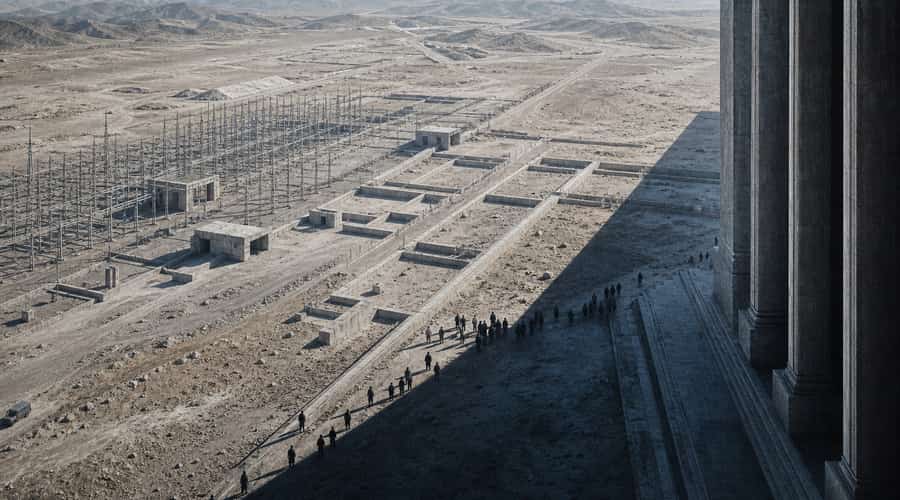
A Utah data center fight has moved from public meetings to court, and that matters for anyone betting on the AI infrastructure boom.
The Stratos Project was supposed to show how quickly America could build the computing muscle behind artificial intelligence. Instead, the proposed Kevin O'Leary backed campus in Box Elder County has become a warning about how quickly local resistance can turn into legal risk.
A group called Box Elder Accountability Referendum, known as BEAR, filed an appeal this week in Brigham City's 1st District Court after Box Elder County Attorney Stephen R. Hadfield rejected its attempt to put the project before voters. The county's position is that the commission resolutions tied to Stratos were administrative actions, not new laws, and therefore cannot be challenged through a referendum. The residents argue the opposite: that decisions affecting land development, tax revenue and the environment carry the force of law and should be subject to a public vote.
That sounds procedural, but it is not small. The appeal is a direct challenge to the way large data center projects are being approved when speed, power access and tax structures are treated as competitive advantages. Developers want certainty. Communities want a say. Courts are increasingly where that tension goes when the public process feels too narrow.
According to Utah News Dispatch, the Stratos plan originally covered about 40,000 acres in northern Utah and moved through an approval process involving the Military Installation Development Authority, the state entity helping facilitate the project. Box Elder County commissioners voted in support of the project on May 4 after a meeting that drew heavy public opposition. The county is home to roughly 65,000 people, which helps explain why a project of this scale landed with such force.
The concern is not simply that a celebrity investor is involved. It is that the project sits at the intersection of land, water, power and public trust. Stratos has been described as a hyperscale data center campus with its own natural gas power generation, a structure meant to avoid straining the local grid. But in a state already worried about water supply and the Great Salt Lake, that explanation does not end the argument. For many residents, it starts one.
That is the part investors should pay attention to. AI infrastructure is often discussed as if the main constraints are chips, transformers and capital. Those are real constraints. But they are not the only ones. A data center can have financing, political support and a national security pitch, yet still run into a county-level dispute that slows the calendar and changes the economics.
The political picture has already shifted. Utah Senate President Stuart Adams, who also chairs MIDA, called for the project area to be cut by 75%, from 40,000 acres to about 10,000 acres. O'Leary later agreed to concessions described by the Utah Senate as including a 75% effective reduction, commitments tied to water for the Great Salt Lake, open space, wildlife protections, continued agricultural use, heat-capture technology and independent environmental reviews.
Those concessions show that public pressure can move even well-connected projects. They also show that a headline approval is not the same as a buildable plan. Adams said the process is still in its early stages and that no approvals or permits have been applied for, let alone issued. That matters because a developer's risk profile changes sharply between an endorsed concept and a permitted, financed, construction-ready project.
Celebrity capital cuts both ways
O'Leary's profile gives Stratos national attention and a useful megaphone. It also makes the project a bigger target. A lesser-known developer might have faced technical hearings and local opposition. O'Leary brings television fame, political visibility and a ready-made storyline about billionaires, AI and rural communities being asked to absorb the costs of national ambition.
That attention can help if a project needs to attract partners or frame itself as strategic infrastructure. It can hurt when residents feel they are being rushed. FOX 13 reported this week that Box Elder County commissioners had two meetings about Stratos before the public was told, while county officials described them as informational and said no decisions were made. Even if that explanation holds legally, it adds to the perception problem.
For developers, perception is not cosmetic. It affects litigation, permitting, local elections, financing conditions and the appetite of hyperscale customers that do not want their next compute cluster attached to a political fight. If the Stratos appeal succeeds, referendum sponsors would get a path to gather signatures and potentially force a vote. If it fails, the campaign has still created a public record and a model for other communities watching data centers arrive at speed.
The broader lesson is straightforward. AI infrastructure is no longer just a land acquisition and power procurement story. It is a governance story. Investors who treat local approval as a box to check are likely to misprice the risk, especially in places where water, air quality and public finance are already sensitive issues.
Stratos may still move forward in some reduced form. It may become a more careful version of the project its backers first imagined. But the next phase will be shaped as much by judges, residents and regulators as by power engineers and capital providers. That is what the AI buildout looks like now: not just bigger campuses, but harder questions about who gets to decide where they belong.
Also read: AI is testing founders instead of banning hiring • AgiBot is turning humanoid robots into a volume business • Alphabet turns to shareholders to fund its AI buildout