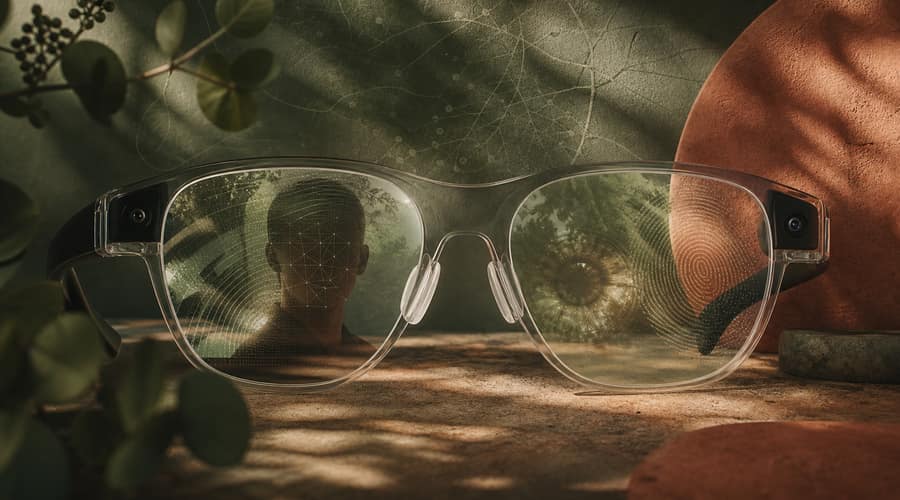
Meta has not launched face recognition for its smart glasses, but the machinery is already sitting inside its companion app. That difference matters less than the company may think.
Meta's smart glasses story has moved from clever consumer hardware to a harder question: how much biometric capability can a company place on people's devices before users deserve a clear say?
According to WIRED, code reviewed in the live Meta AI app shows an unreleased face-recognition system, internally called NameTag, built for Meta's smart glasses platform. The feature is not currently exposed to consumers, and outside reviewers did not find evidence that it is identifying people for ordinary users today. But the code, models, local storage, and notification pieces appear to be present in software already downloaded to millions of phones.
That is why this is more than a privacy scare about a feature that may never ship. Meta is not merely sketching a product roadmap in a lab. It has distributed working components of a biometric system through the app used with Ray-Ban Meta and Oakley smart glasses, including models that can detect faces, crop them, and turn them into faceprints that can be searched against a database on the user's phone.
For entrepreneurs and product teams, the lesson is not that every unreleased feature is dangerous. Modern software ships in stages. Apps contain dormant code all the time. The problem begins when the dormant feature is a system that could identify people in public through a wearable camera.
Meta's argument is straightforward. The company says it is exploring these kinds of features, that nothing has shipped to consumers, and that no final decision has been made. It has also said it is not building a central face database. That may be technically important, especially if biometric data remains local to a user's phone.
But local storage does not make the consent issue disappear. A smart glasses wearer may have accepted Meta's app terms. The person being viewed across a cafe, at a conference, or on the street has accepted nothing. That is the unusual tension with wearable AI: the most important data subject may not be the customer.
The system WIRED described would reportedly check faces captured by the glasses against faceprints stored on the phone. Recognized faces could trigger notifications, while unknown faces may be cropped, indexed, and stored in a pending folder. Security researcher Buchodi, who separately analyzed the app, said the pipeline could be manually triggered in testing and could generate a recognition notification after matching a stored faceprint.
Meta's history makes the discovery more sensitive. The company shut down Facebook's broad face-recognition system in 2021 and said it would delete more than a billion face templates. It later paid $650 million to settle an Illinois biometric privacy lawsuit and agreed in 2024 to a $1.4 billion settlement with Texas over biometric data allegations. That does not mean Meta can never use face recognition again. It does mean the burden for transparency is much higher.
Wearables change the business risk
The business opportunity is obvious. Smart glasses become far more useful if they can remember people, summarize interactions, assist visually impaired users, and connect faces with context. This is the promise behind AI hardware more broadly: less typing, less searching, more ambient help.
But the same capability that makes the product useful can make it socially radioactive. Google Glass learned this lesson early. People are willing to tolerate cameras in phones because phones are visible, familiar, and usually held with intent. Glasses are different. They sit on the face, point where the wearer looks, and blur the line between seeing and recording.
That distinction matters for Meta because its hardware strategy depends on normalizing AI wearables before rivals do. If consumers begin to associate smart glasses with silent identification, the market does not just face a regulatory problem. It faces a social adoption problem. Restaurants, offices, schools, conferences, and public spaces may decide the easiest policy is to restrict the devices altogether.
The timing adds pressure. Meta is already facing criticism over its Model Capability Initiative, an employee data program designed to collect computer activity for AI training. Recent reports said the company added limits after staff backlash, including ways to pause collection in 30-minute increments. The employee program and the smart glasses code are not the same issue, but they point to the same strategic habit: Meta is looking for new streams of real-world data to improve AI systems and products.
That is where regulators will focus. Biometric laws in places like Illinois and Texas are built around notice, consent, collection, and storage. A system that keeps faceprints on a user's phone may test the edges of those rules, but it will not avoid political scrutiny if people believe the practical result is public identification without meaningful choice.
Meta still has room to change course. It could remove the dormant code, make any future launch explicitly opt-in, publish plain-language limits on who can be recognized, and build visible signals that make the feature obvious to bystanders. Those steps would not satisfy every critic, but they would show the company understands the difference between exploring a feature and quietly preparing the public infrastructure for it.
The next thing to watch is not only whether NameTag launches. It is whether Meta treats biometric recognition as a declared product decision or as another background capability that appears first in code and only later in public conversation. In consumer AI, that order may decide whether smart glasses become a mainstream device or another technology people learn to distrust on sight.
Also read: GitHub Copilot turns custom model access into a startup opportunity • McDonald’s gives drive-thru AI another cautious test • Google turns to SpaceX for the compute it cannot build fast enough