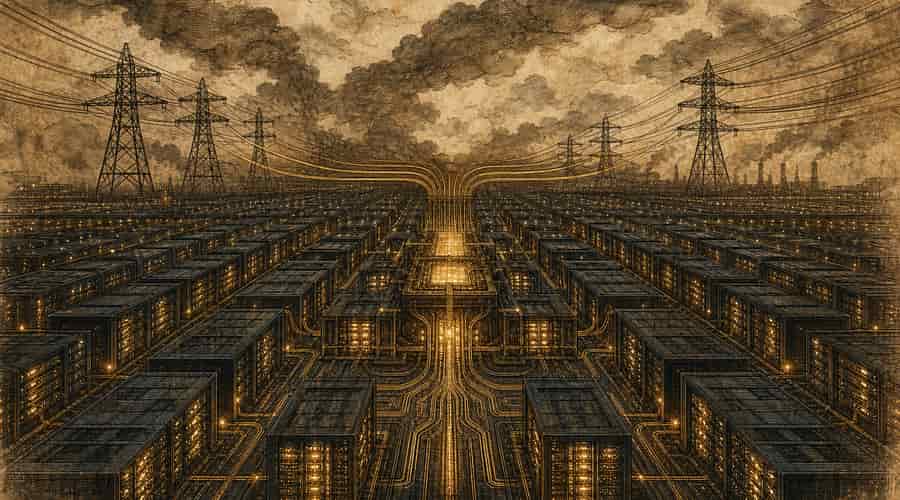
Texas is discovering that the AI infrastructure boom is not just a power supply story. It is now a grid stability test, and some large loads are not passing it.
ERCOT has flagged a new reliability risk just as summer demand begins to build: several large data center and crypto mining facilities seeking to connect to the Texas grid failed voltage ride-through assessments. That may sound technical, but the point is simple. When the grid has a voltage disturbance, these facilities may disconnect suddenly to protect their equipment, and that sudden drop in demand can create a bigger problem for everyone else.
According to Reuters, ERCOT reviewed about 20 gigawatts of large electricity users seeking to connect, including eight projects totaling roughly 3.9 gigawatts that wanted to start before July 1. In simulations, four groups of large power users were identified as capable of tripping in ways that could each cause more than 5,000 megawatts of demand to disappear under certain fault conditions. That is not a rounding error. It is the kind of swing that forces grid operators to think about data centers less like ordinary customers and more like active participants in grid reliability.
This is the uncomfortable part of the AI buildout. A data center can look like economic development, tax base, and digital infrastructure all at once. But to ERCOT, it is also a massive electronic load with fast-acting protection systems, complex power electronics, and a demand profile that may not behave like a factory, refinery, or office tower. The grid was built around the idea that large customers consume power in a reasonably predictable way. AI compute and crypto mining challenge that assumption.
For years, the argument around data centers in Texas has focused on whether there is enough electricity. That is still important, especially in a state where heat waves can push demand to record levels. But ERCOT's latest concern is sharper. The issue is not only whether a project can draw power from the grid, but whether it can stay connected when the grid has a normal disturbance.
Voltage ride-through capability matters because power systems are never perfectly calm. A lightning strike, failed transformer, or line fault can cause voltage to dip for a brief moment. Generators and large loads are expected to ride through those events, not instantly vanish from the system. If too much demand disappears at once, supply and demand fall out of balance in the other direction. That can push frequency higher, force generation offline, or create cascading operating problems.
ERCOT has seen this movie before. Since 2023, the grid operator has identified at least 26 events in which data centers or crypto mining facilities abruptly disconnected because they could not handle disturbances in electricity flow. In December 2022, a failed transformer in West Texas caused nearly 400 crypto miners, data centers, and oil and gas facilities to drop offline without warning. ERCOT later said the event created a surplus of nearly 1,700 megawatts and forced 112 megawatts of generation to shut down.
That history explains why the current testing regime is becoming a de facto chokepoint for new AI and crypto infrastructure investment. A developer can have land, capital, equipment orders, and a power contract, but those pieces mean less if ERCOT's stability models show the site could make a disturbance worse. The interconnection queue is no longer just a waiting room. It is becoming a technical filter.
The backlog is forcing harder choices
The pressure is building quickly. Houston Public Media reported that ERCOT's board voted on June 2 to move ahead with a new batch study process for large loads, starting with Batch Zero, with Public Utility Commission of Texas review expected on June 18. The reason is obvious. In the first few months of 2026, nearly 200 data centers and other large users asked to connect to the grid, seeking a combined 438 gigawatts of power. Experts expect some of that number to be speculative, but even a fraction would reshape planning.
Batching projects may make the process more rational, but it also changes the leverage. Developers will be judged against each other and against transmission limits, not just against their own readiness. Projects with cleaner modeling, stronger ride-through equipment, and more credible financing will have an advantage. Projects that cannot show how they behave during disturbances may find that speed to market is no longer under their control.
This creates a regulatory wedge between hyperscalers and grid operators. Cloud companies and AI infrastructure investors are racing to secure capacity because compute demand is the business opportunity of the decade. ERCOT is trying to keep a real-time power system stable, where one facility's protection setting can become everyone else's reliability problem. Both sides are acting rationally. That does not make the conflict smaller.
The likely result is a new cost layer for data center development in Texas. Battery systems, advanced power conversion, better dynamic models, and stricter commissioning tests may become standard rather than optional. Crypto miners, which have often leaned on flexibility as a selling point, may face closer scrutiny when flexibility turns into sudden disconnection during a grid event.
For Texas, the lesson is clear. Cheap land, available energy, and a business-friendly posture are no longer enough to win the next wave of AI infrastructure. The winners will be the projects that can prove they are not just large power consumers, but stable grid citizens. This summer will show whether that standard arrives as a manageable technical hurdle or as the first real brake on the state's data center rush.
Also read: The stronger dollar is turning Fed risk into a startup financing problem • Anthropic is turning Claude Mythos into a controlled security business • Jensen Huang says the AI selloff has opened a buying window