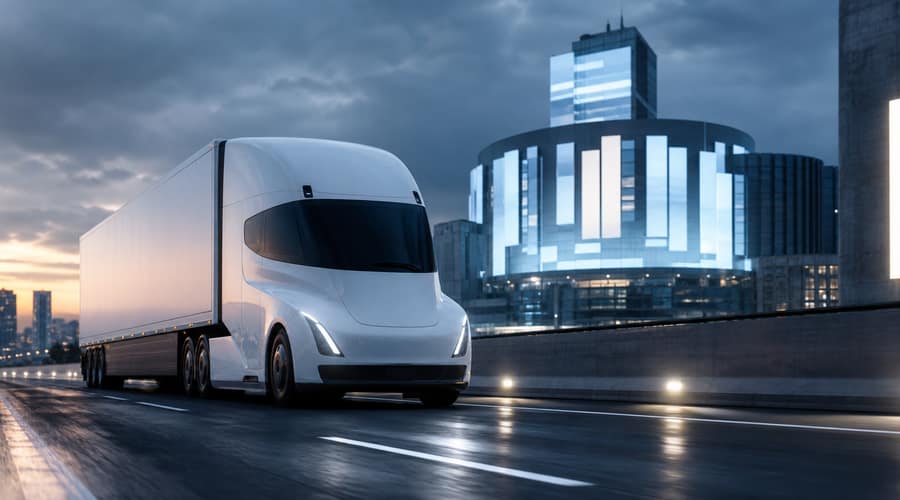
Einride's Nasdaq debut gave investors a clean way to buy into autonomous freight, but the company is still much closer to an electric logistics operator than a scaled self-driving trucking network.
Einride began trading on Nasdaq under the ticker ENRD on June 10 after completing its merger with Legato Merger Corp. III, and the market response was anything but modest. Shares reportedly climbed as much as 240% intraday before closing up about 50%, a sharp first-day move for a freight technology company with roughly 200 electric trucks and only a small number of fully autonomous vehicles in live use.
That is the story worth watching. The market is not simply valuing Einride on what it operates today. It is assigning a price to the possibility that the Swedish company can turn electric freight routes, autonomous trucks, and logistics software into a network that large customers actually depend on.
The deal itself gives that argument some weight. As The Wall Street Journal reported, the merger valued Einride at $1.35 billion before proceeds from the transaction, after an earlier SPAC agreement had put the company at $1.8 billion. Einride also raised $113 million earlier this year from investors including EQT Ventures, giving it fresh capital to support technology development, commercial expansion, and more autonomous deployments.
That capital matters because this is not a software company that can scale mostly through servers and sales teams. Freight is physical. Trucks have to be bought or financed, charging infrastructure has to be placed where routes actually run, and autonomy has to be proven in the dull, repetitive, weather-exposed reality of logistics. A public listing gives Einride more visibility, but the business still has to do the hard operational work route by route.
Einride does have something many autonomous transport companies have lacked: commercial customers already moving freight. Its customer list has included names such as Lidl, PostNord, Oatly, Carlsberg, Heineken, Mars, PepsiCo, GE Appliances, and DP World. These are not experimental logos collected for a pitch deck. They are the kind of shippers that care about cost, reliability, emissions, and whether freight shows up when promised.
The Valuation Versus Operations Gap
The difficult part is the gap between the public-market story and the operating base. Einride has around 200 electric trucks, while fully autonomous operations remain limited. The company expects to expand autonomous deployments, but investors buying after a first-day surge are paying for a future fleet that has not yet been built at meaningful scale.
The financial profile also makes this a clear growth-stage bet. The article's reported figures, including $49 million in annualized operational revenue, a 2025 net loss of SEK 1.72 billion, and operating cash burn of SEK 741.7 million, show why the proceeds from the transaction are central to the investment case. Einride needs time, capital, and customer conversion to make the valuation look reasonable.
That does not make the market reaction irrational. It does make it demanding. If Einride can use its signed contracts and customer relationships to place more electric trucks into daily service, then layer autonomy on routes where the economics work, the company could become one of the more credible public names in automated freight. If autonomous deployments remain small while losses stay heavy, the debut pop will look more like a scarcity trade than a judgment on fundamentals.
Why Logistics Capital Is Paying Attention
Einride is arriving in public markets at a moment when investors are looking beyond pure software and back toward physical automation. Warehouses, ports, trucking yards, and last-mile networks all have the same basic problem: labor is expensive, capacity is uneven, and customers want cleaner logistics without paying much more for it.
That is why autonomous freight still attracts capital despite its long history of overpromising. The prize is large, but the path is unforgiving. Unlike consumer AI apps, a self-driving freight system has to satisfy regulators, enterprise customers, insurers, fleet operators, and safety teams before it can scale. One weak link slows the whole plan.
Einride's advantage is that it is not starting from a blank page. It already sells electric freight services and logistics software, and it has experience working with large shippers across Europe, North America, and the Middle East. The next test is whether that base can support a larger autonomous business rather than simply a cleaner truck leasing and freight management operation.
The numbers to watch are straightforward: how many autonomous vehicles Einride puts into commercial service, how much contracted revenue turns into recurring revenue, and whether cash burn starts to move in the right direction as the fleet grows. Those measures will matter more than the first-day stock chart. June 10 proved that public investors want exposure to autonomous freight. The next year will show whether Einride can turn that appetite into a business that earns the valuation now attached to it.
Also read: May CPI landed at 4.2% and the Fed's rate-cut window just slammed shut • Oracle raised $48 billion this fiscal year and plans to raise $40 billion more, and the market still sent the stock down 7% • Mastercard's Agent Pay for Machines puts blockchain infrastructure at the center of the emerging AI transaction economy