China has moved underwater in the race to power AI infrastructure, putting a commercial subsea data center off Shanghai into operation just as US projects face rising resistance over power, land, and water.
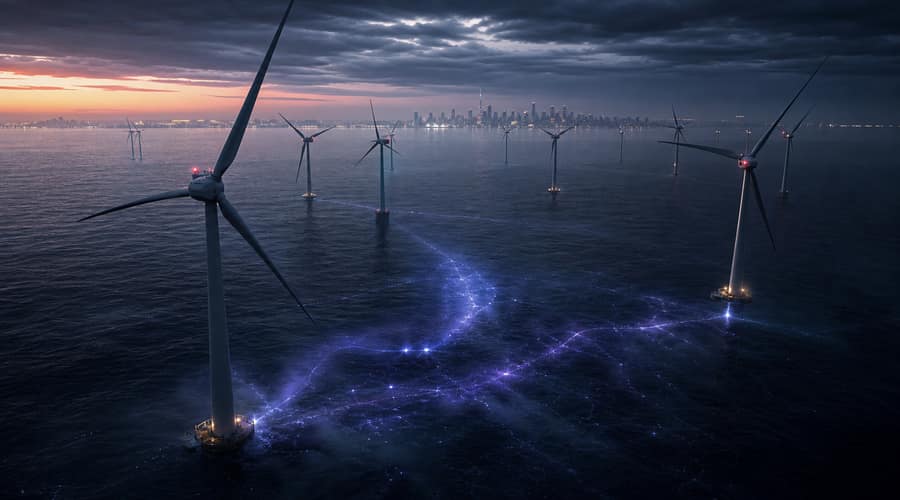
More than ten kilometers off Shanghai's Lingang coast, an underwater data center is now running commercial workloads with ocean cooling and offshore wind doing much of the heavy lifting. The project, led by HiCloud Technology with China Communications Construction, began operations in May 2026 and has quickly become a useful test case for a much bigger question: whether the next wave of AI infrastructure has to keep fighting for land, grid capacity, and freshwater onshore.
The basic design is easy to understand, even if the engineering is not. Servers are sealed inside pressure-resistant subsea modules, placed below the surface, and cooled by the surrounding seawater. The facility has been reported at 24 megawatts of capacity and close to 2,000 servers, with more than 95% of its electricity supplied by nearby offshore wind. According to The Guardian, the project cost about 1.6 billion yuan, or roughly $177 million, and is designed to cut energy use by more than 20% compared with conventional land-based data centers.
The most important number is its Power Usage Effectiveness, or PUE, which has been reported at about 1.15. PUE measures total facility energy use against the energy consumed by the servers themselves, with 1.0 being the theoretical ideal. That puts the Shanghai facility near the level claimed by some of the world's most efficient new data centers, but with a different tradeoff: no cooling towers, no large freshwater draw, and far less land demand than a comparable campus onshore.
That matters because the US data center buildout is running into a very physical problem. The AI industry can raise money faster than utilities can build transmission. The Houston Chronicle recently reported that ERCOT, Texas' main grid operator, has received requests from more than 480 large data centers seeking more than 418 gigawatts of power through 2032, far above the state's current peak demand. Many of those projects will never be built, but the queue itself shows how much speculative demand is now pressing against the grid.
Local politics are tightening at the same time. New York lawmakers have passed a one-year moratorium on new large data centers, though Governor Kathy Hochul still has to decide whether to sign it. Maine lawmakers passed a pause that would have run until November 2027, but Governor Janet Mills vetoed it. Charlotte has approved a 150-day local moratorium, and other cities are moving in the same direction. The resistance is not just procedural. Residents are asking who pays for the power upgrades, who gets the water, and whether a project that creates relatively few permanent jobs deserves priority over housing, factories, or local businesses.
The polling is blunt. A recent Gallup survey found 71% of Americans oppose building AI data centers in their own neighborhoods. Data Center Watch has estimated that projects worth $156 billion have been delayed or stopped since 2025 because of public resistance. Whether every dollar in that figure turns into a lost project is less important than the signal it sends. Infrastructure is no longer just a permitting exercise for the AI sector. It is becoming a political test.
A Different Set of Assumptions
The offshore model changes the argument by removing some of the most contested inputs. It does not need a suburban parcel. It does not require local freshwater for cooling. It can connect directly to renewable generation near coastal demand centers. For cities such as Shanghai, Shenzhen, and Guangzhou, that is not a side benefit. It is the commercial logic of the project.
There are real limits here. Seawater is corrosive. Subsea maintenance is expensive. Cable reliability matters. Environmental monitoring will have to show that heat discharge does not create unacceptable local effects. HiCloud has also described the Shanghai project as a demonstration facility, which means 24 megawatts is not yet proof that underwater data centers can scale to the hundreds of megawatts that hyperscalers now want.
Still, the comparison with Microsoft is instructive. Microsoft's Project Natick placed a server pod off Scotland's Orkney Islands in 2018 and retrieved it in 2020, finding lower failure rates than a typical land facility because the sealed environment reduced exposure to oxygen and humidity. Microsoft did not turn that trial into a commercial offshore platform. China has now taken the next step, combining subsea engineering, offshore wind, and state-backed industrial capacity into an operating facility.
The lesson for US operators is not that every AI data center should be dropped into the ocean. It is that the old siting model is becoming harder to defend in places where grids are strained and communities feel they are being asked to absorb the cost of someone else's compute demand. If offshore deployments prove reliable, the AI infrastructure race may start to look less like a chip shortage and more like a geography problem. The companies that solve power, cooling, and local opposition together will have an advantage that cannot be bought with GPUs alone.
Also read: Einride's 74% Nasdaq Debut Reveals How Much the Market Is Paying for an Autonomous Future That Barely Exists Yet • Japan's Mujin sees a path to a New York IPO as factory reshoring reshapes the market for warehouse automation • A fired xAI engineer's Grok safety lawsuit arrives two days before SpaceX prices the largest IPO in history