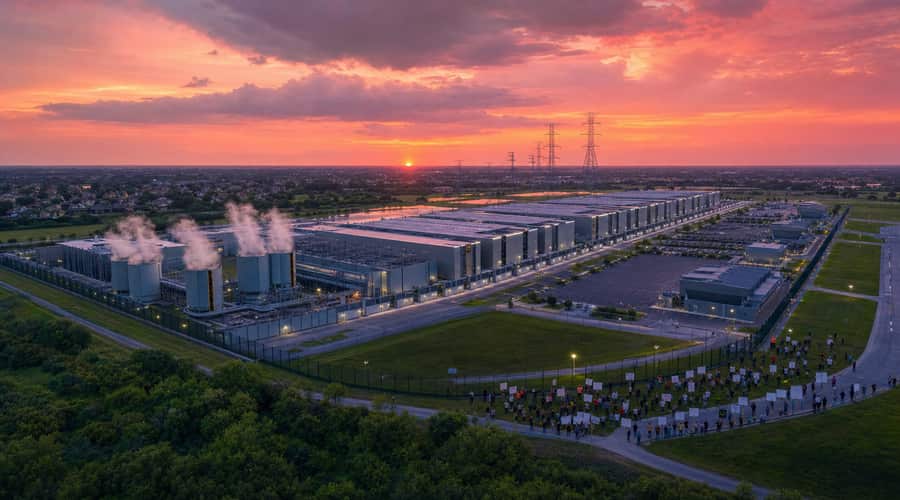
The backlash against AI data centers has become a real constraint on the buildout, with state lawmakers, city councils, and local groups now shaping where new capacity can actually get built.
The fight over AI infrastructure is no longer limited to a few noisy zoning meetings. In the past year, community resistance to large data centers has moved from local irritation into a measurable market risk for developers, utilities, lenders, and the technology companies counting on new capacity to keep AI demand moving.
The most visible new flashpoint is New York. On June 5, 2026, state lawmakers passed a one-year moratorium on permits for new large data centers with peak demand of at least 20 megawatts, sending the bill to Governor Kathy Hochul. If she signs it, New York would become the first state to impose a temporary statewide pause on large data center development. Hochul has not committed to signing the measure, and her office has said it is under review, but the signal to the market is already clear: grid stress and local cost concerns are now political issues, not just engineering problems.
The grid numbers explain why the debate has hardened. New York's grid operator is reviewing roughly two dozen new data center proposals seeking more than 9,000 megawatts of capacity, according to recent reporting from The Verge. For a state already trying to electrify buildings, vehicles, and industry while meeting clean energy goals, that is not a small side demand. It is the kind of load that forces hard choices about transmission, generation, ratepayer costs, and who gets priority when the grid is tight.
That concern is spreading well beyond New York. Charlotte approved a 150-day moratorium this week so officials can study the impact of new data centers before allowing more construction. Michigan lawmakers introduced bills in early June that would pause new approvals until April 2027. In Virginia, once the model for data center expansion, voter support has fallen sharply as residents question whether the promised tax benefits are worth the power demand, land use, noise, and visual impact.
What makes the current opposition difficult for developers is that it does not fit neatly into one political category. Conservatives worried about utility bills, environmental groups focused on emissions and water use, local homeowners worried about property values, and labor groups seeking stronger community benefits can all arrive at the same conclusion: slow the projects down. That gives the movement durability. It also makes traditional industry messaging about innovation and jobs less persuasive than it might have been five years ago.
The public polling is a warning sign for the sector. A recent Gallup poll found that 71% of Americans oppose having AI data centers built in their own area, with nearly half strongly opposed. The reasons were not mainly abstract fears about artificial intelligence. Environmental concerns and higher utility bills led the list. That distinction matters because it means the industry is not only fighting a narrative problem around AI. It is fighting household economics.
Data Center Watch, a project run by 10a Labs, has tracked how quickly that resistance has organized. The group reported that local opposition blocked or delayed $156 billion in planned data center development in 2025, involving at least 48 projects. It also found that grassroots organizations opposing data centers had roughly doubled by April 2026 to nearly 400 nationwide. Those figures are not a complete map of every local fight, but they show that resistance is becoming more coordinated and more visible to capital markets.
The investment consequence is straightforward. A data center site is no longer valuable simply because land is available and a developer has a willing local government. The better question is whether the project can secure power, survive public review, withstand litigation, and avoid becoming a political symbol. A permitted 200-megawatt campus in a cooperative jurisdiction now carries a very different risk profile from a similar site where residents have already organized, utilities face ratepayer pressure, or lawmakers are considering a pause.
That shift helps explain why lenders and investors are becoming more careful. Power certainty has become a core underwriting issue, but so has community certainty. Developers that can show transparent utility agreements, credible local benefits, and a realistic path through zoning will have an advantage over projects that rely on secrecy or speed. The old playbook of quiet site control followed by a late public reveal is becoming expensive.
There is an irony here for the AI market. The companies with existing permitted campuses may gain an unintended moat if new supply gets harder to approve. Demand for compute is still rising, and hyperscalers continue to commit enormous sums to AI infrastructure. But announced capital is not the same thing as deliverable capacity. The next phase of the AI buildout will be decided less by headline spending plans and more by which projects can survive the local politics of power, land, and trust.
Also read: Anthropic quietly degraded Fable 5 for AI researchers, then apologized • Google sues the cybercrime ring that turned Gemini AI into a phishing machine • Kioxia surpassed Toyota as Japan's most valuable company on AI memory demand