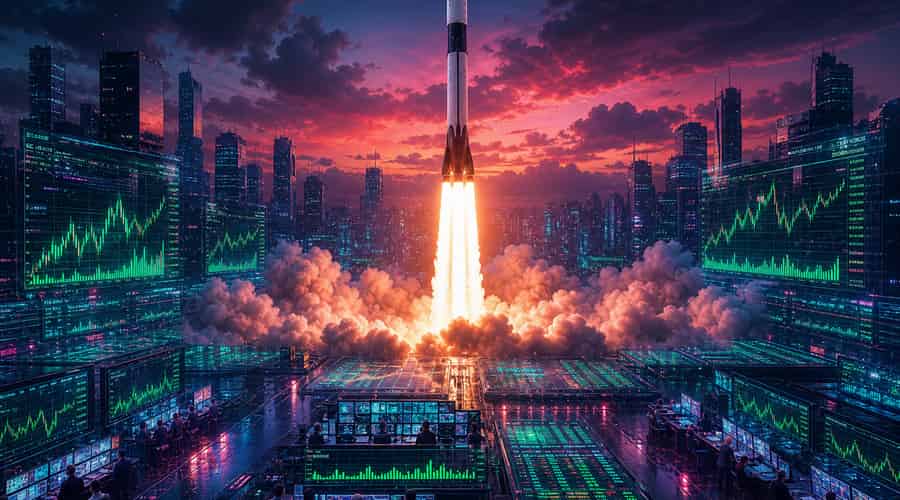
SpaceX has priced the largest IPO in market history, but the first real test is still the opening trade. Early indications point to a sharp debut premium, which is exactly why the listing matters beyond one company.
SpaceX has already done the hard part. The company priced 555.6 million shares at $135 each, raising $75 billion and valuing Elon Musk's rocket and satellite business at roughly $1.77 trillion before a single public-market trade changed hands.
The stock is set to trade on the Nasdaq under the ticker SPCX, and early auction indications pointed to a first trade near $174 to $175, about 29 percent above the IPO price. Reuters reported the indicated level at $174 during the Nasdaq auction process on Friday morning, while several market reports noted that actual trading could take hours as brokers matched buy and sell orders. That distinction matters. A strong indication is not the same thing as a confirmed closing price, but it still shows how aggressive demand has become.
The $75 billion raise blows past every prior record. Saudi Aramco's 2019 listing, which raised roughly $25 billion before an additional greenshoe option, was the previous high-water mark. SpaceX has now tripled that headline figure. If the stock opens near the indicated range, the company's market value would move above $2.2 trillion, putting it among the most valuable public companies in the world and close to the very top of the U.S. market. Reports around the deal also put demand at roughly three to four times the available shares.
What makes the premium remarkable is the nature of the underlying business. SpaceX is not a software company with 80 percent gross margins. Rockets consume capital at a rate most public-market software investors have never had to price. Starship, its next-generation launch system, requires repeated test flights and hardware expenditure before it can generate its largest expected returns. Starlink is the financial engine right now, but its economics depend on launching, maintaining, and replacing satellites at enormous scale. Investors chasing SPCX at a premium are not buying a simple cash machine. They are buying a claim on launch dominance, satellite internet, defense work, and the belief that scale can eventually tame the cost structure.
That is a serious bet, and it is not easy to handicap over ten years. SpaceX has a stronger operating record than most moonshot companies because it already launches payloads, serves satellite broadband customers, and holds major government contracts. But the valuation asks investors to assume that those advantages compound faster than spending does. Public markets have rewarded that kind of ambition before, but they also punish it quickly when execution slips.
The more immediate consequence may not be SpaceX itself but what its reception tells the companies waiting behind it. Anthropic raised $65 billion in May at a $965 billion valuation. OpenAI closed a $122 billion funding round at an $852 billion valuation. Both remain tied to extraordinary capital requirements, and both are being watched as possible public-market tests for frontier AI. SpaceX is effectively running the stress test first, only with rockets, satellites, and AI infrastructure folded into the same story.
The result suggests the demand pool for frontier technology at megacap scale is deeper than skeptics assumed. That does not mean every large AI listing will work. It means investors are still willing to pay for companies that look strategically scarce, even when profits are uncertain and capital needs are high. In this market, scarcity can matter almost as much as current earnings.
Index rules add another twist. S&P Dow Jones Indices decided last week not to fast-track megacap IPOs into the S&P 500, keeping the requirement that newly public companies trade for at least 12 months and meet profitability standards before they can be considered. That means passive investors tracking the S&P 500 will not get automatic exposure to SpaceX right away, even if its market value is larger than many existing constituents.
Nasdaq has taken a more flexible approach. Its revised fast-entry framework allows some newly listed companies to join the Nasdaq-100 after just 15 trading days if they meet the required criteria. If SpaceX qualifies, Nasdaq-100 tracker money could arrive much sooner than S&P 500 flows. That creates an unusual split: one major index family holds back, while another may be forced to buy into the story almost immediately.
SpaceX's record IPO raises the floor for what the market considers an ambitious but credible technology listing. The opening trade will set the first public benchmark, but the longer question is more important: whether investors will keep funding capital-heavy technology companies when the story moves from launch day excitement to quarterly accountability.
Also read: MetaX seeks a Hong Kong listing after shocking Shanghai with a 700 percent debut • Lummis Presses Two Bitcoin Bills Before August and Warns That Failure Means 2030 • Kioxia surpassed Toyota as Japan's most valuable company on AI memory demand