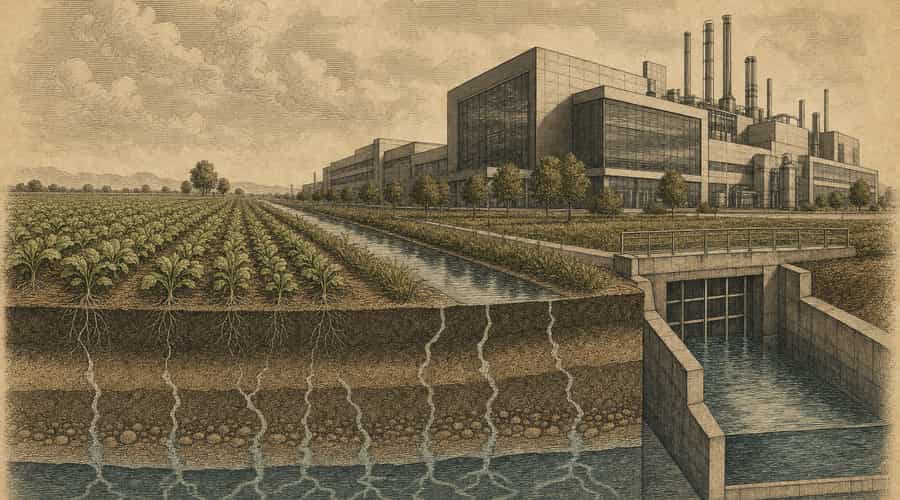
A pollution notice at Tata Electronics' Hosur plant has turned Apple's India manufacturing push into a test of local environmental controls.
Tata Electronics is not just another supplier in Apple's Indian supply chain. Its plant in Hosur, Tamil Nadu, makes iPhone parts and sits inside the wider bet that India can take on more of the work Apple once concentrated in China. That is why a pollution notice from Tamil Nadu's regulator lands harder than a routine compliance dispute.
Reuters reported that the Tamil Nadu Pollution Control Board alleged wastewater from Tata's Hosur facility contaminated groundwater used by nearby farms. The notice, dated May 25 and reviewed by Reuters, followed five inspections between December 2025 and May 2026. It warned that Tata could face a power cutoff and a forced shutdown if the company failed to give a satisfactory explanation.
Tata has pushed back. The company told Reuters that an independent accredited laboratory found the site in full compliance and said it had responded to the authorities. Apple did not comment to Reuters. Tamil Nadu's government also did not comment. For now, the public record is a regulator's allegation, a supplier's denial, and a threat of action that has not yet become a shutdown.
The detail that gives this story weight is the water. This is not an abstract fight over paperwork inside an industrial zone. The regulator's allegation concerns groundwater used by farms near the Hosur site, a city close to the Karnataka border that has become one of the more important nodes in India's electronics buildout. If the allegation is proved, the cost will not only be measured in delayed parts or missed production targets. It will be measured in local trust.
Apple has spent the past several years widening its manufacturing base in India, with Tata becoming one of the names that makes the shift look real. The Financial Times has noted that Tata began making iPhone housings at Hosur in 2020, later bought Wistron's Bengaluru iPhone plant and took a controlling stake in Pegatron's Tamil Nadu facility. That is a serious move from component work toward a fuller role in iPhone production.
The numbers explain the pressure behind it. Counterpoint Research has projected that India will make 26% of global iPhones in 2026. The Times of India, citing Bloomberg, reported earlier this year that Apple assembled roughly 55 million iPhones in India in 2025, up from 36 million in 2024, giving the country about a quarter of Apple's global output. India is no longer a side project for Apple. It is becoming a production answer to tariff risk, geopolitical tension and the limits of relying too heavily on China.
That makes supplier discipline more important, not less. A plant can be useful to Apple only if it can keep running without turning into a political, legal or community problem. Environmental compliance is often treated as a back-office matter until a regulator threatens power disconnection. Then it becomes a supply-chain issue in the most direct possible way.
The bottleneck may not be labor or incentives
India's electronics story is usually told through factory openings, production-linked incentives and export targets. There is truth in that. Industry groups have told the Indian government the country could capture 30% to 35% of global mobile phone production over the next five years, with annual output of $110 billion to $130 billion, according to the Economic Times. Those are large ambitions, and Apple is the company everyone watches to judge whether they are plausible.
But the Hosur notice shows a less comfortable part of the same story. Manufacturing at this scale is physical. It uses water, chemicals, power, transport and land. The closer India moves to the center of global electronics production, the more its factories will be judged not only by how quickly they ship parts but by whether local regulators and communities believe the industrial bargain is being kept.
There is also a reputational problem for Apple. The company does not own Tata Electronics, but consumers and investors rarely draw clean lines between a brand and the factories that feed it. Apple has spent years auditing suppliers and publishing responsibility reports. A water contamination allegation at a key Indian supplier sits directly across that effort, even if the final regulatory finding clears Tata.
The fairest reading is also the most useful one. Tata has not been found guilty in court, and the company says testing supports its position. The regulator, however, has put a serious allegation in writing after several inspections and has raised the possibility of cutting power to the plant. Both facts matter.
For India, the risk is that the next stage of manufacturing growth gets slowed by the things that are harder to announce at investment summits: wastewater treatment, groundwater monitoring, local enforcement and credible dispute resolution. For Apple, the risk is narrower but immediate. A supplier that is central to diversification can still become a weak point if the surrounding system cannot prove it is clean, reliable and trusted by the people living beside it.
Also read: Washington is buying its way into the quantum race • Crypto traders got refunds when SpaceX tokens ran out • Bill Gates warns Washington is changing the rules for tech