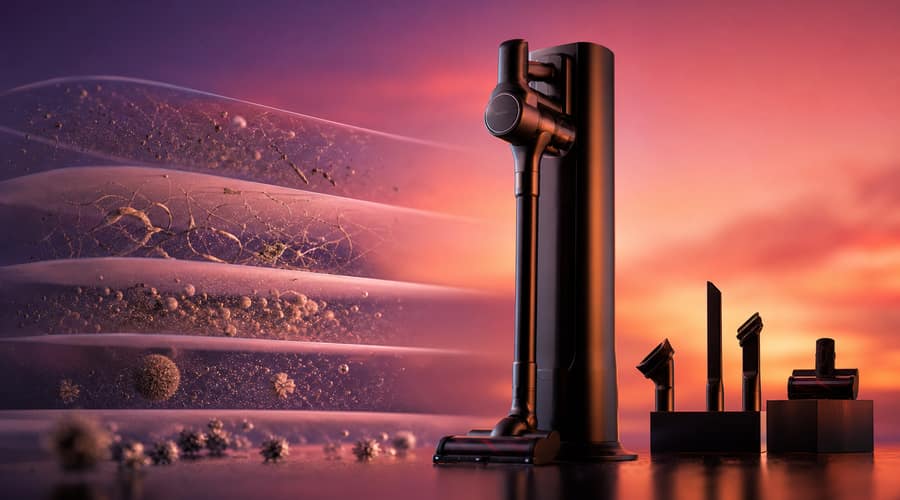
Dyson's 2026 cordless vacuum refresh is less about one stronger motor than a familiar business problem: how a premium hardware brand keeps charging premium prices after rivals copy the convenience features.
Dyson has put four new cordless vacuums into the market, and the headline number is easy to spot. Wired reported on Saturday that the Dyson V16 Piston Animal sells for $980, or $1,100 in its Submarine wet cleaning version, with 315 air watts of suction and a 900 watt Hyperdymium motor. That is the sort of spec Dyson likes because it keeps the brand where it has always preferred to sit: at the top of the shelf, with a price to match.
But the more revealing product is not the most powerful one. It is the Dyson V10 Konical, a $500 cordless vacuum designed to work with Dyson's first auto emptying dock. Wired says the Auto empty Dok will cost $150 in the US and is expected in August. T3 and TechRadar have separately reported that the same system is being sold in the UK as a V10 Konical bundle from July 8 for £569.99, with the vacuum alone priced at £449.99.
That timing matters. Self emptying is no longer a strange robot vacuum trick. Shark, Samsung, Roborock, Dreame and others have spent the last few years pushing docks, sealed bins and automated maintenance into the normal shopping language of floor care. Dyson is not inventing the category here. It is deciding how late it can arrive and still make the economics work.
The V16 Piston Animal gives Dyson a clean flagship story. Homes and Gardens put the US price at $979 and confirmed the same 315 air watt suction figure, a 70 minute runtime and a dust compactor built into the bin. Ideal Home also lists it as Dyson's most powerful cordless model, with a 1.3 litre bin and conical brush bars aimed at hair pickup.
Those details are useful, but they are also familiar. Dyson has spent years training buyers to associate its highest prices with motors, filtration, dust illumination and attachments that look slightly over engineered in a good way. A $980 cordless vacuum is a hard sell, but it is a sell Dyson knows how to make.
The V10 Konical is different. At $500, it sits below the flagship while carrying the feature that feels more current: self emptying. TechRadar reported that the V10 Konical has 150 air watts of suction, up to 60 minutes of runtime and a fully sealed HEPA filtration system that Dyson says captures 99.99 percent of particles as small as 0.1 microns. The dock has its own sealed HEPA system and stores up to 60 days of dust.
This is where the business logic gets more interesting. Dyson is not only selling a vacuum. It is selling a reason to stay inside its accessory system. The Auto empty Dok is also compatible with the V8 Cyclone, according to Wired, T3 and TechRadar, and tools are interchangeable across the V8, V8 Cyclone and V10 Konical family. A customer who might have traded down to Shark or waited for a robot vacuum discount now has a cheaper Dyson path that does not make the old tools feel stranded.
Rivals have made convenience cheaper
Dyson's problem is that rivals have made the dock feel normal at much lower prices. TechRadar reviewed Shark's PowerDetect Speed Clean and Empty system in May at $499.99 with an auto empty charging dock, or $429.99 without it. Homes and Gardens put the Shark PowerDetect Cordless full package at $549.99 and noted that it is often discounted to about $299.99 without the station.
Samsung is attacking from the other end. Homes and Gardens priced the Samsung Bespoke AI Jet Ultra at $1,099.99 and credited it with up to 400 air watts of suction, plus a cleaning station. That is more expensive than Dyson's V16, but it makes the comparison awkward. If a shopper is already above $1,000, Samsung can talk about higher suction and a dock in one package. If the shopper is closer to $500, Shark can talk about auto emptying without asking them to buy into Dyson's most expensive model.
Robot vacuums make the pressure worse. TechRadar's 2026 robot vacuum guide lists self emptying across models from Roborock, Dreame, Eureka, Narwal and Ecovacs, while also noting that budget robot vacuums now sit below $500 and mid range models run from $400 to $800. Once a consumer sees a robot vacuum empty itself, a handheld vacuum that still needs manual bin work feels less advanced, even if it cleans better in the corners.
Dyson's answer is not to race all the way down. The refreshed V8 Cyclone, at $400 in Wired's report, promises 30 percent more suction than the older V8, 150 air watts of power and a 60 minute runtime. It is the entry point. The V10 Konical is the dock ready step up. The V16 is the proof that Dyson still owns the high performance story.
That is a neat ladder, and ladders are how hardware companies protect margins. The risk is that shoppers are becoming less patient with paying separately for convenience that rivals bundle sooner. Dyson can still command attention with motors and filtration, but in 2026 the premium vacuum fight is no longer only about suction. It is about whether the customer believes the whole system is worth staying in.
Also read: Tata's Apple supply role now carries a pollution risk in India • Washington is buying its way into the quantum race • Crypto traders got refunds when SpaceX tokens ran out