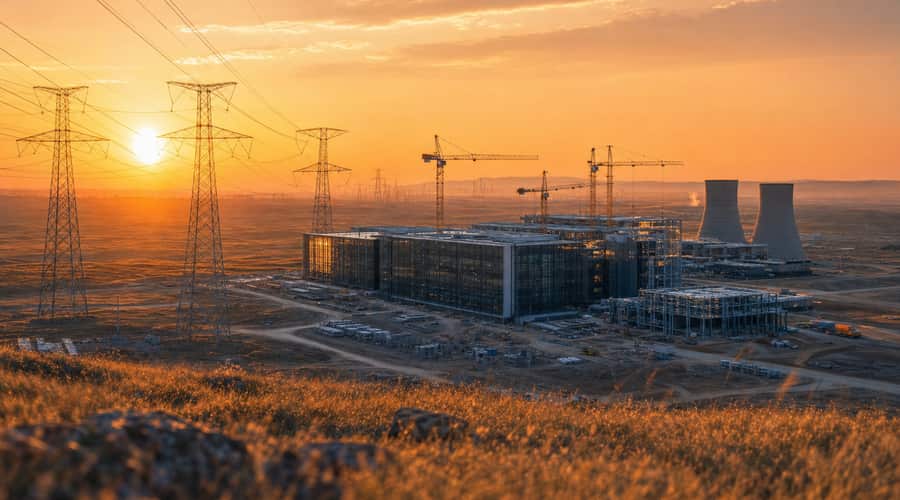
Kazakhstan wants Ekibastuz to become a serious AI computing hub, but the verified story is still about power, money, and execution, not a finished GPU empire.
Kazakhstan's pitch is easy to understand. Put data centers near cheap electricity, offer a politically useful location between China, Russia, and Europe, and sell the country as a neutral place for AI infrastructure at a time when compute is being pulled into the logic of export controls and national security. The harder part is proving that the plan can move from announcements to machines drawing power in northern Kazakhstan.
The most concrete piece of that plan is Ekibastuz, an industrial city in Pavlodar region built around coal and heavy power infrastructure. El Pais reported in April 2026 that Kazakhstan is seeking about $30 billion for a Data Center Valley project there, with the ambition of reaching up to 1 gigawatt of computing capacity. That is the real scale of the bet. It is not a small server room attached to a government innovation program. It is a bid to turn a Soviet-era energy base into a compute district.
That distinction matters because several of the more eye-catching claims around the project are still difficult to verify in open reporting. A published version of this article described a $10 billion agreement with Firebird Inc., Nvidia involvement, a 512-GPU Alem.Cloud cluster, and US export approval for an Armenian Firebird data center. Those details may prove accurate if the underlying Bloomberg reporting is available to readers, but they are not currently corroborated by accessible public search results. For a story this dependent on named companies, chip access, and capital commitments, that gap is too large to treat as settled fact.
Kazakhstan does have one advantage that many AI infrastructure hopefuls lack: it can talk about power without sounding theoretical. Ekibastuz is home to major coal-fired generation, including the Ekibastuz GRES-1 power station, historically one of the country's largest power plants. Cheap electricity is the reason the city has appeared in conversations about crypto mining before, and it is the reason AI data centers now fit the same map. The economics of training and inference still begin with power. Chips make the headlines, but electricity decides whether a campus can run.
That advantage is also the weakness. Coal-heavy power may help Kazakhstan sell cost, but it complicates the pitch to Western investors and technology companies under pressure to account for the carbon profile of their infrastructure. A data center valley powered by Ekibastuz coal can look attractive on a spreadsheet and uncomfortable in an ESG committee at the same time. Kazakhstan can argue that global AI demand needs practical energy answers, but investors will still ask what kind of power they are buying.
The Execution Test Is Still Ahead
The temptation with projects like this is to treat a memorandum, a ministerial meeting, or a headline investment number as if the infrastructure already exists. It does not. A gigawatt-scale compute hub requires substations, grid stability, fiber routes, equipment procurement, construction capacity, cooling systems, financing, and long-term power contracts. None of those disappear because a government has chosen a name for the campus.
Kazakhstan's broader case is still credible enough to watch. The country has uranium, energy infrastructure, and a government that has made digital development part of its national positioning. It also sits outside the two main poles of the US-China technology fight, which gives it a sales line that smaller countries rarely get: compute without direct superpower ownership. For companies trying to place workloads in jurisdictions that are not Washington, Beijing, or Brussels, that is not a trivial offer.
But the same geography cuts both ways. Kazakhstan borders Russia and China, depends on complex regional trade and infrastructure routes, and must persuade foreign customers that political neutrality will remain practical when AI chips, cloud services, and sanctions policy are all moving targets. Neutrality is useful only if clients believe it will survive the next round of restrictions.
The cleanest way to read Kazakhstan's AI push is to separate the verified industrial story from the unverified deal chatter. The verified story is that Ekibastuz has power infrastructure, Kazakhstan wants a large data center district, and recent reporting has put the potential investment target around $30 billion. The unverified layer is the exact status of individual startup deals, Nvidia chip allocations, and export approvals that are not yet visible in accessible public sources.
That does not make the ambition empty. It makes the next proof points very specific. Watch for construction permits, power purchase agreements, named cloud customers, disclosed GPU orders, financing documents, and delivery dates that survive beyond the announcement cycle. Kazakhstan can become a more important compute market, but Data Center Valley will be judged by megawatts delivered, not by the size of the number attached to the first press release.
Also read: FINQ's AI-run ETFs beat the S&P 500 in their debut and the industry is taking notes • Satya Nadella says the real AI moat is a learning loop no one else can copy • US chip curbs didn't slow ByteDance, they built China a homegrown GPU industry