Singapore is putting real money behind AI-driven materials research because chips and clean hydrogen both run into the same hard problem: you can't scale what you can't reliably make.
The materials bottleneck is not a lab curiosity. If you care about faster chips or cheaper clean hydrogen, it is the problem underneath the problem. A promising catalyst in a paper does not give you commercial hydrogen. A theoretical dielectric does not help a chipmaker if no one can produce it at the purity, volume and repeatability a fab needs.
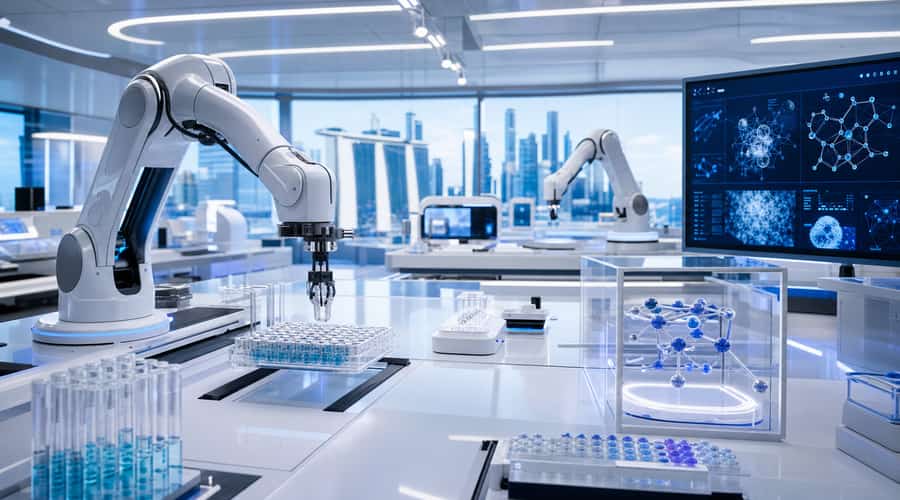
That is where Singapore's new Materials Data Foundry wants to sit. The $10 million joint laboratory between the National University of Singapore and the University of Toronto's Acceleration Consortium is being set up to use AI, automation and rapid experimentation to generate manufacturing recipes for critical materials. Not just better guesses. Recipes a factory can actually run.
According to the project announcement, the foundry is one of eight research projects under Singapore's national AI-for-Science programme, known as AI4S, which the National Research Foundation is backing with $120 million in total funding. The AI4S programme was first announced in October 2024, but the named projects give you the more useful signal: Singapore is not treating AI for science as a slogan. It is pointing the money at bottlenecks where a smaller country can still build leverage.
The announcement also landed alongside the AI4X Accelerate Conference at Raffles City Convention Centre, a five-day gathering co-organised by NUS and the University of Toronto's Acceleration Consortium. More than 800 researchers, engineers and industry figures attended, according to the organisers, with self-driving laboratories and machine learning for scientific discovery at the centre of the agenda. That context matters because the foundry is not a standalone academic bet. It is tied to a live research network trying to change how experiments are designed, run and repeated.
Materials are the real chip constraint
Chip geopolitics usually gets discussed through fabs, export controls and equipment. Fair enough. But once you get close to the angstrom era of transistor scaling, materials start deciding what is possible. The usable list of dielectrics, conductors and etch chemistries gets narrower, and traditional trial-and-error discovery is too slow for the roadmaps companies are trying to keep.
You can see why Singapore wants this capability close to home. Applied Materials opened a $644 million manufacturing plant in Singapore and has deepened its research collaboration with NUS. Beginning in August 2026, NUS is also introducing an Applied AI for Materials and Process Engineering specialisation inside its Master of Science in Semiconductor Technology and Operations programme. That is a plain admission of where the skills gap is: the next useful hire may need to understand both machine learning and materials chemistry.
Frankly, that is the right reading of the market. A country cannot simply declare itself important in semiconductors. It needs fabs, suppliers, researchers, process engineers and a reason for companies to keep doing harder work there. A lab that helps shorten the path from candidate material to manufacturable process is not glamorous. It is exactly the sort of infrastructure that makes the rest of the industry stickier.
Hydrogen has the same problem
Clean hydrogen faces a parallel constraint, though the public conversation often skips past it. NUS already has a Centre for Hydrogen Innovations working on computational catalysis and AI-assisted catalyst discovery, including density functional theory and machine learning methods for water electrolysis. The hard part is not only finding a promising catalyst on a screen. It is making that material repeatedly, at scale, without the economics collapsing.
The Materials Data Foundry is useful because it is aimed at that middle stage. Discovery is exciting, but manufacturing decides whether the discovery matters. If the foundry can test thousands of AI-guided experimental paths and turn the better ones into production instructions, it gives clean hydrogen researchers something more valuable than another candidate material. It gives them a route toward use.
The University of Toronto's Acceleration Consortium brings relevant experience here. Its self-driving laboratory model uses AI to design experiments, robotic systems to run them, and the results to feed the next round of decisions. Similar automated approaches have been used in drug discovery, where companies such as Recursion Pharmaceuticals have screened huge compound libraries far faster than a conventional human-led workflow. Inorganic materials chemistry is a different beast, but the logic is the same: stop treating experimentation as a slow queue and start treating it as a learning loop.
Singapore's decision to fund this through the NRF rather than leave it to industry alone is the revealing part. The country has committed more than S$37 billion to research and development under its RIE2030 plan, with AI and semiconductors among the priorities. Within that, the $120 million AI4S envelope is not enormous. But materials science is exactly where public funding can do work private capital often avoids, because the payoff is real and the timeline is awkward.
No one should pretend the foundry will produce a commercial clean hydrogen catalyst next quarter. That is not how materials work, even with AI in the loop. The better question is whether Singapore can make automated materials discovery boringly reliable, the kind of process companies trust enough to build around. If it can, you will see the impact first in the less flashy places: process recipes, trained engineers, repeatable experiments and companies that decide the next hard materials problem is worth bringing to Singapore.
Also read: Singapore's rapid move to block China-linked race-baiting posts reveals how easily multiracial societies can be targeted • Respond.io raises $62.5 million to take its profitable AI messaging platform from Kuala Lumpur into Western markets • Fonda Matches Founders with the Right Opportunity Before They Build the Wrong Thing