Mobileye has not suddenly become a US robotaxi operator on its own. The verified story is sharper than that: its Volkswagen partnership is moving toward Orlando, and that puts Mobileye's supplier model under a harder test.
Mobileye has spent years selling the eyes and brain of automated driving to other companies. That has been a good place to sit. You supply the chip, the software, and the safety case, while somebody else deals with depots, city permits, angry riders, dirty seats, insurance claims, and the small daily mess of running cars in public.
Now the neat supplier story is getting harder to keep separate from the operating story. MarketWatch reported in April that Mobileye's work with Volkswagen had \"progressed significantly,\" with more than 100 Volkswagen ID. Buzz autonomous vehicles testing on public roads in six cities across the US and Germany. The first US target is Orlando, Florida, where Volkswagen's MOIA unit, Mobileye, and Beep plan to launch driverless services.
That is not the same as Mobileye announcing on June 16 that it will own and operate a 17,000-vehicle US robotaxi fleet. I could not verify that claim in current reporting. The real development is narrower, but it's still important. Mobileye is moving from a clean technology supply role into a proving ground where its system has to work with real passengers, real regulators, and real city streets.
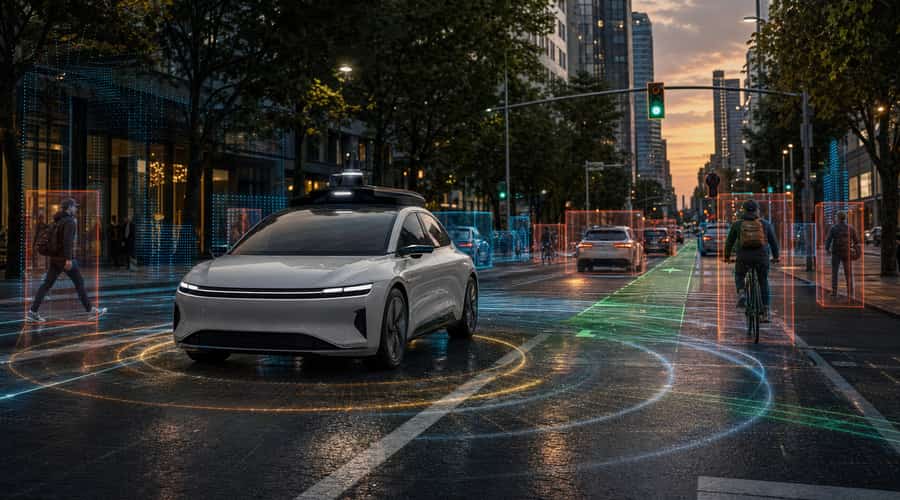
Frankly, that is the test that matters. A self-driving stack can look convincing in demos and partner slides, but a robotaxi service exposes every weak spot. The car has to handle school zones, pickup confusion, blocked lanes, impatient riders, and the ugly edge cases that don't care how strong the investor deck looked. Waymo learned that by running cars for years in Phoenix, San Francisco, Los Angeles, Austin, and Atlanta. Mobileye is coming at the same problem through Volkswagen's fleet and MOIA's mobility operation.
The numbers make the gap plain. As of 2026, Waymo has roughly 3,000 robotaxis in service and is providing about 500,000 paid rides a week, according to publicly reported company figures. Bloomberg reported in February that Waymo's co-chief executive outlined a path to 1 million weekly trips in 2026. That is the company Mobileye is being measured against, whether Mobileye likes the comparison or not.
Mobileye does have assets most late entrants would envy. It owns Moovit, the transit and journey-planning app Intel bought in 2020 for about $900 million before folding it into Mobileye. It has EyeQ chips in millions of vehicles. It has Mobileye Drive, the autonomous-driving platform at the center of the Volkswagen program. It also has Amnon Shashua, a founder-CEO who has been making the same basic argument for years: Mobileye's camera-first heritage and mapping approach can scale more efficiently than heavier autonomous systems.
But you don't win the robotaxi market by being plausible. You win it by getting cars into service and keeping them there.
The Volkswagen link gives Mobileye a real route into that. The Verge reported last year that Volkswagen planned to deploy thousands of autonomous ID. Buzz vans on Uber's platform in the US, starting with Los Angeles testing before commercial service. MarketWatch later reported that Orlando had been picked for the first Mobileye, MOIA, and Beep driverless-services target. Those are concrete steps, not vague autonomy talk.
The financial backdrop is less comfortable. Mobileye reported first-quarter revenue of $558 million and adjusted operating income of $95 million, beating Wall Street expectations cited by MarketWatch. It also lifted full-year revenue guidance to a range of $1.94 billion to $2.02 billion. That is a strong quarter. It doesn't make robotaxi operations cheap.
A fleet business eats capital differently from a chip business. Vehicles have to be bought or financed. They have to be cleaned, charged, repaired, insured, monitored, and pulled from service when something goes wrong. Customer support becomes part of the product. Local politics becomes part of the product. The app experience becomes part of the product. If you're used to selling components to automakers, that is a very different life.
Intel's position also matters. MarketWatch noted, citing FactSet, that Intel still held a 23% stake in Mobileye after spinning it off in 2022. Intel bought Mobileye for $15.3 billion in 2017, but Intel itself has been under pressure across its foundry and core chip businesses. Mobileye can point to improving revenue and better guidance, but it doesn't have Alphabet's balance sheet behind it. Waymo does.
That is why Orlando is more revealing than any grand fleet target would be. A modest first launch will show whether Mobileye's technology can move from supplier credibility to operating credibility. If the service works, Volkswagen and Mobileye get a stronger case for expansion. If it stumbles, investors will stop caring about how many vehicles are testing in six cities and start asking how much money each mile is costing.
Mobileye is still a serious company in a market that has punished unserious promises. Cruise's collapse after its 2023 pedestrian-dragging incident left Waymo with a much clearer US lead. Tesla keeps promising autonomy, but monitored driver-assistance service is not the same thing as a driverless fleet carrying paying passengers at scale. The room is thinner than it used to be.
That gives Mobileye an opening, but not a shortcut. The company doesn't need to sound like Waymo. It needs to prove, city by city, that its stack can survive the boring parts of robotaxi work: high utilization, low intervention rates, safe pickups, predictable maintenance, and rides that passengers trust enough to repeat. Orlando is where that argument starts to leave the slide deck.
Also read: Databricks is closing in on Snowflake and the numbers make that case plainly • Asia's chip stocks are beating Nvidia because the real AI bottleneck was never the GPU • France drops Palantir for a local rival and hands every civil servant a Mistral AI assistant