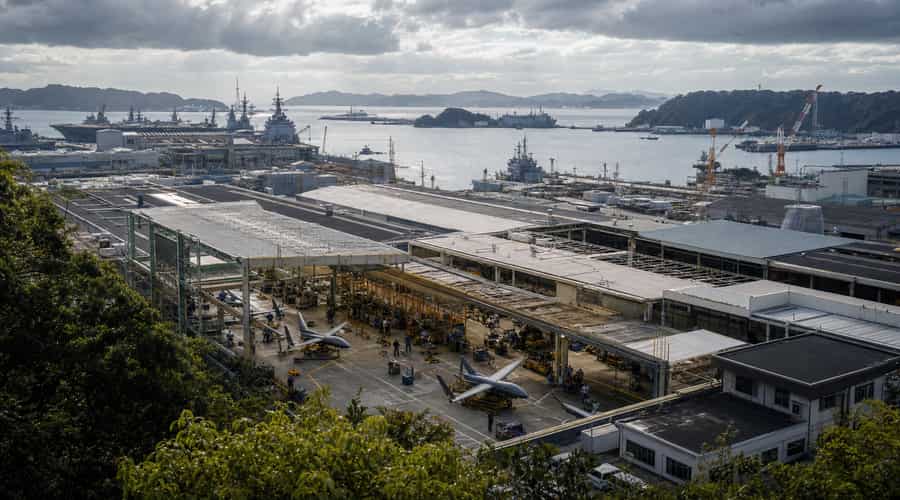
Anduril's talks over Nissan's Oppama plant are not just about buying an old car factory. They show you how quickly defense-tech startups are trying to turn allied manufacturing into a weapons advantage.
Nissan's Oppama assembly plant opened in 1961, produced roughly 18 million vehicles over six decades, and helped launch the Leaf, the electric car that began production there in 2010. It was supposed to wind down quietly by March 2028 as Nissan cut capacity and moved production to Kyushu. Instead, Reuters reported on June 25 that Anduril Industries is in exclusive talks to take over the site and convert it into a military drone manufacturing hub. That is a loud second life for a plant built for postwar Japan's car boom.
The location does a lot of the talking. Oppama sits in Yokosuka, about an hour south of Tokyo, near the naval base that hosts Japan's Maritime Self-Defense Force and the U.S. Navy's only forward-deployed aircraft carrier. You don't need a strategy deck to see why Anduril would look hard at it. The site has research facilities, a proving ground and wharf access, and Nissan has said about 2,400 people work there. Reuters reported that Anduril has offered to retrain those workers to build defense equipment rather than cars.
Anduril has confirmed only that it's exploring ways to strengthen local production in Japan, while Nissan has said no decision has been made on the site's future ownership. Keep those caveats in. They matter. But the shape of the story is already clear enough: a U.S. defense startup wants factory space in Japan at the exact moment Tokyo is trying to loosen the old restraints on weapons exports.
Anduril's behavior makes the Reuters report more convincing, not less. In January 2025, the company announced Arsenal-1 near Rickenbacker International Airport outside Columbus, Ohio. The Associated Press reported at the time that the project was planned as a 5 million-square-foot manufacturing site on 500 acres, with 4,000 jobs and production of military drones and autonomous air vehicles targeted for July 2026. Axios reported in March 2026 that the first main building, about 1 million square feet, was done and that Palmer Luckey expected the first production lines to go live within weeks.
That is the point. Anduril isn't trying to be only a software contractor with a few prototypes and a good pitch. It wants factories. It wants control over production. Frankly, if you're selling autonomous weapons for a world where missiles, drones and spare parts get consumed fast, owning the factory floor is not a branding exercise. It is the business model.
Defense-tech critics have long asked whether companies like Anduril can make weapons at the volume a real conflict demands. Arsenal-1 was the domestic answer. Oppama would be the allied answer. Palmer Luckey and his team have argued for years that defense procurement moves too slowly, with cost-plus contracting and decade-long programs rewarding incumbents more than urgency. The counteroffer is software-defined hardware, built in company-controlled facilities, updated quickly and produced at scale. That promise sounds much less abstract when it involves an old Nissan plant with a port attached.
Japan's policy shift gives the talks their real edge. In April 2026, Prime Minister Sanae Takaichi's government lifted the country's long-running ban on lethal weapons exports, ending the old five-category limit that had confined exports to areas such as rescue, transport, warning, surveillance and minesweeping. The Washington Post reported that Japan can now sell defense equipment to 17 countries with transfer agreements, subject to National Security Council approval. Le Monde also noted that the change came as Tokyo tried to strengthen its defense industry against a harsher regional backdrop.
A U.S. startup making drones inside Japan fits that policy. It also tests it. Article 9 of Japan's constitution still renounces war as a sovereign right, even after years of reinterpretation by successive governments. Public opinion is not a spreadsheet line. A foreign company producing military drones on Japanese soil will be easier to defend in a cabinet paper than in every town hall near Yokosuka.
Anduril is not acting as if Japan is a one-off. The company has already built its reputation around systems such as Lattice, Ghost, Altius and Fury, and in 2025 it formed a production alliance with UAE-based EDGE Group focused on autonomous weapons systems. The Wall Street Journal reported this month that the U.S. Air Force has signed contracts with Anduril and General Atomics for Collaborative Combat Aircraft, the drone wingmen meant to fly with crewed fighters. The Pentagon wants about 150 of those drones by 2030 and ultimately as many as 1,000. Those numbers change the manufacturing question from interesting to urgent.
Oppama also carries a sharper industrial message. Nissan no longer sees enough value in keeping the plant open as a car factory. Anduril sees value in the same concrete, roads, skilled labor and maritime access because the product has changed. Cars need efficiency and demand certainty. Weapons need surge capacity, allied proximity and enough redundancy that one broken supply route doesn't decide the fight.
That is why this story is bigger than real estate. If the deal closes, Oppama would become a symbol of two transitions at once: Japan moving further from postwar restraint, and defense-tech startups moving from clever systems into heavy manufacturing. You can dislike the direction and still see the logic. In the next Pacific crisis, the company with production already near the theater starts with an advantage the best slide deck cannot replace.
Also read: Uber burned through its 2026 AI budget in four months and now every CTO is paying attention • China's trillion-yuan bet on hard tech startups is rewriting the rules of early-stage competition • Vishal Sikka's new AI startup wants to do what Infosys once paid him to prevent