Andy Jassy's June 25 meeting with Narendra Modi turns Amazon's India plan into a harder question: who gets the compute, and who controls it?
The number that matters now isn't $48 billion. It's $80.5 billion. The Economic Times reported that Amazon CEO Andy Jassy met Prime Minister Narendra Modi in New Delhi on June 25 and announced an additional $13 billion for AI and cloud infrastructure in India by 2030, lifting Amazon's planned India investment to $48 billion. Add Microsoft's $17.5 billion pledge and Google's $15 billion plan, and you have a Big Tech infrastructure bet on India that is now too large to treat as ordinary market expansion.
Keep the buckets clear. The Times of India, citing Amazon's announcement, said the new pledge takes Amazon's planned AI and cloud infrastructure spending in India to more than $21 billion between 2026 and 2030, while the company's cumulative India investment from 2010 through 2030 is expected to exceed $88 billion. Those figures are not interchangeable. Blurring them makes the story sound bigger in the wrong way, and the real story is big enough without help.
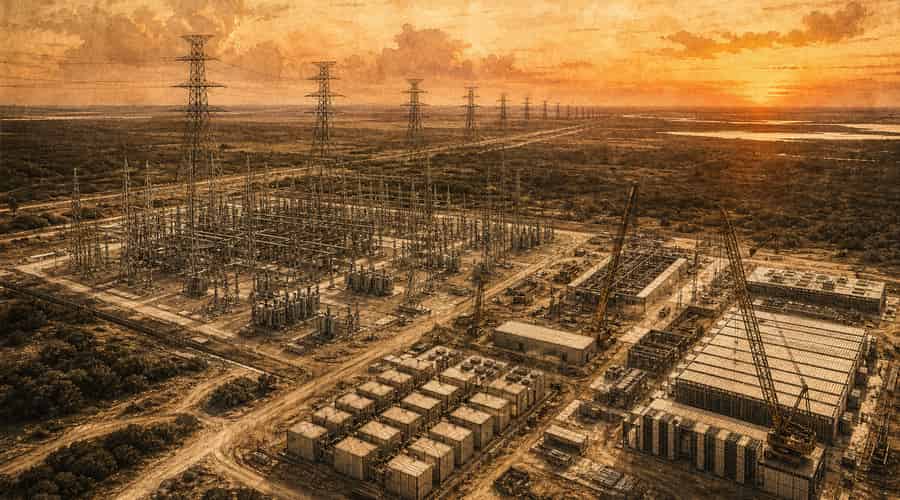
Amazon says the money will expand AWS data center capacity in Mumbai and Hyderabad, where it already operates cloud regions with three availability zones each. That gives Indian startups, enterprises and government bodies closer access to AWS chips, managed AI services and developer tools. If you're building an AI product in Bengaluru, Pune or Delhi, distance to compute isn't an abstract infrastructure point. It affects latency, cost, reliability and how much of your workload has to leave the country.
Microsoft is making the same calculation. The Associated Press reported in December that Satya Nadella announced a $17.5 billion investment over four years, Microsoft's largest in Asia, after meeting Modi in New Delhi. Google has put $15 billion behind a data center hub in Visakhapatnam, Andhra Pradesh. Before Amazon's latest addition, The Washington Post put the combined Amazon, Microsoft and Google commitments since October 2025 at $67.5 billion, with 80% of that arriving in December alone. Add this week's Amazon pledge, and the public total moves to $80.5 billion.
Here's the thing: India wants sovereign AI, but it also wants the hyperscalers. Those two goals sit awkwardly together. The IndiaAI Mission has put roughly $1.25 billion toward public AI infrastructure, and the government has assembled about 34,000 GPUs for public compute. Sarvam AI has released open-source models in the 30 billion and 105 billion parameter range. That's serious work. It's also nowhere near enough to match the capital speed of Amazon, Microsoft and Google.
India has already shown what sovereign digital infrastructure can look like. UPI and Aadhaar became the base layer for payments and identity, with private companies building services on top. That model works because the rails are public. AI compute is different. You can't fork an AWS availability zone, and you can't tell a startup to wait until a domestic data center plan catches up with its customers.
That is why Amazon's pledge is useful and uncomfortable at the same time. It helps Indian builders move faster now, using local AWS capacity rather than routing everything through servers in the United States. It also makes India's AI economy more dependent on private infrastructure owned by companies whose headquarters, capital spending decisions and export-control exposure sit outside India. Any serious reader should hold both facts in their head at once.
There is a domestic counterweight, but it isn't ready tomorrow. The Wall Street Journal reported in February that Adani Group plans to invest $100 billion in AI infrastructure by 2035, expanding its data-center portfolio to five gigawatts from current plans for two gigawatts and leaning on partnerships with Google, Microsoft and EdgeConneX. That gives India a local industrial champion with land, power and balance-sheet ambition. It also gives you the date that matters: 2035. The AI infrastructure race is moving faster than that.
For Amazon, the logic is plain. India has more than 1.4 billion people, hundreds of millions of internet users, deep software talent and a government that wants AI to become part of public services and industry. AWS needs growth markets large enough to move its own numbers, and India is one of the few that can. Jassy's message after meeting Modi, that India will be where some of AI's most important applications are built, is not sentimental. It's a business forecast.
For India, the deal is sharper. You get capacity, chips, cloud regions and developer services now. You also inherit the harder question of whether national AI ambitions can rest on infrastructure someone else owns. New Delhi doesn't have to reject Big Tech to answer that properly. But it does have to stop pretending compute capacity and compute control are the same thing.
Also read: OpenAI quietly upgraded every free ChatGPT user to a smarter model and the competition should be worried • The Netherlands is fighting Washington's chip war on two fronts and ASML is why • Uber burned through its 2026 AI budget in four months and now every CTO is paying attention