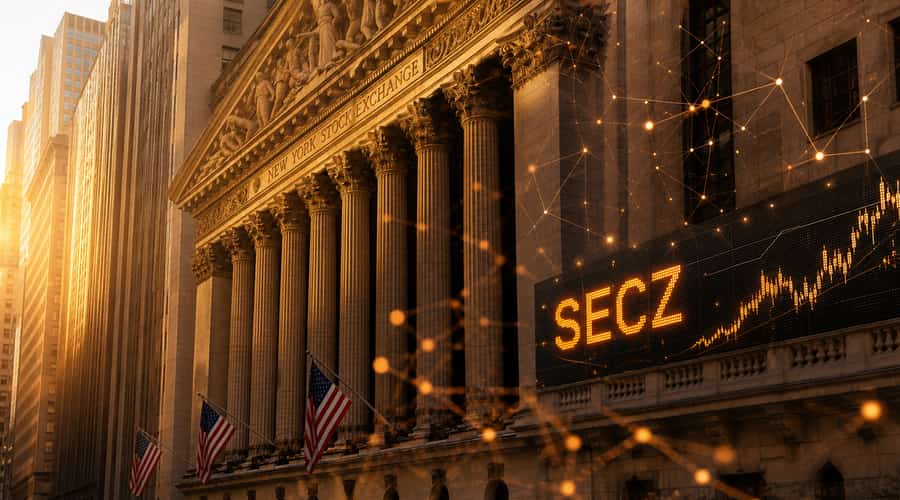
Securitize started trading on the New York Stock Exchange on July 2 under the ticker SECZ, and it plans to put its own stock on a blockchain too.
The company that runs BlackRock's $3 billion BUIDL fund is now a public company itself. Securitize completed its merger with Cantor Equity Partners II, a SPAC backed by Cantor Fitzgerald, raising roughly $400 million in gross proceeds including PIPE financing, according to a report from The Block. The deal values the combined company at a $1.25 billion pre-money equity valuation, and Benchmark has already initiated coverage with a Buy rating and a $16 price target.
You don't see many SPAC deals hold together like this one did. Fewer than 30% of Cantor Equity Partners II's Class A shareholders chose to redeem their shares before the vote, according to Yahoo Finance, meaning Securitize kept more than 71% of the SPAC's trust. That's low by recent SPAC standards, where redemption rates of 80% or 90% have become routine as investors cash out rather than ride along with a merger. Wall Street, in this case, decided to stay in.
Carlos Domingo, Securitize's co-founder and CEO, has been building toward this moment for eight years. "When we started more than eight years ago, the idea that major institutions would embrace tokenized securities was still largely theoretical," he said in a statement carried by PRNewswire. "Today, tokenization is moving into the mainstream, and we believe becoming a public company gives us the visibility, credibility, and capital to lead that next phase of growth."
Securitize's backers read like a shortlist of firms that have spent the last few years deciding tokenization is worth a real bet: BlackRock, Morgan Stanley, Coinbase, Circle. BlackRock is also the client that matters most. BUIDL, its tokenized money market fund, runs on Securitize's platform across eight separate blockchain networks and has grown past $3 billion in total value locked. It pays daily income to token holders and settles in real time instead of waiting on the multi-day cycle that still governs most of Wall Street.
That mismatch, real-time settlement for one fund and a multi-day cycle for nearly everything else, is the whole reason Securitize exists as a business.
The stranger part of the July 2 debut is what Securitize did with its own stock. The company listed SECZ shares on the NYSE through the standard settlement rails, and at the same time launched issuer-sponsored tokenized versions of those same shares for eligible U.S. investors on Avalanche and Solana, according to a company announcement carried by PRNewswire and StockTitan. A share bought through a traditional brokerage settles the way NYSE trades have settled for decades. A tokenized share, in theory, can move and settle in a fraction of that time, any day of the week.
Nobody else has run this experiment on day one of trading. Securitize isn't asking a client to test its infrastructure. It's putting its own listed equity through the same rails it sells to BlackRock and Morgan Stanley, in public, with regulators and short sellers both watching.
Frankly, that's the real test here, not the $400 million raise or the $16 price target. Plenty of tokenization pitches have promised instant settlement and 24/7 markets without ever putting real capital behind the claim. Securitize is now on the hook to prove it works with its own balance sheet.
If tokenized SECZ shares trade cleanly alongside the NYSE-listed stock, every bank that has spent the past two years running tokenization pilots gets a live reference point to point to internally. If the mechanics are clunky, or liquidity between the two versions splits in ways that confuse pricing, the skeptics who think tokenization is still mostly a narrative will have a public example to cite instead of a hypothetical. Either way, the answer won't stay theoretical much longer.
Also read: Strategy Turns Bitcoin Into a Balance Sheet Tool With a New Capital Plan • Venice AI became a unicorn by promising to forget everything you tell it • Senate Republicans race to bring the Clarity Act to a July floor vote