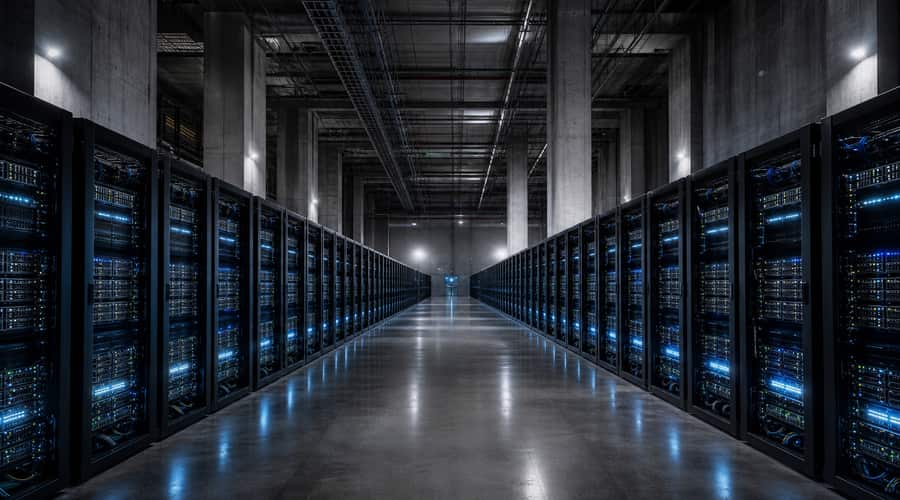
Reflection AI is committing more than $1 billion to Nvidia compute from Nebius, weeks after agreeing to pay SpaceX up to $6.3 billion for more capacity. The company still hasn't shipped a public model. The spending is the story.
If you're watching the AI race, don't start with product demos. Start with the invoices. Reflection AI, the open-source frontier lab founded by former Google DeepMind researchers Misha Laskin and Ioannis Antonoglou, has signed a multi-year computing agreement with Nebius worth more than $1 billion, giving it access to Nvidia GPU capacity through 2029. Neither company has put out a line-item breakdown. Just the headline number is enough.
It follows another huge bill. Axios reported in June that Reflection agreed to pay SpaceXAI, SpaceX's AI division, about $150 million a month for capacity at Colossus 2, the data center near Memphis, Tennessee, using Nvidia GB300 chips. Run that arrangement through 2029 and you get roughly $6.3 billion. MarketWatch later reported that either side can walk away with 90 days' notice after the first three months.
Two deals, one month.
That is a strange position for a company that has not yet released a public model. Reflection was founded in March 2024. Laskin worked on reward modeling for Google's Gemini project. Antonoglou co-created AlphaGo, the DeepMind system that beat Lee Sedol at Go in 2016. The Financial Times reported earlier this year that Reflection raised $2 billion at an $8 billion valuation in October 2025, with backers including Nvidia, Sequoia, Lightspeed, GIC, DST, Eric Schmidt and Citi, then returned to investors seeking a valuation above $20 billion.
Reflection is spending like a frontier lab before the public can judge the frontier.
The company has also moved close to government demand. Axios reported last month that Reflection was partnering with the Department of Energy's Genesis Mission, the federal AI science program launched in November 2025. The Guardian reported in May that Reflection was one of eight AI companies with Pentagon agreements for classified military work, alongside SpaceX, OpenAI, Google, Nvidia, Microsoft, Oracle and Amazon Web Services. That gives the compute deals a clearer shape. Reflection isn't only chasing developer attention. It's trying to look useful to Washington, large enterprises and investors who want a Western open model company strong enough to compete with DeepSeek, Qwen and the closed labs.
Frankly, the public model is now the missing part. A 60-person research-heavy startup does not need more than $7 billion of committed compute for ordinary experiments. It needs that kind of capacity to train at frontier scale, or to persuade the next round of investors that it can. Maybe both.
Nebius Is No Longer a Side Bet
Nebius, the Amsterdam-listed cloud provider created after Yandex's split from its Russian assets, has spent 2026 forcing its way into the AI infrastructure conversation. In March, Nvidia invested $2 billion in Nebius as part of a wider partnership to expand AI cloud capacity. The Wall Street Journal recently described Nebius as a serious challenger to CoreWeave, helped by a $27 billion agreement with Meta and a separate $17.4 billion deal with Microsoft.
The Reflection contract is much smaller than Meta's. It still matters. It shows Nebius is not just leaning on one giant customer while the market waits to see whether its buildout is real. It is selling capacity to another well-funded AI challenger that needs GPUs before it has the revenue profile of a Google, Microsoft or Meta. That is the opening neoclouds have been waiting for.
The Bill Still Looks Small Beside Big Tech
You should keep the scale in perspective. Reflection's reported $150 million a month with SpaceXAI is large for a startup, but it is not large next to the biggest AI buyers. MarketWatch reported that Anthropic's SpaceXAI arrangement is worth about $1.25 billion a month and Alphabet's is about $920 million a month, both with the same 90-day termination structure after an initial period.
That's the gap. Reflection is not outspending the giants. It is buying whatever compute its balance sheet allows while GPU supply is still the scarcest asset in AI. A startup can hire DeepMind researchers, raise money from famous funds and talk about open-source strategy all day. Without chips, none of it trains.
Reflection has not said when it will release a public model. What it has done, twice in a single month, is make sure it has somewhere to train one.
Also read: GMI Cloud seeks $635 million loan backed by its Nvidia GPU contracts • AI Inference Costs Are Quietly Eating SaaS Gross Margins • China's June exports surge past forecasts as the AI hardware boom accelerates