Marc Lore just raised more than $650 million for a company that still loses money by design, and he says Wonder is ready for Wall Street next year.
Marc Lore has already built and sold two companies to Walmart and Amazon. Now he's asking public investors to believe in a third one before it turns a profit.
Wonder, the food-hall company Lore founded in 2018, announced a more than $650 million Series D on July 16 at a $9 billion pre-money valuation. Cathie Wood's ARK Invest led the new money, backed by AllianceBernstein and Kayne Anderson, with returning investors Accel, GV and NEA also back in - and Goldman Sachs, Jefferies and JPMorgan running placement. You don't need to be a banker to read that lineup. That's the group you assemble when a private round is also an IPO rehearsal.
Lore told Fortune, in an exclusive interview, that Wonder is "ready and prepared to go public early next year." That's a bold claim for a company that investor materials reviewed by The Information say will lose roughly $618 million on an adjusted EBITDA basis this year alone.
How the food halls actually work
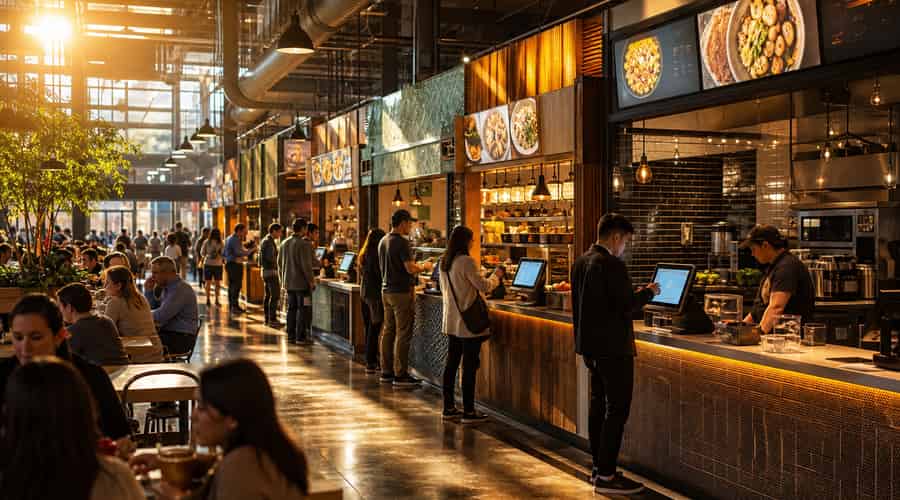
Here's what the money buys. Fortune reported that Wonder operates 135 food halls across 10 East Coast states, each built around a single kitchen that can turn out up to 30 restaurant concepts, including licensed names such as Bobby Flay's Amalfi and Tejas Barbeque. Order through the app and you can mix barbecue from one concept with something from another in a single checkout. Wonder cooks it and handles the delivery itself.
One kitchen. One landlord. One delivery system. A long menu.
That sounds simple, but it is the whole bet. Ghost kitchens looked clever during the pandemic until customers realized many of the brands had no real identity and no storefront worth trusting. Wonder is trying to keep the operational math of a ghost kitchen while making the experience feel closer to a food hall you can actually walk into.
Lore isn't new to betting on infrastructure before profit. He co-founded Diapers.com parent Quidsi, sold it to Amazon for $545 million, then built Jet.com and sold that to Walmart for $3.3 billion in 2016. He knows what a buyer, or a public market, wants to see: scale, growth, and a story a slide deck can carry. According to Fortune, Lore said same-service-area sales at Wonder are growing roughly 20% year over year. That is the number he'll lean on hardest in an S-1.
The company hasn't stopped at food halls. Wonder bought Blue Apron for $103 million in 2023. It acquired Grubhub from Just Eat Takeaway.com in a deal valued at $650 million, including $500 million of assumed debt, and closed that transaction last year. Fortune also reported that Wonder recently bought Sweetgreen's Spyce division for $186.4 million and closed on Mighty Quinn's BBQ this week.
That's a lot to digest. It is also why the IPO pitch is bigger than restaurant delivery. Lore wants Wonder to become a mealtime platform that spans owned kitchens, Grubhub's marketplace, meal kits, automated food preparation, and eventually AI-driven meal planning. Public investors will decide whether that sounds like a platform or just an expensive pile of food assets.
The math investors are underwriting
The hard part is the cash burn. The Information reported that Wonder projects it will burn nearly $2.7 billion in cash through 2029 and doesn't expect to reach positive cash flow until 2030. That's not a rounding error. It is a multiyear bet: investors fund the losses now and hope the savings that come with running at scale show up later.
The Series D also includes an IPO ratchet, according to The Information and Fortune. If Wonder prices its public offering below 1.5 times the Series D share price, investors get extra shares to cover the gap. That protection tells you something useful. The funds writing checks aren't pretending the math is settled. They're hedging it.
Frankly, this is the kind of deal that only gets done in a market hungry for a growth story that isn't another AI wrapper. Wood called Wonder a company "disrupting an industry that has been slow to change with the kind of scalable, innovative model that we look for across the ARK portfolio." That's the pitch. The test comes when Wonder's books are open to anyone with a Bloomberg terminal, not just investors reading a placement deck.
For founders watching from the outside, the lesson isn't that losing money is fine. It's that losing money with real revenue growth, a clear expansion plan, and a founder like Marc Lore attached can still get funded at a premium. Most founders don't get that benefit of the doubt. Lore has earned his through two prior exits worth billions combined, and Wall Street is being asked to give him one more shot.
Wonder plans to expand into Texas next year, pushing beyond its East Coast base. It has also announced a drone-delivery partnership with Zipline in that state. Whether that expansion lands before or after an IPO may depend on investor appetite over the next few months, but the bigger question is already clear: can Wonder make the unit economics work before the patience runs out?
Also read: Fora becomes a travel unicorn by turning career switchers into agents • A Scrappy New York Startup Is Betting $9 Million It Can Outsmart Kalshi and Polymarket • Goldman Sachs Bets $100 Million On the Plumbing Behind the AI Boom