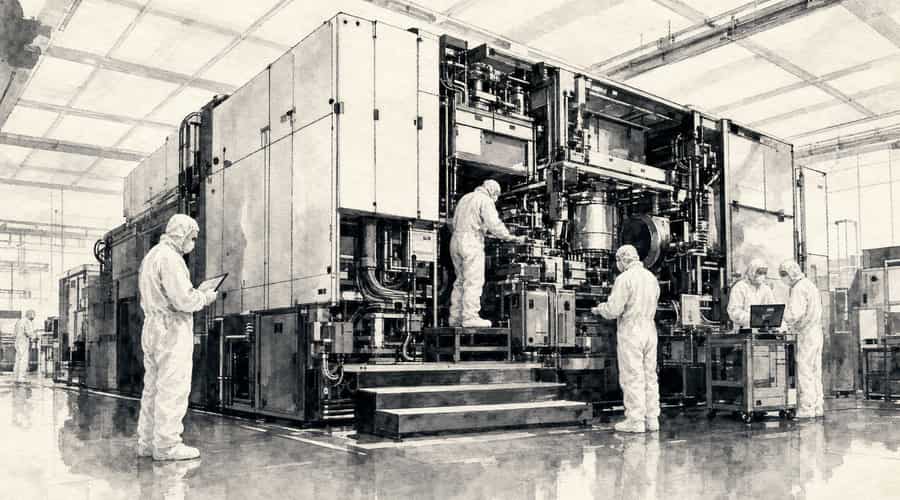
ASML is handing nearly every employee a €20,000 share award, but the real message is simpler: the company needs its people in place while the AI chip buildout runs through Veldhoven.
The email went out this week from Veldhoven. ASML told its roughly 44,500 employees worldwide that they'll receive a one-off share package worth €20,000 if they stay with the chip-machine maker until at least January 1, 2030. Leave before then and the award is not yours to sell. That's the point.
DutchNews.nl reported the plan on Friday, citing Eindhovens Dagblad, and NOS said ASML confirmed the award in an email to all employees. A company spokesperson told NOS the package was meant as appreciation for staff efforts, but especially for the work needed in the coming years. The remaining conditions are still being worked out, which matters if you work there. A headline number is nice. The vesting language is where the real value sits.
The timing is not subtle. On July 15, ASML reported second-quarter net sales of €9.326 billion, gross margin of 54.0%, and net income of €2.918 billion, according to the company's own results. Reuters reported that sales beat the €8.80 billion expected by analysts tracked by LSEG, while net income beat the €2.62 billion estimate. ASML also lifted its 2026 revenue outlook to €43 billion to €45 billion, with gross margin now expected between 54% and 56%.
Those are not normal numbers. They're the figures of a company sitting at the choke point of the AI chip economy.
ASML sold 86 new lithography systems and 5 used systems in the quarter. It also said customers are accelerating capacity expansion plans, a phrase that sounds dry until you remember who those customers are: TSMC, Samsung, Intel, SK Hynix, Micron, you name the advanced chipmaker and its roadmap eventually runs through ASML's machines. Reuters also noted that ASML is the only maker of extreme ultraviolet lithography equipment, the EUV systems needed to produce the most advanced chips.
The stock award is about control
Here's the thing. A €20,000 award spread across roughly 44,500 workers is not just a thank-you note. If every eligible employee received the full amount, the headline value would sit close to €900 million. Reformatorisch Dagblad made the same rough calculation after ANP reported the confirmation. That is a serious price to pay for retention, and ASML is paying it because replacing these people is not like hiring another office manager.
The company already showed you where it thinks the pressure is. In January, ASML said it would cut about 1,700 jobs, mainly in the Netherlands, as part of a move to reduce management layers and bureaucracy. DutchNews.nl reported that ASML later agreed with unions in June that there would be no forced redundancies until at least May 2027. That sequence matters. Trim bureaucracy, calm the workforce, then put a 2030 lock on the employees you need for the next production cycle.
That is the strategy in plain sight.
You can see why. EUV machines are not ordinary industrial equipment. They are vast, expensive systems built from specialist knowledge, long training, and supplier coordination that cannot be rebuilt quickly if people leave. ASML can buy back stock any quarter it wants. It can't buy people that fast. Another generation of trained EUV engineers, field service staff, and production specialists is not sitting on the open market waiting to be hired.
Markets still want proof
The awkward part: the wider chip trade is getting nervous even as ASML keeps printing strong results. Chip stocks are sliding. MarketWatch reported this week that the PHLX Semiconductor Index was down about 16% from its June 22 record close, with a bear-market level not far below. The Wall Street Journal told the same story: a chip selloff as the AI trade lost steam, memory names and other semiconductor stocks under pressure.
Do not confuse that with ASML suddenly becoming weak. It is not. The concern is further down the chain: whether the vast spending on AI data centers, advanced memory, and new fabs will earn enough money fast enough to justify the share prices investors already paid. ASML is selling the picks and shovels. The miners still have to prove the mine is rich enough.
That distinction is why this employee award is more interesting than a standard bonus story. If you own ASML shares, you should care less about the sentimental framing and more about the lockup date. January 1, 2030 is a management view of how long the hard part lasts. The company is telling its workers that the next three and a half years matter enough to put real stock behind the ask.
For employees, the deal is straightforward but not free. You get a meaningful award if you stay. You also tie part of your upside to one employer through a period when ASML is expanding, reorganizing, and operating under enormous pressure from customers who need more machines. For ASML, it's cheaper than losing trained people at the exact moment every AI chip plan in the world needs Veldhoven to keep moving.
The company's strongest quarter did not remove the market's doubts about AI spending. It did something more useful. It showed that ASML has enough confidence in demand to spend nearly €900 million, at least on paper, to keep its own people from walking before 2030.
Also read: Bonzo Finance Will Make Hedera Users Whole After Its 9 Million Dollar Exploit • Kimi K3 Shows the Cheap Chinese AI Era Is Coming to an End • Upper90 Lends $400 Million Against AI Inference Chips Instead of Nvidia GPUs