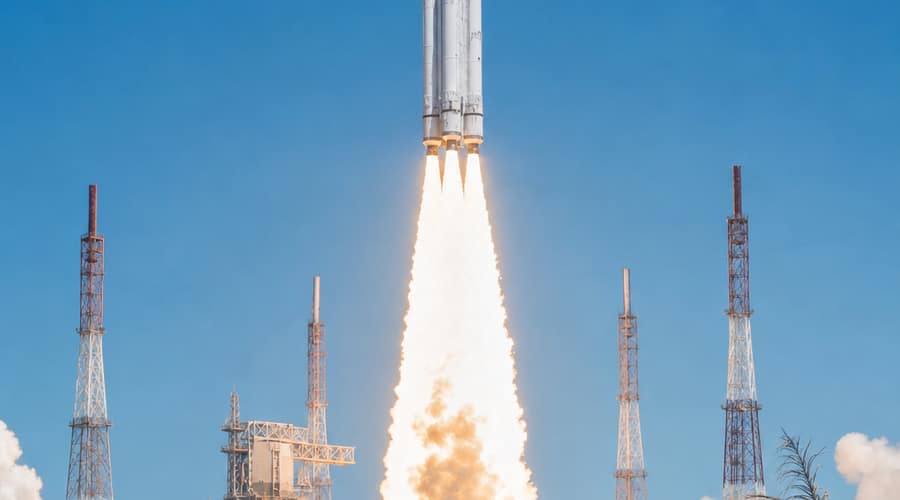
Skyroot Aerospace has put Vikram-1 into orbit from Sriharikota, and India's private space industry now has a proof point it didn't have yesterday.
Vikram-1 lifted off from the First Launch Pad at the Satish Dhawan Space Centre in Sriharikota, Andhra Pradesh, on Saturday, July 18, after a hold of about 35 minutes caused by a navigation-related issue in the countdown. Then it flew. The rocket, built by Hyderabad-based Skyroot Aerospace, carried its payloads toward a 450-kilometer low-Earth orbit under Mission Aagaman, giving India its first orbital launch by a privately developed rocket.
That last phrase matters. This was not a private company operating outside India's public space system, because the launch used ISRO's Sriharikota range and the private sector reforms India began opening in 2020. But it was still a hard break from the old model. For decades, if an Indian rocket went to orbit, it came from the state system. Vikram-1 changes that scoreboard.
The rocket is not glamorous, and that is part of the point. Skyroot describes Vikram-1 as a seven-story, multi-stage launch vehicle built for small satellites, with capacity of up to 350 kilograms to low-Earth orbit and 260 kilograms to sun-synchronous orbit. Space.com noted before the launch that the vehicle uses three solid-fueled lower stages and a restartable liquid-fueled upper stage, a configuration meant to place small payloads in more than one orbit. You don't need poetry here. You need repeatability.
On this first flight, the payload stack included Skyroot's SCOPE platform, technology demonstration payloads tied to Grahaa Space and Cosmoserve, a payload from Germany's DCUBED, plus symbolic cargo from Cosmos Diamonds and artist Ajay Kumar Mattewada, according to reports from Space.com and The Economic Times. Prime Minister Narendra Modi's handwritten Vande Mataram postcard was also onboard. Even a test flight had a little theater.
Modi called Skyroot co-founder and CEO Pawan Kumar Chandana after the mission, and The Economic Times reported that he congratulated the team for planting new seeds in the sky. The image is political, but the call itself is practical. Skyroot's founders, Chandana and Naga Bharath Daka, are former ISRO engineers who left to build a private launch company in a market that used to have one dominant gatekeeper.
Frankly, that is the real story. A country does not create a private launch market by announcing one. It creates one when a company takes a rocket from design to orbit and still delivers the flight - ugly countdown holds and all.
The money arrived before the proof
Investors had already priced Skyroot like a winner. TechCrunch reported in May that the company raised $60 million in a round co-led by GIC and Sherpalo Ventures - plus structured debt from funds affiliated with BlackRock. The round valued Skyroot at $1.1 billion on a pre-money basis, making it India's first space technology unicorn before Vikram-1 had reached orbit.
That is a bold bet. Skyroot's last public flight milestone was Vikram-S, the suborbital rocket launched from Sriharikota in November 2022. It made Skyroot the first Indian private company to reach space, but suborbital flight and orbital service are not the same business. Vikram-1 is the first proof that the valuation had metal and propellant behind it.
You should still keep the champagne in the fridge. One orbital flight is not a launch cadence. Customers buying small-satellite launches care about price, schedule, insurance, reliability and whether the second and third flights look boring. Boring is the prize in launch. Rocket Lab did not become a public market space company because Electron worked once. It became credible because it kept flying.
Skyroot has moved ahead of its local peers
Skyroot is not building in an empty Indian market. Agnikul Cosmos has been developing its Agnibaan launcher, and Pixxel has raised money for hyperspectral imaging satellites backed by investors including Google. Those companies still matter, but Skyroot now owns the cleanest milestone in Indian private launch: orbit.
The wider market is big enough for more than one winner. Business Standard has put India's space economy at about $8.4 billion, with more than 400 startups working across launch, satellites, data and related services. That number can sound abstract until a rocket actually leaves the pad. Now every founder pitching Indian space infrastructure has a better answer when an investor asks whether private Indian space companies can move beyond slides and test stands.
There is also a sharper competitive point. Small satellites do not wait politely for national launch schedules, and foreign launch slots can become expensive or politically awkward. A domestic private launcher gives Indian satellite startups one more option, and it gives the government a private industrial base it can point to when it talks about space reform.
Skyroot has earned the attention. Now it has to earn the habit. The next test is not whether Vikram-1 can make headlines, because it already has. The next test is whether Skyroot can make launches regular enough that customers stop treating them as history and start treating them as infrastructure.
Also read: How to Prepare a Board Deck for Your First Startup Board Meeting • A Regulatory Filing Reveals DeepSeek Is Now Worth About $52 Billion • A Former DeepMind Researcher Just Raised $55 Million Before Building Anything