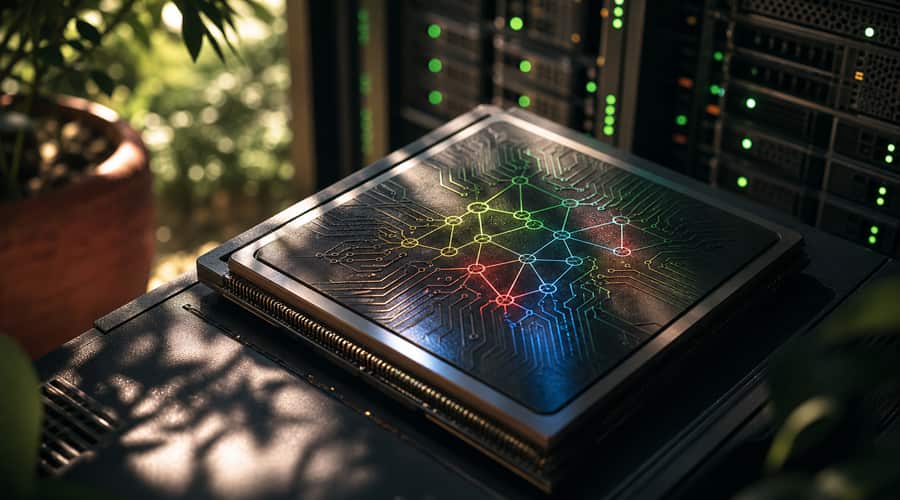
Alphabet shares rose after a report that Google is building Frozen v2, a server chip designed around Gemini itself. You should read the move as a power bill story first, and a Nvidia challenge second.
Alphabet didn't need a finished chip to move the stock. It needed a credible answer to one question investors keep asking about AI: how much money gets burned before the systems start paying for themselves?
Reuters reported on July 20, citing The Information, that Google is developing a new server chip informally called Frozen v2, built to incorporate elements of Gemini directly into the hardware. Alphabet shares were up about 3% in early trading after the report, and Investor's Business Daily put the move at $357.04. For a company already worth trillions, that's not noise. It landed.
Frozen v2 is not another TPU. The Information's report, as summarized by Reuters, says the chip is meant to hardwire parts of Gemini's architecture into silicon so Google can serve AI tokens with less wasted computation and less data movement. Google's own estimates, according to the report, put the gain at six to 10 times more tokens per unit of power than its latest custom AI chips. That is the point. In inference, power use is the bill.
The catch is time. Google is reportedly aiming to deploy the chip as soon as 2028, and engineers are still deciding how much model information can be built into the hardware. So don't treat this like a product launch. It isn't. It is a statement. Google thinks the next phase of AI infrastructure will be won by whoever controls the model, the cloud and the silicon underneath both. That's the bet.
Chips Needed A Better Headline
If you've been watching semiconductor stocks over the past two weeks, you know why this story mattered. The PHLX Semiconductor Index fell into bear market territory last week, with MarketWatch citing a 20.2% slide from its June 22 peak. That's a chip market already on edge. Barclays said the selloff reflected a fresh round of AI jitters, especially around whether huge capital spending by cloud companies can keep producing visible returns. Nerves were already frayed.
Google's chip story arrived against that backdrop, and it gave investors something more concrete than another model benchmark. Google already has Ironwood, its seventh-generation TPU, which it introduced at Google Cloud Next in April 2025 and made available to cloud customers later that year. Google's own documentation says Ironwood scales to 9,216 chips in a pod and delivers 42.5 FP8 exaflops, with 192 GiB of high-bandwidth memory per chip. Those are not marketing adjectives. They are the hardware facts Google is asking customers to bet on.
Anthropic has already made that bet. Google Cloud said in October 2025 that Anthropic would get access to up to one million TPUs, with more than a gigawatt of capacity coming online in 2026. That is a serious commitment from the company behind Claude, and it tells you why Nvidia's grip on AI compute is strong but not sacred. The largest AI buyers don't want one supplier forever. They want clout, capacity and lower operating costs.
Frankly, that is where Frozen v2 gets interesting. A chip designed around Gemini would be less flexible than a general-purpose accelerator, but Google can afford that trade. It owns Gemini. It owns the cloud platform. It owns the software stack around TPUs. Nvidia sells the industry's default AI platform to everyone; Google can tune a narrower system for its own workloads and then decide how much of that advantage to expose to cloud customers.
None of this unseats Nvidia overnight. Nvidia still has the broader ecosystem, the customer habit and the order book. Jensen Huang said at GTC in March that he could see at least $1 trillion of demand through 2027 for Nvidia systems, and 60% of the company's business came from the top five hyperscalers. That is the mountain Google is climbing.
The Earnings Test
The timing is awkward in a useful way. Alphabet reports second-quarter earnings on July 22, two days after the Frozen v2 report, and investors will be listening less for chip poetry than for cloud numbers. You can spend tens of billions on AI infrastructure and still disappoint Wall Street if the revenue doesn't follow quickly enough.
There is another reason the chip report helped. Bloomberg reported last week that Google was months behind schedule on Gemini 3.5 Pro, particularly as it worked to improve coding performance, and Investing.com said Alphabet closed down 4.4% on July 16 after that report. A delayed flagship model makes Google look like it is chasing. A specialized chip designed around Gemini makes it look like it is building a deeper moat.
Both can be true at once. Google can be late on a model release and still be one of the few companies with the engineering base to redesign the machine that runs it. That is why this story moved the stock. Frozen v2 won't help Alphabet's July earnings. It won't ship next quarter. But if the Information's reporting is right, it shows Google is trying to make AI cheaper at the physical layer, where the real constraint is measured in chips, watts and years.
Also read: Elon Musk Calls a Reported $52 Billion SpaceX Foxconn Server Deal Fake News • IREN inks $2.8 billion in AI cloud deals, lifts revenue target past $4 billion • Brussels Fines Alibaba's AliExpress a Record 550 Million Euros